jump to navigation

Never seen before F-35′s centerline gun pod unveiled February 23, 2012

Posted by David Cenciotti in F-35.
Tags: , , , , , , ,
4 comments

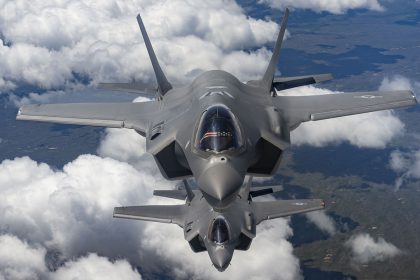
This image was posted on the Naval Air Systems Command (NAVAIR) few hours after I published the F-35 progress report with all the 2012′s updates.

On Feb. 22, six days after the first F-35A CTOL (Conventional Take Off and Landing) had flown with external stores, even the STOVL (Short Take Off and Vertical Landing) variant of the Joint Strike Fighter, flew for the first time with external weapons.

Noteworthy, along with the AIM-9X carried by the CTOL, the F-35B carried a never seen before (at least in photo) white 25 mm gun pod on the centerline.

Its particular shape was probably designed to fit in the triangular space between the fuselage weapons doors.

Image credit: Lockheed Martin

F-35 progress report. The year so far in review. February 23, 2012

Posted by David Cenciotti in F-35.
Tags: , , , , , , , , ,
1 comment so far

Update Feb. 23 22.47 GMT

Lockheed Martin has just released a media update that provides some interesting figures about the F-35 System Development and Demonstration (SDD) flight test plan. The press release traces the history of the JSF program since the beginning of 2012. However, I’ve modified it a little bit to add some interesting information about the program: either officially released news by partner countries authorities or details reported by media all around the world.

  • On Jan. 9, AF-4, an F-35A Conventional Takeoff and Landing (CTOL) test aircraft, reached the highest altitude to date in an F-35; 43,000 feet Mean Sea Level (MSL).
  • Demonstrating the ongoing maturation of the F-35 integrated sensor suite, AF-3, an F-35A CTOL test jet, completed the first low Distributed Aperture System (DAS) approach on Jan. 17.
  • With the ferry flight of BF-7, an F-35B STOVL, Eglin AFB, Fla., became home of the largest F-35 fleet in the DOD on Jan. 19. BF-7 was the 23rd F-35 Lightning II delivered to the DOD.
  • The F-35 SDD fleet including AA-1, the original test aircraft, crossed the 2,500 flight hour threshold on Jan. 25.
  • During a Media Briefing in Rome, Italy, Tom Burbage, Executive VP of Lockheed Martin and General Manager of F-35 Program Integration, said that the F-35C (Carrier Variant) was fixed with a new tailhook system that will be tested beginning next April, making arrested landing on aircraft carriers possible after the series of failed tests. “We will solve all issues” he said.
  • On Jan. 30 the Associated Press reported that Australia is reviewing its purchaase schedule for 12 F-35 Joint Strike Fighters.
  • A BAC1-11 configured with the F-35′s AN/APG-81 active electronically scanned array (AESA) radar and the AN/AAQ-37 infrared distributed aperture system (DAS) has taken part to the Bold Alligator 2012 exercise.
  • On Feb. 7 a UK Ministry of Defence spokeswoman announced that Britain will not make final decisions on the overall number of F-35 before the next planned Strategic Defence Review (in 2015).
  • On Feb. 15, Italian Minister of Defense announced Italy’s plan to purchase 90 F-35s. The aircraft will be delivered to four Italian Air Force squadrons at Amendola and Ghedi, and one Navy squadron at Grottaglie (equipped with F-35B that will also operate from Cavour aircraft carrier).
  • On Feb. 17 the Government of the Netherlands announced that the first F-35 designated for the RNlAF had its jet engine installed. The Netherlands has ordered two JSFs as test aircraft.
  • On Feb. 19 the Canadian Press reported that Canadian Defense experts are considering a further upgrade to the aging RCAF F-18s (CF-188s in the local designation) to fill the gap until the delivery of the first F-35s, expected in 2016.
  • On Feb. 21 Royal Air Force test pilot Squadron Leader Jim Schofield flew CF-2, the Carrier Variant of the F-35 that will be known as Joint Combat Aircraft in UK.
  • On Feb. 22, six days after the first F-35A CTOL (Conventional Take Off and Landing) had flown with external stores, even the STOVL (Short Take Off and Vertical Landing) variant of the Joint Strike Fighter, flew for the first time with external weapons.Noteworthy, along with the AIM-9X carried by the CTOL, the F-35B carried a never seen before white 25 mm gun pod on the centerline.
  • On Feb. 23 Turkey confirmed its plan to buy 100 F-35s for 16 billion USD. “In the first stage, orders will be given for two F-35 planes. Turkey plans in total to buy 100 F-35 warplanes” the Minister of Defense said.

Cumulative flight test activity totals for 2012 through Feb. 20 are provided below:

  • F-35A CTOL jets have flown 46 times.
  • F-35B STOVL aircraft have completed 45 flights.
  • F-35C Carrier Variant (CV) jets have flown 23 times.

From the start of flight testing in December 2006, F-35s have flown 1,704 times, including the production-model flights and AA-1, the original flight test aircraft.

Image credit: Locheed Martin

Photo: Lockheed Martin F-35′s first mission with external weapons February 20, 2012

Posted by David Cenciotti in F-35.
Tags: , , , , , , , , , ,
add a comment

On Feb. 16, 2012, an F-35A aircraft from Edwards AFB, California, flew for the first time with external weapons.

Although no weapons were delivered during the sortie, the payload of the Joint Strike Fighter’s Conventional Takeoff and Landing (CTOL) variant in this test mission included two AIM-9X air-to-air missiles on the outboard wing stations, two internal 2,000-pound GBU-31 GPS-guided bombs and two AIM-120 AMRAAMs (Advanced Medium Range Air-to-Air Missiles) inside the two internal weapon bays.

The F-35 had also four external pylons that can carry 2,000-lb air-to-ground weapons.

The 5th Generation multirole fighter is designed to carry up to 18,000 pounds on 10 weapon stations featuring four weapon stations inside two weapon bays, for maximum stealth capability, and an additional three weapon stations on each wing.

Image credit: Lockheed Martin by Paul Weatherman

Along with the B STOVL (Short Take Off Vertical Landing) variant, the CTOL one was selected by Italy to replace the Air Force’s Tornado and AMX bombers.

F-35 unaffordable? No problem, here’s your Plan B: the (unstealthy) F-16V February 16, 2012

Posted by Richard Clements in F-35, Military Aviation.
Tags: , , , , ,
add a comment

Lockheed Martin took the opportunity to wow the crowds at the Singapore Air Show and unwrapped its latest version of the legendary F-16 Fighting Falcon: the F-16V variant. The upgrades include a new glass cockpit, a new mission computer and data-link architecture, as well as a brand new active electronically scanned array (AESA) radar.

The latest in a long line of versions including the Block 60 aircraft (developed for the United Arab Emirates), the new F-16V would be the highest spec F-16 available and, although Lockheed Martin has not disclosed it yet, it would be assumed that some of the features from the previous most advanced versions would still be available (conformal fuel tanks etc.)

Lockheed Martin also said that elements of the upgrade would be available to older models as an upgrade program so the new AESA radar could make its way into older aircraft and sales of the ‘V’ version would be aimed at existing operators.

So, countries that cannot stretch to the costs of buying and running the F-35 have a cheaper alternative especially if they already operate older versions of the F-16.

Details about the new cockpit layout, the embedded software and the specifications of the radar have not yet been unveiled. However the F-16V will be fully interoperable and able to exchange data with the F-22 and the F-35. But it will not be stealth.

Lockheed Martin’s Press Release doesn’t mention customers but could be pitched at the USAF (thus the need to exchange data with the F-22) as an unstealthy gap filler until large numbers of F-35s start entering service.

This could also be an admission that the initial estimates of F-35 sales are going to be nowhere near what they were projected; in this case, we could consider the F-16V a “Budget”version of the F-35.

Richard Clements for TheAviationist.com

Image credit: Lockheed Martin

Italy has decided: F-35s to be cut by more than 30 percent. February 15, 2012

Posted by David Cenciotti in F-35, Italian Air Force, Italian Navy.
Tags: , , , , , , , , ,
12 comments

More technology, less personnel and only 90 F-35s: this is the outcome Italian Defense spending review.

On Feb. 15, the long awaited Italian Defense spending review was finally presented to the Parliament by the Minister of Defense Giampaolo Paola.

“Long awaited” because the review was supposed to shed some light on the future of the Lockheed Martin F-35 Lightning II in Italy: Rome’s commitment to the program (as a Level 2 partner with 2.5 Billion Euro already invested and an original envisaged requirement for 131 planes) is important to keep the troubled and costly stealth multirole jet affordable.

The reform seeks to balance the spending for personnel, operations and investment, to ensure the future financial sustainability and operational effectiveness of the armed forces. In simple words: cuts to personnel and programs with the long term goal to cover the personnel spending with half the allocated budget (worth 0.9 percent of the GDP) and use the remainder between operations (including training and maintenance) and procurement (25 percent each) of advanced technologies.

Therefore, along with the reduction by 43,000 people to abate the current 70 percent of the overall defense budget for spending on military personnel, the review has led to the revision of the some important programs. First of all, the much criticized F-35 program.

Accordingly, 41 aircraft will be scrapped leaving the Italian Air Force and Navy with only 90 F-35 in the A and B version. The latter, recently removed from probation, will replace the Navy’s AV-8B+ Harrier II on board the Cavour aircraft carrier as well as the Air Force’s AMX, both involved in the recent Air War in Libya.

“The F-35 program was reviewed. Nevertheless it remains a major commitment in terms of technology, technology transfer to the industry and employment” Di Paola said few days after placing the first order for three F-35s.

Digital mock-up by Al Clark

Italy buys its first three F-35s. With a shocking announcement: “a JSF will cost less than a Eurofighter Typhoon” February 8, 2012

Posted by David Cenciotti in F-35, Military Aviation.
Tags: , , , , ,
9 comments

On Feb. 7, 2012, Gen. Claudio Debertolis, head of the agency that is responsible for the procurement of new armaments, has announced that Italy has already ordered the first three Lockheed Martin F-35s.

Unit price: 80 million USD.

Talking to the lower house’s defense commitee, Debertolis explained that these first planes will cost more than the rest of the fleet since costs are going to decrease as the program, currently in Low Rate Initial Production,  continues. The Italian high rank officer is particularly optimistic, as he believes that the unit price will be around 70 million each (Lockheed Martin estimates 65M USD for the F-35A and about 73M USD for the F-35B), less than the 79 million USD currently paid for the Eurofighter Typhoon and much less of the 121 million USD per aircraft anticipated in 2011.

Quite surprising, since unit price is one of the JSF partner’s main concern, but possible, considering also that the Typhoon has just lost India’s mother of all tenders based on price.

Although there’s no official commitment yet, the initial requirement for Italy foresaw 131 examples (69 conventional take-off and landing F-35As and 62 of the short take-off and vertical landing variant F-35Bs). Debertolis confirmed that determining how many aircraft Italy will purchase is not a current task, since it will depend on the Defense Budget Review. Nevertheless, even if the number of aircraft will be much lower than the initial 131, the MoD will work to make sure that the industry will get the expected compensation.

Italy is working on stretching deliveries and slowing purchase  “a much easier task than that with the Eurofighter program, since the F-35 procurement is modular therefore delays don’t imply increasing costs” Debertolis said.

Furthermore with the recent Eurofighter defeat in India, Italy is going to stop working on the Typhoon and “divert” part (if not all) of its workforce towards the F-35, being assembled at the Cameri FACO (Final Assembly and Check Out) facility.

Finally, Debertolis has confirmed that Italy will have both A and B variants, with the STOVL (Short Take Off Vertical Landing) ones serving both the Air Force and the Navy, that will use them on the Cavour aircraft carrier.

In spite of the widespread criticism surrounding the program and the global financial crisis it looks like the F-35 has, if not a bright future ahead, at least good chances to survive the austerity measures of the new Monti’s technocratic cabinet.

Image credit: Lockheed Martin

The F-35 unable to meet South Korea’s fighter competition requirements? February 8, 2012

Posted by Richard Clements in Aviation, Military Aviation.
Tags: , , , , , , , ,
2 comments

On Jan. 30, South Korea released a request for proposal for a next generation fighter plane that the ROKAF (Republic of Korea Air Force) is going to procure within the so-called F-X stage III.

Given the recent reports (later denied by the company), according to which Boeing has stopped development of the modifications for the F-15 Silent Eagle, the project saw the Lockheed Martin F-35 as the favorite choice. So far.

Two of the “must have” requirements included in the RFP may be a bit of a problem for the F-35. In fact, Seoul’s future combat plane has to fly at Mach 1.6 or faster and has to field external weapons on pylons.

The projected top speed of the F-35 is mach 1.6 which is the bare minimum required but as of writing has not been accomplished yet and, being a stealth plane, the Joint Strike Fighter was designed to carry weapons internally.

Lockheed Martin’s director for the F-35 Korea campaign Randy Howard spoke to the Korean Times and said that “the F-35 is designed to carry weapons internally. That’s what it does, and that’s why it is stealthy” although he did concede that if Korea insists on external weapons his company would simply customise the aircraft to Seoul’s needs.

The F-35 has 6 hard points to carry external weapons but this capability would not be ready for when the Koreans want to test out the aircraft during the June – September 2012 time frame. However, Koreans expect to recive US government assurances that the fighter will indeed meet both selection criteria, if not before June, at least once development has been completed.

Image credit: Lockheed Martin

Similar concerns don’t seem to disturb the other two F-X contenders. The above mentioned Silent Eagle is a modification of an existing model which already meets all of the requirements as does the Eurofighter Typhoon, recently defeated by the Dassault Rafale in the Indian MMRCA competition.

Noteworthy, the Eurofighter Typhoon is the only non-stealthy aircraft in the South Korean competition that, initially, featured the radar-evading capability as one of the tender’s mandatory requirements (later lifted to have more choice).

Next months will tell us whether Boeing will be able develop the Silent Eagle in time, Lockheed Martin will convice Seoul that the Lightning II can meet all the requirements or Eurofighter will walk away with the $7.62billion contract.

There could even be a fourth option in that Korea sticks with what it knows and orders a further 60 F-15Ks like those that have recently taken part to the Red Flag 12-2 at Nellis AFB.

Watch this space, by October all could have been revealed.

Written with The Aviationist’s Editor David Cenciotti

Image credit: Tony Lovelock


Is Boeing calling time on the stealthy F-15 Silent Eagle? Lockheed Martin hopes so. January 29, 2012

Posted by Richard Clements in Military Aviation.
Tags: , , , , , , ,
add a comment

Silent Eagle, not to become reality?

The Korea Times has reported that there is a possibility that aviation giant Boeing may not full fill its promise to provide the stealthly version of it’s F-15 to South Korea.

In an article published on Jan. 25, titled Boeing may give up offering stealthy jet journalist Lee Tae-hoon wrote that “a source familiar with Boeing’s plan to modify its F-15s said little progress has been made in the making of the F-15SE, especially in the development of its conformal weapons bay (CWB), which allows the aircraft to carry weapons internally.”

According to the informed source “only 10 percent of work has been completed for the research and development of the F-15SE’s conformal weapons bay.”

Boeing’s proposal had included canted vertical stabilisers and a conformal weapons bay on each side of the aircraft to reduce the radar cross section of the aircraft, all compulsary requirements to Korea’s KX-III procurement program to acquire advanced jets. Seoul had removed these requirements to allow other manufacturers the chance to compete, although had signed a memorandum of understanding with Boeing back in 2010. However Boeing announced late on 2010 that it had suspended development of the proposed features.

Tae-hoon also reported that other industry officials noted that it will be physically impossible for Boeing to complete the development of the CWB and canted tails by the end of October this year when Seoul plans to finalize the deal after three to four months of evaluations and negotiations. “Boeing will most likely change their offer. They won’t offer the Silent Eagle” a senior official of Lockheed Martin, which is competing with Boeing and the European Aeronautic Defense and Space Company (EADS) for the FX-III bid, said asking for anonymity.

“They are going to offer the F-15K because that’s the only plane they can deliver by 2016.”

This opens the door for the F-35 and the Eurofighter Typhoon to get a toe hold in Korea.

Although EADS could try to offer a version with conformal fuel tanks and thrust vectoring, neither variant of the Typhoon is stealth. Therefore, since radar-evading capability remains a crucial factor in deciding the next South Korea fighter jets, Lockheed Martin F-35 seems to be favorite and this would explain Tom Burbage (Executive VP of Lockheed Martin and General Manager of F-35 Program Integration) optimism over the deal in the recent Press Briefing held in Rome.

What is yet to be determined is which of the three versions of the F-35 Lockheed has put forward to Seoul for consideration.

Written with The Aviationist’s Editor David Cenciotti

Credit: Boeing

You will believe China has already copied the Lockheed Martin F-35 and the T-50 just visited Nellis AFB when you see these images. January 28, 2012

Posted by David Cenciotti in Information Warfare.
Tags: , , , , ,
7 comments

Did you know that China’s J-18 Night Owl has already been photographed and appears as a copy of the Lockheed Martin F-35? And what about the T-50 that has secretly visited Nellis AFB?

Have a look at the following images.

I didn’t know that either until Al Clark, an aviation illustrator and photographer, sent me a link to his works. Obviously, above images were photoshopped, but the result is awesome and it takes some time to analyze them and be sure they are not genuine.

I’ve often been asked to evaluate the authenticity of images published on Chinese forums and websites, as well as footage released by Iran that has often used doctored videos and fake images to spread regime’s propaganda messages and, in most cases, the authenticity of the material released by the Iranian State TV or news agency, could soon be determined.

If they want to deceive not only intelligence officer but also amateur analysts, and be much more credible, maybe Iran state media should start studying how Al Clark creates his realistic digital mock-ups.

Old Harriers and new choppers unleashed. Welcome aboard the Cavour aircraft carrier during “blue water ops”. January 27, 2012

Posted by David Cenciotti in Aircraft Carriers.
Tags: , , , , , , , , , , ,
2 comments

On Jan. 25, along with the ambassadors of NATO members, EU, Middle East and Mediterranean partners, The Aviationist has had the opportunity to visit the Cavour aircraft carrier during “blue water ops” off Civitavecchia port.

The event was jointly organized by the Ministry of Defense and the Ministry of Foreign Affairs to showcase one of the most important assets of the Italian Defense, one of the few European aircraft carriers that is not only important for military operations, but it is also a versatile platform that made its operative debut during the Haiti relief mission.

The Cavour symbolizes “a variety of possible uses that make it cost-effective” said Adm. Luigi Binelli Mantelli, future Chief of Staff of the Italian Navy.

Along with the F-35 program, the Italian Navy flagship was recently targeted by potential budget cuts as a consequence of the country’s financial crisis. However, “the AV-8B will fly until 2020, when they will be replaced by the F-35B. The MoD Di Paola has confirmed the project will continue. We don’t know how many aircraft we will get. The Air Force will get the majority, but even the Italian Navy will receive its planes” Binelli Mantelli said.

According to the Admiral, the F-35, is mainly an Air Force project, since the service needs the plane for its future. However, the Navy has joined the program and the future STOVL (Short Take Off Vertical Landing) variant of the Joint Strike Fighter, that was removed from probation one year earlier than expected, will serve as a force multiplier and complement the capabilities of the ship, capabilities that were showed to the ambassadors, diplomats and media during a tactical event involving the AV-8B+ Harrier (both single and double seat), AW-101 and NH-90 helicopters, the San Marco Regiment special forces and the Caio Duilio, a radar-evading Anti-Air Warfare destroyer.

Giovanni Maduli took the following images for The Aviationist.