.
jump to navigation

NASA’s WB-57F BACN “flying gateway” once again heading to Afghanistan February 8, 2013

Posted by David Cenciotti in : Military Aviation , 1 comment so far

At the end of last year, we reported about the return of a NASA WB-57 Canberra from operations in Afghanistan, where the civil-registered plane act as Battlefield Airborne Communications Node (BACN).

BACN is technological “gateway” system that, acting as a sort-of middleware, interconnects different radio systems and datalinks and makes them able to transfer information and communicate.

photo_1

The WB-57 bridges the gap between different kinetic platforms, such as U.S. Navy F/A-18s and USAF B-52 or B-1 bombers that are equipped with incompatible systems. Needless to say, its capability to link ground patrols, Forward Air Controllers (FACs)/Joint Terminal Attack Controllers and planes providing Close Air Support, is particularly important in Afghanistan, a theater where Line Of Sight communication can not always be established among the interested parties.

Consequently, WB-57s are frequently deployed in Asia.

photo

One of them, NASA 928, flew there via Bermuda, Lajes and RAF Mildenhall last week. Its ferry flight could be easily tracked on Flight Aware, as the following screenshot shows.

wb-57 flight aware

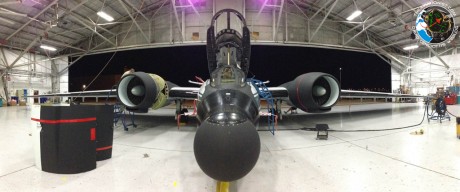
The following picture show the WB-57 conducting final preps prior to the Afghan deployment. The ball turret system mounted on the nose houses houses an optical bench, providing installation of both HDTV and infrared cameras. According to the NASA website, optics consist of an 11-inch-diameter, 4.2 meter fixed-focal-length lens. The system can be operated in both auto track and manual modes.

BACN WB-57F side

A 32-inch-ball turret system was part of the WB-57 Ascent Video Experiment (WAVE) that enabled better observation of the Space Shuttle on days of heavier cloud cover.

Enhanced by Zemanta

U.S. Air Force to turn combat planes into flying wireless routers January 21, 2013

Posted by David Cenciotti in : Information Security, Military Aviation , add a comment

The U.S. Air Force is trying to turn the targeting pods carried by some of its legacy fighters and the B-1 Lancer bomber, into flying wireless routers that would allow ground troops to communicate each other.

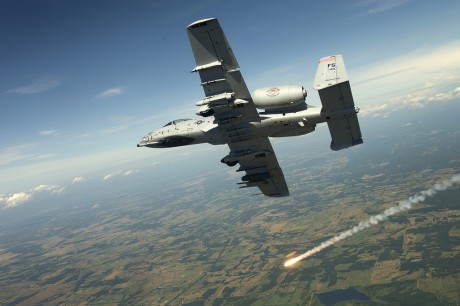
Tested by the 40th Flight Test Squadron at Eglin Air Force Base, Florida, on an A-10 Warthog, the flying router is a software upgrade called Net-T (network tactical) for the Litening II and Sniper advanced targeting pods.

A-10 flares

Image credit: U.S. Air Force

It allows ground units on patrol to interconnect each other by way of Remote Operations Video Enhanced Receiver (ROVER) 5, a portable terminal similar to a tablet or a mini-iPAD that JTACs (Joint Terminal Attack Controllers) use to receive realtime footage from the aircraft targeting pods.

ROVER systems are used by JTACs to determine whether the pilot on a nearby combat plane is cueing the weapons to the correct ground target.

Until now, ROVERs could only upload and download data from a nearby aircraft. With the new capability, that has begun developmental testing in October 2012 and flown 23 sorties so far, data streams from different terminals will be routed by the pod.

In other words, different units on the ground, in “line of sight” to the fighter plane, will be able to exchange imagery, maps and any file type without relying on satellite or radio communication.

Obviously, such wireless network will need to be protected with proper security measures, in order to prevent enemy from eavesdropping traffic or sending malware to the various peers.

According to Maj. Olivia Elliot, the 40th FLTS A-10 flight commander who undertook the test flight for the Warthog, the Net-T portion of the targeting pod is quite easy to operate and once the proper settings are configured “it’s a single button push” and the pilot’s only concern is to remain within range of the system.

Litening

Image credit: U.S. Air Force

During testing activity aimed to discover the operational envelope of the system, five ROVER terminals were set up within the Eglin range and data exchange was tested on a variety of aircraft and pod types, including F-16, F-15E and B-1B.

Such tests by 53rd Wing’s “Team Eglin” will be used to validate the system, that is expected to enter the active service by 2014.

Enhanced by Zemanta

Photo: Air Force Joint Terminal Attack Controller marks ground target for a Navy Hornet under starry sky. In Kuwait. September 17, 2012

Posted by David Cenciotti in : Military Aviation , add a comment

Taken on Sept. 11, 2012, the following picture shows U.S. Air Force 1st Lt. Drew Parks, a Joint Terminal Attack Controller, 82nd Expeditionary Air Support Operations Squadron, as he communicates with a U.S. Navy F/A-18 Super Hornet supporting Operation Spartan Shield Southwest Asia.

Although the exact location is “undisclosed”, Spartan Shield is the name of the U.S. operation in Kuwait, hence the image was taken during an exercise in the desert over there.

Role of the JTACs, previously known as FACS (Forward Air Controllers), is to provide precision terminal attack guidance of U.S. and coalition close air support from a forward position.

The JTAC acts as a sort of “broker” between the commander of the troops on the ground and the pilot, working embedded on a patrol, in the vicinity of the enemy, in an armored vehicle, or from the Tactical Operations Center of a Forward Operating Base. Through the  ROVER (Remote Operations Video Enhanced Receiver) system made ​​available by the Advanced Targeting Forward Looking Infrared (ATFLIR) pod that the F-18s carry on the left side of the fuselage, the JTAC receives on a portable terminal similar to a Playstation, realtime footage he then uses to determine whether the pilot is cueing the weapons to the correct ground target (and avoid friendly fire or collateral damage).

Image credit: U.S. Air Force


Switch to our mobile site