Thirty minutes to choose your fighter jet: how the Shah of Iran chose the F-14 Tomcat over the F-15 Eagle February 11, 2013
Posted by Dario Leone in : Military Aviation , 30commentsDespite all the skepticism about the actual airworthiness of Iran’s new stealth fighter “Qaher 313″, one thing is certain: Iran is still flying the iconic Grumman F-14.
More than 6 years after its last flight with the U.S. Navy, the Tomcat is still in service in a small number of examples with the Islamic Republic of Iran Air Force (IRIAF), to such an extent, Iran has recently tested a brand new air-to-air missile dubbed “Fakour”, for the combat plane made famous by Top Gun.
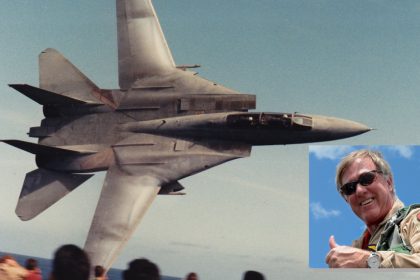
In fact, 80 F-14s were ordered by the Shah and 79 were effectively delivered. The procurement of the Tomcat to Iran was very important not only for Grumman, which was facing serious cash flow problems due to the difficult development of the aircraft, but also for the future of the fighter itself, since at the time F-14’s program was affected by schedule slippage and cost overruns.
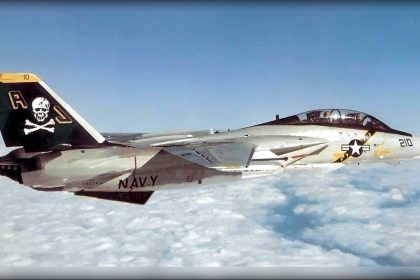
Image credit: Grumman/IIAF
When the Shah announced his intention to replace the old F-4 Phantoms in service with the Imperial Iranian Air Force, it was clear that both the USAF’s new F-15 and the Navy’s F-14 would have had the same opportunity to become Iranian’s main fighter.
So, after briefings held by USAF and Navy personnel in the Shah’s palace in Tehran, Iranian officials decided that it would have been the flight demonstration at Andrews Air Force Base, near Washington DC, scheduled in July 1973, to determine which one between the two fighters, would be the best to satisfy the then Imperial Iranian Air Force’s requiremens.
The flight demonstration was scheduled not to exceed 30 minutes from the first take off to the landing of the second aircraft.
The base was closed for that short time in which at the presence of the Shah, the two U.S. fighters had to fly their demonstration: it was decided that the USAF’s F-15, piloted by Irv Burrows (McDonnell Douglas’ test pilot), would have performed first, while Don Evans and Dennis Romano (Grumman’s test crew) with their F-14, would wait their turn after the Eagle.
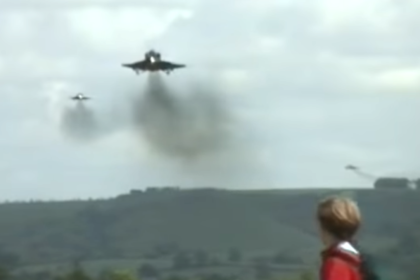
While the F-15 taxied onto runway, Don and Dennis started engines of the Tomcat ahead of the schedule and burned down fuel in the warm up area during the Eagle demonstration, to reduce the difference in thrust to weight ratio between the two fighters. However F-15’s demonstration was spectacular, not only for the raw power of the aircraft but also for pilot’s skills: Burrows was a great pilot and that day, he showed all his ability.
Image credit: U.S. Air Force
The flight demonstration was the same for both aircraft: it consisted in a sequence of maneuvers beginning with a high performance take off followed by an Immelman turn and climb-out, then a descent to a high speed fly-by, two high-g low altitude turns followed by a slow speed fly-by in the landing configuration and last, the landing.
Since the F-15 has a higher thrust to weight ratio than the F-14A, the Eagle performed a really impressive flight profile during which it pulled an incredible 7-g 360 degree turn.
After the F-15 had finished its display, everyone was waiting for the underpowered F-14A demonstration: the Tomcat’s TF-30 engines would have not given to the aircraft the same thrust to weigh ratio of the Eagle.
However, during the F-15’s performance, Evans and Romano burned down a great quantity of fuel and now they had only 2,500 pounds of remaining gas: while this little quantity was only sufficient to accomplish their flight demonstration, 2,500 pounds was also one eight of the Tomcat’s internal fuel capacity and thanks to this fact the Tomcat had the same thrust to weight ratio of the Eagle.
At this point the F-14 had one thing that the F-15 didn’t have: variable geometry wings that would have made the difference for the grace of the flight demonstration.
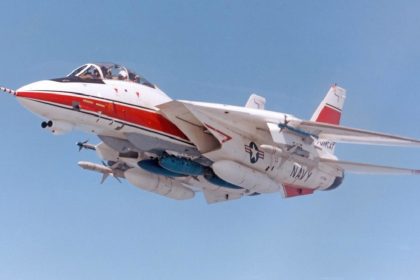
Don and Dennis pushed both throttles to full zone five afterburner (which was the maximum afterburner thrust setting for TF-30 engine) and took off to perform the same demonstration of the F-15: the sequence of the maneuvers was just like the Eagle’s one, but the Tomcat’s crew, during the knife-edge pass, decided to sweep the wings from fully swept to fully forward and then they executed a turn at the maximum Tomcat’s performance, producing a large cloud of vapor off the wings due to the shock wave.
Image credit: U.S. Navy
Then approaching the mid with the wings swept at 40 degrees, the Tomcat went into a full afterburner 360 degree 8 ½ g turn accelerated to 400 knots, very impressive to see. To end the demonstration, Evans and Romano added a touch-and-go landing: when the main landing gears came in touch with the runway they inserted full zone five afterburners and the Tomcat climbed in vertical. At this point, while they had almost ran out of fuel, they made a spectacular carrier landing approach and they fully stopped in one thousand feet of runway.
Once the show ended, the Shah literally ignored the Eagle and walked directly towards the Tomcat speaking for some minutes with the crew still sat in the cockpit of the fighter: he’d chosen the Tomcat, saving the Grumman and assuring a future to the F-14.
Related articles
Grumman F-14 Tomcat’s first flight (and first crash) video January 29, 2013
Posted by Dario Leone in : Aviation Safety, Military Aviation , 1 comment so farSeveral years since it was eventually retired from the U.S. Navy, the Grumman F-14 Tomcat remains one of the most loved planes by aviation enthusiasts.
Any article about the iconic fighter plane, still operating with the Islamic Republic of Iran Air Force, its story, capabilities, records and surrounding anecdotes, always become a much debated and commented post on The Aviationist.
For this reason, we will continue writing about this legendary plane and its replacement: the F/A-18E/F Super Hornet.
The following video, part of a documentary uploaded to Youtube, shows both the first flight and the first crash of the legendary F-14 Tomcat.
On Dec. 21, 1970, the first Full Scale Development (FSD) Grumman F-14A Tomcat (BuNo 157980) took off for its maiden flight from Grumman’s flight test centre at Calverton.
That day, Grumman chief test pilot Robert Smythe and project test pilot William Miller decided to take off in spite of the bad weather: the poor wx conditions, however, forced the test pilots to cut the flight (consisting in a couple of visual patterns with the wings in the forward position) short.
Although the flight lasted less than initially planned, the first Tomcat took the air a month ahead of the contracted data and showed the great potential of the aircraft.
The F-14 BuNo 157980 took off for the second time on Dec. 30 and that day Miller sat in the front cockpit since in the first flight Smythe had been in front.
It was during this flight that a chase plane noted that the Tomcat was leaving a trail of smoke: shortly thereafter the F-14 experienced a primary hydraulic system failure forcing Miller to head immediately back home.
While they were preparing to land, the secondary hydraulic system also failed, due to the use of the emergency nitrogen bottle to blow down the landing gear: once it failed, the crew tried to rely on the Combat Survival System which had to supply the power to the rudders and tailerons only.
However this last limited control system showed signs of failing as well, the pilot lost control all over the aircraft and the crew was forced to eject.
The breakdown was caused by a fatigue failure of both titanium main hydraulic lines due to a coincidence of pump resonance and a loose connector: ironically, the F-14’s hydraulic system was fixed by changing from titanium to stainless steel hydraulic lines only.
As you can see from footage (around 03:20 min), the crew ejected only few meters above the trees but, luckily, they suffered only minor injuries.
Sadly, Miller died on 30 June 1972 when its Tomcat crashed into Chesapeake Bay during preparation for an air display with the tenth FSD F-14 (BuNo 157989), while Smythe passed away this year.
Both Smythe and Miller contributed in bringing to life the last in a long tradition of Grumman Cats.
Written with David Cenciotti
Image credit: U.S. Navy
Related articles
The special way U.S. Navy F-14 Tomcats wished Merry Christmas to sailors deployed at sea December 25, 2012
Posted by Dario Leone in : Aircraft Carriers, Military Aviation , 2commentsChristmas is an ordinary day when you are embarked on an aircraft carrier for maritime security operations. Still, this doesn’t mean there are no alternate ways to celebrate it, as the following images show.
The first photo depicts an F-14D Tomcat belonging to the “Bounty Hunters” of Fighter Squadron Two (VF-2), while it performs a high speed flyby over the USS Constellation (CV-64) on Dec. 25, 2002, ten years ago today.
Image credit: U.S. Navy
During that cruise, the “Connie” steamed in support of Operation Enduring Freedom (OEF) in Afghanistan and though it was Christmas, the deck of the aircraft carrier was very busy due to war.
The second picture was taken on Dec. 30, 2005 and shows another F-14D Tomcat belonging to the “Tomcatters” of Fighter Squadron Three One (VF-31), which flies over the USS Theodore Roosevelt (CVN-71).
Image credit: U.S. Navy
At that time the Carrier Air Wing Eight (CVW-8) was embarked on the Teddy Roosevelt and “celebrated” the end of the year and the beginning of the new one, ensuring Close Air Support (CAS) missions for the ground troops during Operation Enduring Freedom (OEF).
In 2000, VF-103 Jolly Rogers painted their F-14 with Modex 103 with a special emblem: the traditional Skull was given a Santa Hat while a Season’s Greeting text was written on the side of the black drop tanks. The special painted F-14 became known as the “Santa Cat”.
Image credit: VF-103 via Almansur.com blog
As we all know the aircraft carriers have the task to guarantee, with their presence, the theater security in every world’ s major conflicts: peace and freedom need to be guaranteed also during Christmas holidays.
Related articles
F-14 vs F-18: which one would you fly in combat? November 21, 2012
Posted by Dario Leone in : Aircraft Carriers, Military Aviation , 89commentsLook at the pictures below.
The first shows an F/A-18C Hornet parked on the deck of the aircraft carrier USS Constellation (CV-64) as a VF-2 Bounty Hunters F-14D Super Tomcat in the background is launched from the steam catapult.
The second shows a VF-143 Pukin Dogs F-14B Tomcat in formation with a F/A-18E of the same squadron during the unit transition to the Super Hornet.
Image credit: U.S. Navy
What the two pictures have in common is that they both feature the some of the most famous (current and past) aircraft in the U.S. Navy inventory.
Until 2006, the “Wing King” of Naval Aviation was the F-14 Tomcat. The legendary plane on September 22 of that year made its last flight. Since then, the backbone of every Carrier Air Wing (CVW) is the F/A-18 both Hornet and Super Hornet.
Although it was retired from the U.S. military service, the F-14 is still in service with the IRIAF (Islamic Republic of Iran Air Force). However, this article does not focus on the outcome of an eventual close encounter between Iranian Tomcats and American Hornets; it is just a comparison between two fantastic flying machines.
So which aircraft would you take to a fight?
The question, of course, it’s very difficult to answer. It depends on the way you see it and may significantly vary from pilot to pilot.
However, some assumptions can be made in accordance with the most widely known characteristics of both weapon system, as the author as done in this article with the aim to give readers a comparison between the Hornet and its predecessor.
If the mission is strictly fleet defense, the F-14 was a perfect platform. In fact, the six wing mounted pylons of the Super Hornet (or the four of the Hornet) impose a higher drag on the F/A-18 that couldn’t match the Tomcat performance as a very high speed interceptor.
Indeed, the Tomcat is known to be a very fast airplane, with great sustained energy performance and, since it carried a great quantity of fuel which gave it a good endurance, the F-14 was also very good for high speed strike missions.
But the Cold War ended a couple of decades ago and “its” Bears bombers are no the threat that led to the Tomcat possessing those attributes in first place. Furthermore, while the F-14 was an older aircraft in which some newer technologies were integrated, the F/A-18 Super Hornet is a more modern airplane with newer equipment, easier to maintain: a great advantage in times of budget constraints.
In close air combat, the Super Hornet is much maneuverable (with a good authority at slow speed and high AOA – angle of attack) and, even if it lacks the AIM-54 Phoenix for the long distances in BVR (Beyond Visual Range) engagements, it has got the JHMCS (Joint Helmet Mounted Cueing System) and the AIM-9X Sidewinder for the dogfights which the F-14 didn’t integrate.
In FAC(A) Forward Air Controller (Airborne) mission both aircrafts have some strengths and weaknesses: while the Tomcat had a greater on-station time than the Super Hornet, the F/A-18 has an integrated cockpit and for air-to ground missions has the capability to carry not only Laser Guided Bombs (LGBs) and Joint Direct Attack Munitions (JDAMs), but also High Anti-Radiation Missile (HARM) and Joint Standoff Weapons (JSOWs) which the F-14 could not carry. Still, the F-14 could carry a reconnaissance pod whereas the F-18 can fly as a buddy refueler.
Anyway, thanks to its eleven weapon stations, the Super Hornet is more flexible than the Tomcat and it can carry a larger array of air-to-ground ordnance.
So the F/A-18E/F is a great aircraft and a very versatile strike fighter. Still, it’s a Legacy Hornet evolution and it’s not as revolutionary as the F-14 was when it entered the active service in the ’70s, as the most experienced Tomcat driver, Capt. Dale “Snort” Snodgrass, once said.
And, although it was an old plane, according to a female U.S. Navy RIO (Radar Intercept Officer) the F-14 was also a sexy aircraft: “The Super Hornet is a wonderful jet, and it’ s only going to get better. But it will never be cool. The Tomcat was cool. I know sexy when I see it.”
Related articles
Tomcat vs Zero: when the F-14 of the “Jolly Rogers” flew to Hollywood October 25, 2012
Posted by Dario Leone in : Aircraft Carriers, Military Aviation , 12commentsThe Strike Fighter Squadron (VFA) 103 is one of the most famous squadrons in the U.S. Navy. The unit has gained a certain popularity over the year thanks to the famous squadron markings they gained when the Sluggers (as the squadron was nicknamed until then) became the Jolly Rogers and adopted the most recognizable symbol in Naval Aviation: Ensign Jack Ernie’s skull-and-crossbones on all-black tails.
VFA-103 is actually the third squadron to use the name and symbol of the Jolly Rogers:despite being different units, with no “lineal descent” from one another, both VF-61 (originally VF-17), VF-84, and VFA-103 have shared the same name, insignia and traditions.
When the Jolly Rogers were still equipped with the F-14 Tomcat (they now fly the F/A-18F Super Hornet) the Fighter Squadron (VF) 84, they took part in two movies.
Image credit: U.S. Navy
During the 1995, VF-84 starred in Executive Decision, a movie about the hijacking of a Boeing 747 transporting enough nerve agent to wipe out the entire United States East Coast, intercepted by VF-84’s Tomcats loaded with Sidewinder, Sparrow and Phoenix air to air missiles.
The Jolly Rogers took part to the movie with two Tomcats (BuNo 160391 and 160655). On Oct. 1, 1995, few days after filming the flying sequences, the Jolly Rogers of VF-84 were disbanded.
However, the motion picture that gave the world recognition to the Jolly Rogers, was the 1980′s “The Final Countdown”.
Not only the VF-84, but also the aircraft carrier USS Nimitz (CVN-68) which steamed in the Pacific Ocean for the first time, were featured in the movie.
In this film the ship and its Carrier Air Wing (at that time, the Nimitz had the CVW-8 on board) are transported back in time till Dec. 6 1941, when they have a chance to face the Japanese Fleet ready to attack Pearl Harbor.
Along with a beautiful RF-8G Crusader belonging to VFP-63 (which is the one and only appearance of this kind of aircraft on the deck of a Nimitz class carrier) “The Final Countdown” features some F-14 of the Jolly Rogers, two of those find themselves in a dogfight against two Japanese Zeros replica.
The scenes of the “close encounter” between the Tomcats and the Zeros are among the highlights of the movie.
You may find the dogfight in the videos below a bit anachronistic, but watching the Tomcat maneuvering in all its “feline grace” against another legendary WWII warbird, is both unusual and cool.
Dario Leone for The Aviationist.com
Related Articles
- 27 years ago today, the Achille Lauro incident: when the U.S. Navy forced an Egyptair Boeing 737 off course (theaviationist.com)
- Tony Scott, Hank Kleeman, Kara Hultgreen and the F-14 Tomcat: three (tragic) stories and a legendary plane (theaviationist.com)