Typhoon’s super sci-fi helmet: a (supposedly) unnecessary extra feature on the F-22 December 12, 2011
Posted by David Cenciotti in Military Aviation.Tags: Eurofighter, F-22, F-35, Helmet Mounted Symbology System, High-Off BoreSight, HMDS, HMSS, HOBS, JHMCS, Joint Helmet Mounted Cueing System, Military Aviation, Typhoon
add a comment
When I first saw this picture (taken by contributor Nicola Ruffino), I immediately thought that the Eurofighter Typhoon’s Helmet Mounted Symbology System (HMSS), is not only quite advanced, if compared to the the American JHMCS (Joint Helmet Mounted Cueing System), but it is also so ugly and bumpy that let the backseater look like a sort of Hellboy (a comic book superhero).
Even if they implement the same basic features, compared to the American JHMCS (Joint Helmet Mounted Cueing System) (that was developed earlier and became operational beginning in the late ’90s), the Typhoon’s HMSS features lower latency, higher definition, improved symbology and night vision.
Both the JHMCS and the HMSS provide the essential flight and weapon aiming information through line of sight imagery. Information imagery (including aircraft’s airspeed, altitude, weapons status, aiming etc) are projected on the visor (the HEA – Helmet Equipment Assembly – for the Typhoon) , enabling the pilot to look out in any direction with all the required data always in his field of vision.
Noteworthy, although it is integrated in U.S. F-15C/D, F-16 Block 40 and 50 and F-18C/D/E/F, the F-22 Raptor doesn’t need a JHMCS. There are various reasons why the most advanced (and much troubled) air superiority fighter lacks it and the HOBS (High Off-Boresight) weapons: confidence that capability was not needed since no opponents would get close enough to be engaged with an AIM-9X in a cone more than 80 degrees to either side of the nose of the aircraft; limited head space below the canopy; the use of missiles carried inside ventral bays whose sensor can’t provide aiming to the system until they are ejected. And also various integration problems that brought the Air Force to cancel funding.
Did the F-22 need HOBS? Sure, as it would have improved its lethality even further. Indeed, although simulated 1 F-22 vs 3 JHMCS F-16Cs engagements proved that the Raptor can master even challenging scenarios such an extra feature would have been a useful addition when facing large formations of Gen. 5 fighters like the Chinese J-20.
In fact as I’ve already written on this blog, “quantity” rather than “quality” should worry U.S. fighter planes in the future:
“the real problem for the US with the J-20 is not with the aircraft’s performances, equipment and capabilities (even if the US legacy fighters were designed 20 years earlier than current Chinese or Russian fighters of the same “class”); the problem is that China will probably build thousands of them.”
Left image: U.S. Air Force
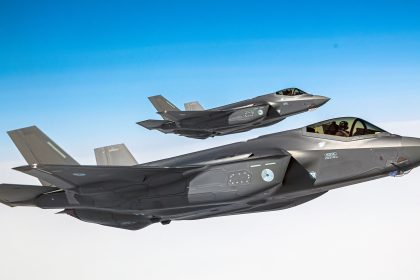
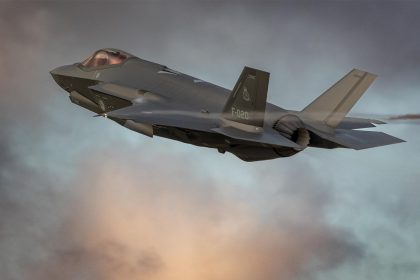
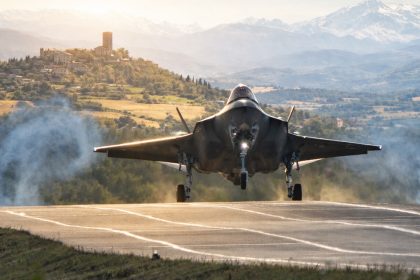
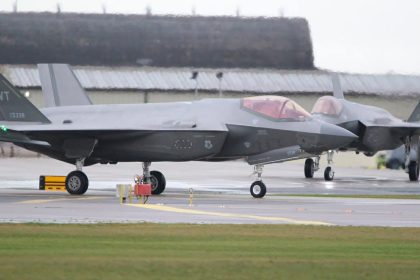
By the way, the multi-role F-35 will get a HMDS (Helmet Mounted Display System): all of the plane’s sensors along with a set of cameras mounted on the jet’s outer surfaces feed the system providing the pilot with a X-ray vision-like imagery: he can see in all directions, and through any surface, with all the information needed to fly the plane and to cue weapons projected onto the visor.
Although the JHMCS is quite common all around the world, the Typhoon’s HMSS is obviously more rare. A good opportunity to see this helmet in action in the U.S. could come in the next years, following the German Air Force plan to base 24 Eurofighter Typhoons at Holloman Air Force Base, at the German Air Force Flying Training Center established in 1958. The Typhoons will be used to train German pilots on the type, as done with the Tornados, that the GAF expects to keep in New Mexico until 2019.
Image: Eurofighter
Is the F-35 stealth jet so advanced that it can be flown using one hand only? Picture raise question November 10, 2011
Posted by David Cenciotti in Aircraft Carriers, Aviation, F-35, Military Aviation.Tags: aircraft carrier, catapult launch, F-18, F-35, HOTAS, JHMCS, JSF, Military Aviation, Naval Aviation, STOVL, USS Wasp
2 comments
Do you remember HOTAS (Hands On Throttle And Stick)?
Ok, forget it.
As the following Lockheed Martin picture shows, the F-35B, the (most costly) Short Take Off and Vertical Landing (STOVL) version of the Joint Strike Fighter, is not only pretty easy to fly as I witnessed in a ride on board the JSF Cockpit Demo, but it embodies so much advanced technology to be flown by the pilot with only one hand (resting his left one).
Obviously I’m kidding.
Indeed the above picture depicts Marine Corps Maj. Richard Rusnok on board the second F-35B test aircraft “BF-4″ as he returns to land aboard USS Wasp on Oct.6, 2011, during STOVL ship suitability testing aboard the land amphibious assault ship off the coast of Virginia. He’s simply resting his left arm on the canopy edge. As someone commented, at least this shows that the F-35 cockpit is quite comfortable!
However a funny image about the F-35 (especially after publishing the famous “F-35 Garbage” picture that someone saw as disrespectful….?!) gives me the opportunity to talk about a standard feature of all the most recent generations of fighters.
Hands On Throttle And Stick is the concept according to which all the vital switches and buttons a combat pilot needs to access the radar functions, the weapon control and flight managent systems, the attack and identification systems, the radio and navigation equipment, etc, are placed on the flight control stick and engine throttle, allowing him/her to give inputs to the onboard computers without having to remove a hand from the flight controls.
Coupled with a JHMCS (joint helmet-mounted cueing system), HOTAS enables the pilot to perform a high-G turn while using the throttle to obtain the desired thrust and switch from the air-to-ground to the air-to-air mode (and vice versa) and cue onboard weapons against enemy aircraft or ground vehicles merely by pointing his head at the target to guide the weapons.
Some aircraft as the Typhoon, use the DVI (Direct Voice Input) creating an integrated system dubbed VTAS (Voice Throttle And Stick). In VTAS cockpits, voice can be used to control some non-critical systems reducing pilot workload and removing the need for him to look down at any of the MFD (Multi-Function Displays).
DVI is affected by in-flight environment noise and has to cope with quick voice level variability under high-G stress, different types of microphones with different frequency responses, and also different type of English (English spoken by an American or British pilot is sensibly different from the one of a Spanish or Italian one). So far, I’ve never heard of VTAS being effectively used in combat, but most probably, DVI will be extensively used in the next years and even the F-35 should have a speech recognition system in the future.
Naturally, there are some phases of the flight that don’t require the pilot to keep the hands on the flight controls. Sometimes pilots leave the control stick free although its position is not kept by the autopilot.
For instance, during catapult launches from aircraft carriers, after rudders have been deflected for take off, F-18 pilots are required to hang on a handle on the cockpit mount in order to prevent the quick acceleration inducing some involuntary movement on the flight control stick.
F-35: an expensive hard-to-recycle form of garbage? October 28, 2011
Posted by David Cenciotti in Aviation, F-35, Military Aviation.Tags: F-35, FX-3, Joint Strike Fighter, JSF
add a comment
I find the following picture rather funny. It was taken at Seoul Air Show and shows a Lockheed F-35 Lightning II….with a “garbage” sign posted on the barrier in front of the plane. Obviously it’s only a matter of perspective, but I must admit that the signs seems to be an explainatory panel like the ones you can find next to the airplanes in static display. The person who took this picture and sent it to me has a sense of humour (and knows how to tease a competitor).
The F-35 is in fact among the candidates for S. Korea’s next generation fighter, known as FX-III project with a budget of 8.29 trillion won (7.86 billion USD) for 60 jets. It competes with the Eurofighter Typhoon, the Boeing F-15SE and Sukhoi T50 PAK-FA (yes, the Russia’s 5th generation fighter plane, that was forced to abort take off after at MAKS 2011 air show on Aug. 21, at Ramenskoye air base, near Moscow.
Initially seen as the favorite candidate, the F-35 has been recently questioned because of the delays and the high unit cost. As reported by the Seoul Daily on Sept. 16, a high raking DAPA (Defense Acquisition Program Administration) recently said “A fighter, which is not detected by the radar system, but low in strike capability, will not be effective. We will not necessarily insist on stealth function”, a remark that undermined one of the cornerstones of Lockheed’s appearant advantage over competitors.
Competitors that didn’t miss the chance to take a picture that ridiculed the still dangerous opponent.
PS Please don’t send me tons of emails to tell me why I’m against the F-35. It’s just a humorous picture.
Italian Navy AV-8B+ Harrier 20th anniversary October 27, 2011
Posted by David Cenciotti in Italian Navy, Military Aviation.Tags: F-35, F-35C, Garibaldi, Grottaglie, I GrupAer, Marina Militare, Operation Unified Protector, STOVL
2 comments
On Oct. 27, 2011, with a ceremony at Grottaglie airbase, near Taranto, the Marina Militare (Italian Navy) celebrates the 20th anniversary of the Harrier in Italian service. The AV-8B+ Harriers of the I GrupAer have recently taken part to the Operation Unified Protector in Libya, performing both DCA (Defensive Counter Air) and BAI (Battlefield Air Interdiction) out of the Garibaldi aircraft carrier.
Above images courtesy of the Marina Militare
When I tweeted the news of the 20th anniversary on Twitter, many of my followers replied with comments dealing with the much criticised British Strategic Defense and Security Review that, more or less one year ago, scrapped the entire “Jump Jet” fleet, leaving the UK with no aircraft to equip aircraft carriers (hence, with no maritime strike capability) until 2020.
With the SDSR, the UK reduced its planned buy of F-35s and abandoned the F-35B STOVL (Short Take-Off Vertical Landing) version of the JSF for the carrier variant F-35C. The abandonment of the F-35B is tied to the decision to convert one of the two future British aircraft carriers in a “cat and trap” supercarrier, hence able to launch the planes by means of a catapult and to recover them by means of an arresting gear system.
According to the current plans, the ItAF will be equipped with both the conventional F-35A and the F-35B STOVL variant, while the Italian Navy will procure only the STOVL version for its current and future aircraft carriers. However, in spite of the current trials at sea, the future of the F-35B is quite uncertain and there is still a possibility that the Marina Militare will have to opt for a “Plan B” if the STOVL version will be scrapped at the end of the 2-year probation announced by former US Sec Def Robert Gates on Jan. 6, 2011.
What about purchasing some retired-but-still-perfectly-airworthy RAF Harrier GR9s before they are all sold for spares? The Italian Navy would lose the air defense capability (since the GR9 is an air-to-ground combat plane) but it will retain a jet plane capable to operate from its aircraft carriers in the strike and CAS (Close Air Support) roles.
I’d start negotiating a trade-in price….:-)
Last RAF/RN Harrier GR9 operational flight took place at RAF Cottesmore on Dec. 15, 2010. The following video is the best I’ve seen so far about the Jump Jet farewell flight.
A new breed of fighter pilots for easy-to-fly high tech fighter jets August 17, 2011
Posted by David Cenciotti in F-35, Military Aviation.Tags: Eurofighter, F-35, fighter pilot, fighter plane, HMDS, Joint Strike Fighter, JSF, netcentric warfare, sensor fusion, stealth, Typhoon, USAF
4 comments
Earlier this summer, the U.S. Air Force took delivery of the first production of Lockheed Martin’s F-35 Lightning II to the 33rd Fighter Wing at Eglin AFB, Fla. The F-35 is the world’s most advanced multirole aircraft. It is the most expensive single U.S. military procurement project in history and is expected to replace a wide range of aircraft in the military’s inventory.
Designated AF-9, the newly delivered jet is a multi-role conventional takeoff and landing (CTOL) version of the futuristic fighter plane known as Joint Strike Fighter, which has been chosen by the air forces of Italy, the Netherlands, Turkey, Canada, Australia, Denmark and Norway.
Two other variants of the Joint Strike Fighter have been developed and are currently under testing: a short take off and vertical landing one, designated F-35B, and the F-35C carrier-based variant, selected for aircraft carrier operations by the U.S. Navy and the UK’s Royal Air Force. Israel will employ a customized version designated F-35I.
The F-35 Lightning II is a fifth generation fighter. It combines the high speed and agility of fast jet planes with modern technologies such as radar-evading fiber mat skins and gigabit data networking for net-centric warfare.
New breed of fighter pilots
The Joint Strike fighter aircraft is designed to improve a pilot’s situational awareness by and collecting and combining data from different onboard and offboard data sources into a single detailed view of the surrounding airspace and battlefield.
Like most modern advanced fighter planes, it contains a complex weapon system: pilots have to focus on information management, rather than worrying about “flying the aircraft.” For this reason, today’s fighter pilots are more like system administrators or information managers than the iconic Top Guns of the past.
“With previous generations fighters, flying the airplane required 80 percent of the pilot’s effort,” said one pilot of the Italian Air Force who has recently taken part to Unified Protector in Libya with the Eurofighter Typhoon, Europe’s most advanced fighter.
“With modern planes, the basic handling it’s quite simple and represents no more than 20 percent: they almost fly autonomously. On the other side, management of the huge amount of information that it provides can be overwhelming [and] is quite demanding,” this pilot told TechNewsDaily under condition of anonymity.
Lt.Col. Salvatore “Cheero” Ferrara, an Italian Air Force pilot assigned to the JSF program at Washington DC, had a slightly different take on the responsibilities of today’s pilots.
“I believe that the traits of future fighter pilots will be roughly the same as those of past pilots,” Ferrara said. “The only difference is that those skills will be used in a different way: instead of processing flight mechanics data – as I had to do with the Lockheed F-104 Starfighter – they will need to process and manage the huge amount of digital information concerning the management of both the mission and the electronic scenario.”
Easier to fly than ever before
Some years ago, under the supervision of a Lockheed Martin test pilot, I had the opportunity to fly, hover and vertically land a F-35B jet in a military flight simulator. I was surprised to discover that the controls of the so-called Cockpit Demonstrator were not as alien or difficult to navigate as I expected. There was a big panoramic touch screen that can be configured at will by tapping the screen with fingers, like a tablet or a smartphone.
…..
[Read the rest of my article on Tech News Daily]
Image source: Lockheed Martin
A glimpse into the future with the first F-35C catapult launch video July 27, 2011
Posted by David Cenciotti in Aircraft Carriers, F-35, Military Aviation.Tags: 5th generation fighter, aircraft carrier, catapult, catapult lauch, CF-3, F-35, F-35 JSF, F-35 Lightning II, F-35C, Harrer, JBD, jet blast deflector, Lakehurst, Lockheed Martin, Military Aviation, Naval Aviation, RAF, Royal Navy, Short Take-Off Vertical Landing, STOVL, super carrier, US Navy
3 comments
Ok, it isn’t taken on the deck of USS Nimitz. However, the following video, just released by the US Navy, gives you an idea of what US (and British) naval aviation will look like in the future. Just imagine some more green, blue, yellow, red jackets, the typical “island” of a supercarrier in the background, steam coming out of the catapults, and the sea at the end of the deck. To be honest, to add some more realism, we should add some payload (weapons and tanks) to that clean and light aircraft….
The video was taken at Lakehurst on Jul. 27, 2011 when Navy test pilot Lt. Christopher Tabert took off with the F-35C CF-3, the designated carrier suitability testing aircraft, launched by a steam catapult during catapult and jet blast deflector testing.
Noteworthy, as the F-18, the F-35C has the rudders deflected inwards during catapult launches to help the nose raising as the aircraft leaves the ship.
The F-35C is the carrier variant of the Joint Strike Fighter, with larger wing surfaces and reinforced landing gear for slower catapult launch and landing approach speeds and deck impacts associated with the demanding carrier take-off and landing environment than the A (Conventional) and B (STOVL) variant.
Lockheed’s SecurID Breach Also Threatens Online Banking June 16, 2011
Posted by David Cenciotti in Information Security, Information Warfare.Tags: AES cypher, Cyber War, EMC Corporation, F-35, Homeland Security, Information Security, Information Warfare, Joint Strike Fighter, JSF, L-3, One Time Password, OTP, Pentagon, pin code, RSA, RSA Breach, SecurID
add a comment
The same type of attack used recently to get around security measures at Lockheed Martin, and possibly other defense contractors as well, could also be used to hack international banking services, security experts say.
That’s because both the defense and banking industries rely heavily on RSA’s SecurID tokens, 40 million of which are in use around the world.
Small businesses and private users use SecurID tokens to access online banking services, while large corporations use them to authenticate employees who need to remotely or locally access internal networks and resources.
SecurID devices are small, tamper-resistant tokens that generate numeric codes every 30 or 60 seconds. The complex cryptographic algorithm combines three inputs: the token’s serial number, the internal seed (a secret key hard-coded in the token) and absolute computer time (which counts seconds from January 1, 1970 and never repeats).
The same computation is performed by the authentication server, which compares its code with the one provided by the user. If they correspond, the user is granted access.
The seemingly random sequences of numbers generated by SecurID tokens are technically called OTPs (One Time Passwords) — they can be used only once and expire even if never used.
An OTP can’t be modified, changed or altered, and a SecurID token can’t be fixed, opened or reprogrammed. If it’s compromised, a SecurID token must be replaced.
These tokens can also exist as software applications installed on a PC or a smartphone to perform the same function.
Theoretically, the physical possession of the token, PC or smartphone ensures the security of the authentication mechanism. The only circumstance under which an attacker could clone the token (and it would take some time) would be if seeds and token serial numbers had been stolen.
Unfortunately, that’s exactly what seems to have happened.
“On March 17, 2011, RSA, the security division of EMC Corporation, one of the most important players in the IT security market, publicly announced that information that could be used to reduce the effectiveness of their SecurID authentication implementation was compromised,” explained Paolo Passeri, an ICT (Information and Communication Technology) Security expert based in Rome, Italy.
Passeri was among the first to understand that the RSA security breach could be used to attack EMC Security Division’s corporate clients using SecurID tokens.
Two months later, Lockheed Martin, one of the world’s largest suppliers of military hardware to the U.S. and other countries, announced it had suffered a network intrusion. Lockheed Martin disabled all remote access to its internal networks and said it would replace every one of its RSA SecurID tokens – and that RSA would pay the replacement costs.
“Since the information stolen from RSA, alone, could not be used to successfully clone the tokens, in order to perpetrate the attacks, the hackers must have used keylogger malware and phishing campaigns to get the missing pieces of the puzzle (usernames and PINs — personal identification numbers),” Passeri surmised.
In fact, RSA has not publicly disclosed what was taken from its servers in March (it will tell only existing clients who sign a non-disclosure agreement), and Lockheed Martin has not said if or how its attackers had usernames or passwords.
But the problems for defense contractors may have just begun.
….
[Read the rest of my article on Tech News Daily]
RSA Security breach explained: why US defense programs could be compromised June 1, 2011
Posted by David Cenciotti in Information Security, Information Warfare.Tags: AES cypher, Cyber War, EMC Corporation, F-35, Homeland Security, Joint Strike Fighter, JSF, L-3, One Time Password, OTP, Pentagon, pin code, RSA, RSA Breach, SecurID
add a comment
As almost everybody know by now, on Mar. 17, 2011, RSA (the Security Division of EMC Corporation and one of the most important IT Security vendors of the world) publicly announced that some information that could be used to reduce the effectiveness of one of their two-factor authentication implementations was compromised. In other words: their Database, mapping SecurID token serial numbers, to the token “seeds” was stolen.
What are we talking about?
To make it simple, SecurID devices are small tamper-resistant tokens (resembling calculators), which generate a numeric code at fixed intervals (usually 30 or 60 seconds before the displayed code is replaced by the next one). Even if they are usually pieces of hardware, they exist also as a software application that can be installed on a pc or smartphone to perform the same function. Those randomic sequences of numbers generated by SecurID tokens are authentication codes, technically called OTPs (One Time Passwords). The term One-Time means that they can be used for a single authentication process and they expire even if they are never used. Such tokens provide a OTP that can be used for both network or application/web authentication. Many use them to access their homebanking while companies use them to authenticate employees that need to (remotely or locally) access the internal network and resources.
Image: Wikipedia
These tokens generate the 6 or 8-digit OTP using an AES (Advanced Encryption Standard) algorithm to hash the token serial number, the internal seed and the Current Time (BTW: the server makes the same computation performed by the token devices and generates a OTP that is compared to that provided by the user).
Paolo Passeri studied the subject and in an interesting blog post dated Apr. 10 and provided some more information about the inputs that are used to generate the OTP:
- a 128-bit token-specific true-random seed,
- a 64-bit standard ISO representation of Current Time (yr/mo/day/hour/min/second),
- a 32-bit token-specific salt (the serial number of the token), and
- another 32 bits of padding, which can be adapted for new functions or additional defensive layers in the future.
Since the AES-Hash operation is performed on 128 bit blocks, the latter two inputs are not a specific security feature but they are needed to pad the standard Current Time representation to fulfil the “rule” of 128 bit multiples.
As you can understand, both the seed and the serial number are unique for each token and, theoretically, the physical possession of the device ensures the security of the authentication mechanism. The only circumstance under which an attacker could be able to clone the token (and generate authentication codes on behalf of the legitimate user) was if seeds and token serial numbers had been stolen. That’s exactly what happened: an Advanced Persistent Threat (APT) was able (injecting a malware and using other vulnerabilities) to steal the database mapping seeds to serial numbers.
Even if the SecurID generates new strings of digits on a 30-60 second basis, some implementations require the user to enter the OTP along with a PIN (Personal Identification Number), a fixed code like the one used at ATMs. Even if the PIN represents an additional security layer that, for sure, was not stored in the RSA DB, such short codes are easier to hack and can be retrieved using malware, keyloggers and many other methods.
One last thing: the OTP can’t be modified/changed/altered and the token, and the SecurID, being tamper-proof, can’t be fixed, opened, reprogrammed. Therefore, if compromised, the SecurID must be replaced.
Targeting defense contractors
As analysts predicted, the RSA hack was not simply intended to discredit the EMC Security division. The actual targets were the corporate clients which use the SecurID token for user authentication and, among them, defense contractors.
Indeed, the first defense contractor to be known to have suffered a security violation was Lockheed Martin that on May 22 disabled all remote access to its internal network (“at least for a week”) and planned the replacement of all its RSA SecurID tokens after detecting an intrusion in the internal network. Needless to say Lockheed is one of world’s largest defense contractors, “an American global aerospace, defense, security and advanced technology company” supplying hi-tech military hardware to US and worldwide military (F-16, C-130, F-22, F-35 to name but few interesting Lockheed “products”).
On May 31 Wired reported that another defence contractor, L-3, was targeted using SecurID stolen data even if it is not clear whether the hackers were successful in the penetration or not.
Both attacks show a certain interest for data managed by military contractors which manufacture some of the most sophisticated and sensitive US (and foreign) military equipment; weapon systems currently used in both Iraq, Afghanistan and Libya. However, as Paolo Passeri commented:
I wonder if military contractors are the only targets or if they have been the only ones capable to detect the attempts because of their strict security protocols and policies.
Certainly, defense contractors’ networks contain many classified data about current and future US projects. However, such data is usually secured in closed networks that are not interconnected with corporate LANs or that require additional authentication procedures. I have already explained, when I commented the hack into the F-35 Lightning II JSF (Joint Strike Fighter) project that network intrusions or data leakage not always imply a significant loss. It all depends on the information that is actually stolen.
Image: Lockheed Martin
For sure, Advanced Persistent Threats as well as RSA SecurID weakness, are something that, defense contractors and Government agencies, facing a huge and growing Cyber risk, must be able to deal with. First of all, companies should follow the example of Raytheon (another Defense Contractor) that has declared to have taken immediate companywide actions, as soon as the RSA incident information was made public, to prevent a widespread disruption of their network but, to enhance the effectiveness of their security countermeasure, I think, sooner or later, all corporates/agencies will have to consider the opportunity to use more costly biometric devices (usually seen in movies like Star Trek, Minority Report, X-Men, Planet of the Apes and few others) that perform user authentication by means of voice analysis, face recognition, iris scan, keystroke dynamics identification, etc.
A multi-role Italian Eurofighter Typhoon? February 13, 2011
Posted by David Cenciotti in Italian Air Force, Military Aviation.Tags: Aeronautica Militare, Alenia Aeronautica, AMI, Decimomannu, Eurofighter, F-2000, F-35, fighter pilot, ItAF, Italian Air Force, JDAM, Joint Direct Attack Munition, Joint Strike Fighter, JSF, Lockheed Martin, Military Aviation, RSV, Typhoon
1 comment so far
When the following pictures (courtesy of zetamimmo) appeared on the Italian Vipers forum someone thought that, finally, the Aeronautica Militare (Italian Air Force, ItAF), had begun thinking to the Eurofighter Typhoon as a multi-role aircraft, something contrasting the previous vision, according to which, the F-2000 should be only used as an air superiority fighter.
However, the pictures, taken at Decimomannu airbase in February, depicts a TF-2000A that, although wearing the Reparto Sperimentale Volo (RSV – Test Unit Wing of the ItAF), it’s currently flown by both Alenia Aeronautica and RSV to conduct testing activities. For example, during my visit to Decimomannu for the F-15E deployment the aircraft serialled MM X-614/IPA 2 was involved in supersonic runs (see pictures at the end of this article), while it carried GBUs to test the aircraft’s autopilot during flights in heavy configurations.
The last part of my article titled “Italian Typhoon”, published in the April 2010 issue of Air Forces Monthly ended with the following words, which explain the past (and current!) vision of the Italian Air Force about the role of the F-2000:
Under Tranche 3A, by 2013, Italy will receive 21 Typhoons bringing the total to 95 (comprising 27 Trance 1 and 47 Tranche 2 examples). The aircraft will be used in the air superiority role, as Italy, due to the cost associated with the envisaged upgrades required by the integration of the air-to-ground weapons, has always been skeptical about a multi-role Eurofighter. At the end of 2008, answering some questions about the JSF (Joint Strike Fighter), Gen. Vincenzo Camporini, former ItAF Chief of Staff, current Defence Chief of Staff, affirmed that: “There’s no competition or conflict between the JSF and the Eurofighter. The Eurofighter was designed for the Air Defence, a role that the aircraft is perfectly able to fulfil, but it can’t perform the attack role in an economically sustainable manner”. That vision hasn’t changed with the Tranche 3 contract signed in July 2009. In a recent interview, Gen. Giuseppe Bernardis, Air Force Deputy Chief of Staff, said that Italy did not completely rule out the use of Eurofighters for air-to-ground missions, since both T2 and T3 aircraft will have the ability to carry Paveway and JDAM (Joint Direct Attack Munition) that are already used by the Tornado and the AMX, and will be carried in the future by the F-35s (that Italy plans to acquire in 109 examples: 69 conventional take-off and landing F-35As and 40 short take-off and vertical landing F-35Bs). Hence, the air-to-ground mission is viewed as secondary for the Typhoon; provided their ability to use the ordnance in inventory for other aircraft, the Eurofighter will be possibly be used as “back up” attack platforms until 2040.
Fighter generations comparison chart January 13, 2011
Posted by David Cenciotti in China, Military Aviation, Military History.Tags: active electronically scanned arrays, AESA, Black Eagle, Chengdu, Chinese stealth fighter, Eurofighter, extreme agility, F-104, F-15SG, F-16, F-18, F-18E, F-2000, F-22, F-35, f-6, F-80, F-86K, fifth generation, fighter generations, fighter pilot, fourth generation, full-sensor fusion, infrared missiles, integrated avionics, J-20, jet propulsion, Joint Strike Fighter, Lockheed Martin, look-down, Mig-21, Military Aviation, Mirage 2000, missiles, PAK FA, sensor fusion, shoot-down, stealth, Su-30, Super Hornet, swept wings, T-50, Typhoon
9 comments
The appearance of the new J-20 (unofficially dubbed “Black Eagle”) raised many questions about the Chinese stealth fighter. Some experts think it will be more capable than the F-22 while others (and I’m among these ones) think that the real problem for the US with the J-20 is not with the aircraft’s performances, equipment and capabilities (even if the US legacy fighters were designed 20 years earlier than current Chinese or Russian fighters of the same “class”); the problem is that China will probably build thousands of them.
Anyway, comparing the US and Chinese fighters, everybody referred to “fifth generation planes” bringing once again the concept of “fighter generation” under the spotlight. Generations are a common way to classify jet fighters. Often, generations have been “assigned” to fighters in accordance with the timeframes encompassing the peak period of service entry for such aircraft. The best definition I’ve found so far of fighter generations is the one contained in an article published in 2009 by Air Force Magazine, that proposes a generations break down based on capabilities:
Generation 1: Jet propulsion
Generation 2: Swept wings; range-only radar; infrared missiles
Generation 3: Supersonic speed; pulse radar; able to shoot at targets beyond visual range.
Generation 4: Pulse-doppler radar; high maneuverability; look-down, shoot-down missiles.
Generation 4+: High agility; sensor fusion; reduced signatures.
Generation 4++: Active electronically scanned arrays; continued reduced signatures or some “active” (waveform canceling) stealth; some supercruise.
Generation 5: All-aspect stealth with internal weapons, extreme agility, full-sensor fusion, integrated avionics, some or full supercruise.
Potential Generation 6: extreme stealth; efficient in all flight regimes (subsonic to multi-Mach); possible “morphing” capability; smart skins; highly networked; extremely sensitive sensors; optionally manned; directed energy weapons.
In order to give the readers an idea of the type of aircraft belonging to each generation I’ve prepared the following table with the help of Tom Cooper / ACIG.org and Ugo Crisponi / Aviatiographic.com, who provided the profiles.
As I’ve already commented on Twitter, what such a table should let you understand at a glance is that capabilities and appearance are inversely proportional: former generations aircraft look much better than more modern fighters…..