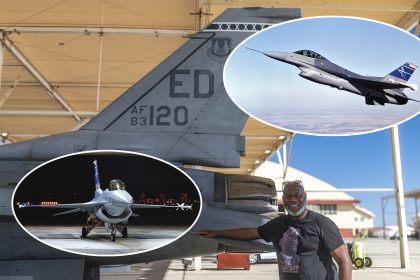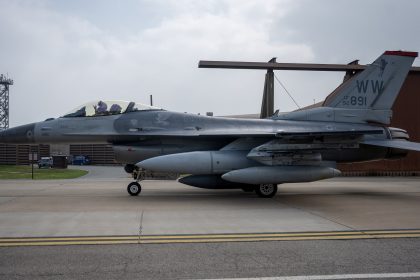
Canopy fogging caused F-16 runway overrun at Oshkosh February 23, 2012
Posted by Richard Clements in Airshow, Aviation Safety.Tags: Air National Guard, airshow, Alabama Air National Guard, F-16, General Dynamics F-16 Fighting Falcon, Oshkosh, Oshkosh Wisconsin
2 comments
An Alabama Air National Guard pilot had a close call when his F-16 developed a problem with the onboard environmental control system which leads to his cockpit canopy fogging up. The pilot was landing after taking part in an airshow at Wittman Airport, Oshkosh, Wis., when the ventilation system failed and condensation formed during the final approach.
With his vision obscured, the pilot from the 187th Fighter Wing at Dannelly Field Alabama tried to de-mist the canopy, most likely in a similar manner to a car’s windshield but was ultimately unsuccessful. So he managed to land the F-16 on the runway but veered off onto soft ground that snapped the front landing gear and the airframe then dug into the grass causing some $5 million worth of damage.
Being distracted by the fogging probelm the pilot failed to apply the air brake that would have effectively reduced the fast touch-down speed and stop the aircraft in the available remaining runway.
Investigators said in their report that the aircraft had been maintained correctly therefore the root cause was a random component failure.
The lack of casualties and the non fatal damage to the aircraft shows how much skill the pilot had: in spite of his inability to evaluate the remaining runway and his vision obscured by the fogged canopy, he decided to ride the stricken Falcon in rather than risk hundreds of casualties on the ground by ejecting.
Richard Clements for The Aviationist
Related articles
Vipers, Growlers, Prowlers, Eagles and Hogs: U.S. combat planes at Aviano airbase during Libya air war. With heart background. February 7, 2012
Posted by David Cenciotti in Military Aviation, Operation Odyssey Dawn, Operation Unified Protector.Tags: A-10, Aviano, Boeing EA-18G Growler, F-15E, F-16, Libya, NATO, Operation Odyssey Dawn, Operation Unified Protector, U.S. Air Force, U.S. Navy, United States
add a comment
Although the U.S. involvement in Libya was scaled down few days after NATO took control over the air campaign on Mar. 31, 2011, American tactical aircraft (“tacair”) played an important role during the opening stages of the Washington-led Operation Odyssey Dawn (for more details I suggest you reading the first debriefs of my Libya Air War series).
Even if U.S. planes also operated from other deployment base (RAF Mildenhall, Moron, Souda Bay, Istres), Aviano airbase, in northeast Italy, and Sigonella, in Sicily, were the two main hubs used by the Air Force, Navy and Marine Corps assets. In particular, Aviano was mainly used by the tacair component, while “Saigon” was used by support planes (PSYOPS, tankers, etc.) and drones (both Reapers and Global Hawks).
Among the aircraft on temporary deployment to Aviano (that is the permanent base of the 31st FW’s F-16s) there were: VAQ-132 EA-18G Growlers, VAQ-140 and VMAQ-1 EA-6B Prowlers, 494FS F-15E, 81FS A-10s and 480FS F-16CJs. A Jordanian Air Force detachment operated from Aviano throughout the duration of Operation Unified Protector.
The following pictures, taken by Simone Gazzola, show some of the most interesting aircraft taking off or landing at Aviano.

Note also the “heart” shape on the background of some pictures. It’s a land-art project called Lumacuore (an Italian word formed by combining the words lumaca= snail and cuore = heart) and made between 2009 and 2010 on the side of Piancavallo mountain by the Italian artist Laura Trevisan with the aim of “spreading a cultural message on human rights, love and respect for nature as well as the environmentally friendly development of the territory.”
Another day, another Iranian drone. Tehran reveals the new “A1″ UAV. January 30, 2012
Posted by Richard Clements in Drones, Iran.Tags: Ababil, drones, F-16, Iran, Islamic Republic of Iran Air Force, Israel, Israel Defence, Military Aviation, UAV, Unmanned Aerial Vehicle
4 comments
On Jan. 30, Iran has announced the development of a new UAV (Unmanned Aerial Vehicle) called the “A1″. According to the information released so far, the new drone allegedly has a service ceiling of 10,000 feet, an endurance of two hours and can carry up to a 11lbs (5kg) payload. Furthermore, it has an engine running on hi-octane gas/oil mix (2 stroke engine??) with a 2 blade pusher propeller and can be either launched from a ramp attached to the bed of a truck or ship-launched from rocket launchers.
These “features” seem to suggest that the new drone is another variant of the Ababil indigenous UAV family, which already includes the Ababil-5, used as a medium range surveillance platform, and the Ababil-T, a short to medium range UCAV with offensive capabilities.
Image credit: PressTV
Press TV website which broke the news also mentions a –B and a –S version but does not disclose what the purposes of these are.
It was an Ababil-T drone, allegedly launched from within Lebanon and sported Hezbollah markings, that was shot down in 2006 by an Israeli Air Force F-16 using a Rafael Python 5, about 5 nautical miles off Israel’s coast.
Ababil-T (credit: IDF)
The launching of the new drone is a further evidence of a blooming indigenous UAV program which has similar beginnings to that of the Israeli UAV program, started many years ago to develop drones for artillery spotting and battlefield overwatch as well as decoys for SAM sites (they are used to personify manned assets and spur a reaction by the SAM site that can be then attacked by other SEAD assets).
Although the significance of Iran’s UAV program remains unclear (especially if we consider the claims about the prodigious performance of some drones that are nothing more than scale models), it’s once again interesting to notice how the Iranian government use the local media to trickle out information on new systems being developed by Tehran.
The Aviationist will monitor further developments as and when they arise.
Written with The Aviationist’s Editor David Cenciotti
Have you ever seen a Tornado-like spinning vortex on a Typhoon? Just phase transition thermodynamics December 3, 2011
Posted by David Cenciotti in Aviation, Italian Air Force, Military Aviation.Tags: air intake, airplane, condensation, Eurofighter, F-16, Foreign Object Damage, Gioia del Colle, Ice FOD, Military Aviation, phase transition, thermodynamics, Typhoon, vortex
3 comments
I’m pretty sure many of this weblog’s readers have already seen this phenomenon generated at the air intake of an F-16. There is also a quite famous image of a C-17 engine, generating this tornado-like spinning vortex. However, the following picture is the first I’ve seen so far showing the vortex generated by an Italian Eurofighter Typhoon (F-2000A according to the Mission Design Series).
The picture was taken in May 2011, by Nicola Ruffino and shows a Typhoon of the 36° Stormo, based at Gioia del Colle, generating a vortex on the apron before taxiing for night sortie.
The principle is quite simple: the air is sucked into the intake generating a depression. As the pressure lowers, the air cools and the water vapor contained in it condesates and becomes visible. The process is the same I’ve explained when I discussed sonic booms and condensation clouds) and it is frequent in high humidity or wet weather conditions.
Noteworthy, if temperature is particularly low the water vapor contained in the air changes directly to ice (without first becoming a liquid). Known as “deposition”, this phase transition can cause some problem to the aircraft, in the form of engine Ice FOD (Foreign Object Damage) and intake ice build-up.

“Turkish F-16s now able to hit Israeli planes”: since when IFF can prevent a fighter from firing a missile? September 19, 2011
Posted by David Cenciotti in Aviation, Aviation Safety, Military Aviation.Tags: air defense, F-16, IFF, Military Aviation, transponder, Turkish Air Force
12 comments
Last week an article titled “Turkey F-16s can now hit Israel targets” made the news and spread quite quickly on the Internet.
According to the article, Turkey has developed a new IFF (Identification Friend or Foe) system for its F-16s that will allow them for the first time to fire at Israeli targets. Developed by Turkey’s Military Electronics Industry (ASELSAN) the new IFF will be mounted on all Turkish fighters (as well as military vessels and submarines) to replace the previous US version which “identified all Israeli targets as a “friend”, thus preventing the Turkish fighter jets from firing at them automatically, even if the Turkish pilots were ordered to fire at them.”
Considered as an ancestor of the RFID, the IFF was developed during World War II to identify friendly targets. Indeed, the acronym is improper, as the system can only identify friendly targets: if an IFF interrogation receives no reply or an invalid one, the target can’t be “declared” hostile.
IFF transponder systems are used by both military and civilian aircraft. Modern IFF have two-channels: one frequency is used for interrogating signals and another for the reply.
The interrogator’s coded signal consists of two pulses spaced at a precisely defined interval. The time interval between the two pulses, discriminated by the onboard transponder circuitry, determines the IFF Mode.
Modes 1, 2, 4 and 5 are used by military planes only whereas mode 3/A, C and S are used by both military and civilian planes. However, some military aircraft (for instance, the F-18E/F Super Hornet) have only Mode 1, 2, 3/A and C modes-capable IFF transponders with Mode 4 available only with specific upgrade fix.
Here’s a quick review of IFF transponders operative modes:
- Mode 1 provides a mission code (mil only)
- Mode 2 provides the “tail number” or unit code that identifies a particular aircraft (mil only)
- Mode 3/A – provides the ATC-assigned identification code for the aircraft (civ/mil)
- Mode 4 provides a reply to crypto coded challenge (mil only)
- Mode 5 provides the secured version of Mode S and ADS-B (mil only)
- Mode C provides the aircraft’s pressure altitude (civ/mil)
- Mode S provides multiple information formats to a selective interrogation (civ/mil)
Is the IFF linked to the missiles?
As said, the IFF enables quick identification of a friendly aircraft, but it is of little help when trying to identify hostile planes. It is not linked to the aircraft armament and (at least on the majority of the airplanes I know) it can’t prevent an interceptor from shooting at a “friendly” aircraft. This for one a simple reason: you can’t rule out the possibility that some hijacked civil (hence friendly) or military planes are used as weapons of mass destruction to attack a target. Therefore, you can’t rule out the possibility you will need to intercept and shoot down a so-called “renegade” flight with an air-to-air missile, one day.
Furthermore, IFF is automatically switched off when EMCON (Emission Control) is applied, hence, an adversary plane involved in an aggressive mission will likely have its IFF on stand-by….
“As far as I know, the IFF is not interconnected to the missile. The decision to fire and bring down a friendly plane it’s up to the pilot. At least, this is how our planes work” has explained to me an F-16 pilot I’ve inquired on this topic.
If anybody is able to shed some light on the Turkish F-16′s “IFF blockade”, please leave a comment or send me an email.
Air Force One journey on September 11: no escort during the attacks, 11 fighters when the airspace was completely free of airliners September 9, 2011
Posted by David Cenciotti in 9-11, Military Aviation.Tags: 9-11, air defense, Air Force One, F-16, NORAD, Sept.11, VC-25
1 comment so far
Here’s the second episode of the 9/11 series. The first one, titled US Air Defense response to the September 11 attacks: known and unknown facts described how the NORAD reacted to the hijackings. This article will explain the tour across the US of the Air Force One on that day.
At 09.57 LT on Sept. 11, 2001, President Bush leaves Sarasota Bradenton airport, Florida on board the Air Force One. The Presidential VC-25 performs a rocket-like climb immediately after take off and climbs without any fighter escort. The first fighters that the VC-25 encounters enroute to Barksdale are two (even if some reported three or four) 147th FW Texas ANG F-16s from Ellington IAP.
That’s extremely weird, a tactical mistake that has almost no explaination. Long before President Bush left the elementary school where it was reached by the news of the terrorist attacks, arrangements would have been made to protect the POTUS before and especially after he had boarded Air Force One. We should not forget that we are in the middle of an air attack. The US Air Defense is almost unable to distinguish a normal civilian flight from one that is going to be hijacked and used as a weapon of mass destruction. For this reason, the entire US air space is shut down and all flights other than military and emergency ones are ordered to land as soon as possible.
Incredibly, in such a critical situation, the most important US airplane is left with no protection even if there was enough time to arrange it: on 9/11 there were two airbases (Homestead and Tyndall) in Florida with fighters on 24-hour alert, that could be scrambled in about five minutes and reach Sarasota before AF1 departed.
Some might object that pursuing and hitting a mobile target is far more difficult than crashing into the World Trade Center or the Pentagon. However, at that time the US air space was not the safest place to be for the most important American citizen and the possibility of hijacked military planes or bizjets capable to intercept the VC-25 could not be ruled out.
As Col. Mark Tillman (pilot of the Air Force One on that day) recalls, initially, the AF1 was expected to go directly to its home base, Andrews AFB, located near Washington DC. The plan was to climb above any airliner in the 30K feet range of altitudes and go straight home. However, shortly after take off, the FAA ATC controller at Jacksonville Center called the Air Force One with the message:
“Air Force One, you have traffic behind you that’s descending into you. They are not talking to us and they are not showing off transponder”: a situation much similar to that of the hijacked planes. For this reason, the pilot performed a sort of evasive maneuver, flying westbound over the Gulf of Mexico: an airspace that it’s ringed by Air Force bases and it’s usually not used by airliners because of many military training areas.
While Air Force One was overflying the Gulf of Mexico trying to escape a potential threat, the radio operator got a message from the Vice President at Washington: “Angel is next”, meaning that the Air Force One (Angel was at that time its classified callsign; the subsequent investigation found the original claim to be a result of miscommunication).
Few minutes later, Houston Center radioed another thrilling message:
“Air Force One, you have fast movers your 7 o’clock”.
Houston Center did not know who they were. They could be foreign nationals being trained in the US on Air Force or Navy planes, attacking “Angel”.
Eventually, the fast movers self-IDed as “Cowry 45”, a flight of two F-16s from Texas ANG, scrambled from Ellington, closing on their HVA (High Value Asset) at supersonic speed over the Gulf of Mexico: although some sources reported that airplanes were scramble from Tyndall, as said, the first aircraft to reach the AF1 were those of the Texas ANG.
“Cowry 45” intercepted the AF1 20 minutes after the alert scramble (after passing 90 minutes on “battle stations” waiting for the green light to take off), 50 miles off the Louisiana coast.
Finally escorted by fighter planes, Air Force One landed at Barksdale airbase at 11.45. One of the escort fighters stayed airborne to provide air cover while the other one also landed to refuel. To provide additional cover, Ellington launched two additional F-16s. While AF1 was taking off again from Barksdale at 01.30 pm, the F-16 orbiting overhead had to land to refuel as well, so three fighters escorted the POTUS to Offutt AFB, Nebraska, his next stop.
Air Force One landed at Offutt at 02.50 pm LT followed by its escorting aircraft.
It departed to Andrews AFB at 04.36 pm LT. A huge force was expected to meet the VC-25 and escort it across the country to Washington: four F-15s from Langley and four F-16s from Andrews along with the three Texas ANG F-16s that were miles behind it since they had taken off later and were struggling to catch up with the VC-25 flying at Mach .92.
However, to make their rejoin easy and give them the opportunity to make history (they were from Texas ANG, President Bush’s former flying unit) Air Force One performed a 360° turn after which it had 11 escort fighters: the F-15 were above it, the DC ANG F-16 on the left wing and the Texas ANG slightly behind.
Air Force One landed at Andrews AFB at 06.34 p.m. escorted on the very last part of the flight by two F-15s and one F-16s. Bush then reached the White House on Marine One helicopter, arriving shortly before 07.00 p.m. LT.
Concluding: Air Force One, the most important aircraft on the planet, flew without escort during the most tense moments of the 9/11 terrorist attacks, when no (civil) plane could be considered “friendly” to such an extent the airspace had to be shut down, but it finally got an escort of 11 fighter planes (a bit too many?) when the airspace was completely free of any civil liner.
Images: US Air Force
Operation Unified Protector (was Odyssey Dawn) explained (Day 81 – 104) July 1, 2011
Posted by David Cenciotti in Aviation, Italian Air Force, Libyan Uprising, Military Aviation, Operation Odyssey Dawn, Operation Unified Protector.Tags: 155° Gruppo, 46 Brigata Aerea, 50° Stormo, A-10, A310, aar, Aeronautica Militare, AEW, AGM-114 Hellfire, AGM-88, air-to-air refueling, Airborne Early Warning, airdrop, Allied Force, AMI, Armée de l'Air, ATCC, Aviano, AWACS, B-1, B-2, B707, Belgian Air Force, Benghazi, Brimstone, C-130J, C-135FR, Canadian Air Force, CC-150, CF-18, COI, Decimomannu, Deliberate Force, E-3F, EA-18G, EF-18, Electronic Warfare, Ellsworth, Eurofighter, EW, F-15E, F-16, Growler, Hornet, intelligence, ItAF, Italian Air Force, JAS-39, JSTAR, KC-130J, Laser Guided Bombs, leaflets, LGB, Libya, Libyan uprising, Military Aviation, Mirage 2000, NATO, Odyssey Dawn, Operation Ellamy, Operation Harmattan, Operation Mobile, Pantelleria, PGM, Piacenza, Pisa, Precision Guided Munitions, Predator, PSYOPS, Qatar Emiri Air Force, QEAF, RAF Marham, Rafale, RDAF, RNoAF, RoNAF, Royal Danish Air Force, Royal Norwegian Air Force, SA-6, SA-8, SAM, Scud, SEAD, Sentinel, SIGINT, Sigonella, Sniper, Souda Bay, Spanish Air Force, stand-off missile, Suppression of Enemy Air Defences, Surface to Air Missile, Swedish Air Force, Tactical Recovery of Aircraft and Personnel, Targeting Pod, TLAM, Tomahawk, Tomahawk Land Attack Missile, Tornado, Tornado ECR, Tornado GR4, TRAP, Trapani, Tripoli, TuAF, Turkish Air Force, Typhoon, UAE AF, UAE Air Force, UAV, UCAV, Unified Protector, United States Air Force Europe, USAFE, Wild Weasel
6 comments
Previous debriefings: Archive
With the air campaign in Libya in progress for more than 100 days, I think it’s better to give the blog’s reader an extremely quick recap of the main political and military updates (just to recall the latest developments that can be found on mainstream media) and then focus a bit more on the many “Other interesting things, information and thoughts” section of my Debriefs.
On Jun. 27, the International Criminal Court (ICC) has issued an arrest warrant on suspicion of crimes against humanity for Libyan leader Gaddafi along with his closest aides: his son Saif al-Islam and intelligence chief Abdullah al-Senussi. Libya dismissed the ICC warrant, rejecting the authority of the tribunal.
In the meanwhile, with the air support of NATO, rebels are continuing their advance towards Tripoli: their forces are now within 50 miles from the capital. They have recently seized some Libyan arms depots located 25 km south of Zenten and collected many weapons left on the field by the retreating Gaddafi’s troops. Actually, they have also been supplied with large amounts of rocket launchers, assault rifles, machine guns and anti-tank missiles, into the Jebel Nafusa region by France, Le Figaro newspaper reported on Jun. 28 (citing an undisclosed source). These “humanitarian drops” gave the anti-Government forces the impetus to push towards the capital and to protect undefended civilians that were threatened by loyalists. For sure such air drops could not be done without a prior coordination with NATO, required for planes deconfliction; however, as important as informing partners of such mission was a prior coordination with liaison officers on the ground (like those I talked about on my last report) who could ensure that the dropped “goods” did not go in the wrong hands.
Anyway, NATO and partners’ air and sea activities have contributed to bring some stabilization in certain parts of Libya as Lieutenant General Charles Bouchard, Commander of the Operation Unified Protector, explained in Jun. 28 Press Briefing. Benghazi is now seeing signs of normalcy, while Brega and Ajdabiya continue to stabilize, even if “a significant size force in the Brega area” is still under the regime control.
Further to the west, in the Misratah area, the population has been able to move forward from the port while in the area between Zlitan and Dafiniyah the regime forces have placed around 300 civilians to shield themselves against any operations.
In the west, Nalut area is still under shelling by artillery pieces while fighting in the town of Yafran and Zlitan have stopped. “In Tripoli, the situation remains very tense. We have reports that the population has tried at some places to show some demonstrations against the regime. But these demonstrations have been very severely put down by a very repressive security force” Bouchard said.
Noteworthy, during the Press Briefing NATO showed reconnaissance imagery showing the words “TNX NATO” or “Thank you” written on a road next to a check point or on a roof top to be seen from above: a sign of appreciation for what NATO is doing in Libya from local population.
Dealing with figures of NATO air campaign, since the beginning of Unified Protector (Mar. 31, 08.00GMT) a total of 13.035 sorties, including 4.908 strike sorties, have been conducted.
Above: air strike sorties trend since Mar.31 (courtesy of @88simon88)
Few days earlier, on Jun.10, outgoing US Defense SecretaryRobert Gates had lashed out US European allies complaining that the poorly effective air campaign in Libya was pushing NATO towards “collective military irrelevance.”
US SECDEF condemned European nations for years of shrinking defense budgets that have forced the US to play, once again, a major role in the NATO operation. With frustration, he said:
“The mightiest military alliance in history is only 11 weeks into an operation against a poorly armed regime in a sparsely populated country, yet many allies are beginning to run short of munitions, requiring the U.S., once more, to make up the difference.”
However “a NATO with reduced capabilities is still better than no NATO at all”, he said.
Under a political point of view, another interesting news is that Germany will supply bombs and other ordnance components to help NATO in Libya in spite of Berlin’s opposition not only to join air strikes but also to flying support missions (you’ll remember the decision to remove their crews from NATO AWACS operating in Libya). It looks like the decision came after a request from NATO Maintenance and Supply Agency (NAMSA).
On Jun. 14 Tunisian AF F-5s & reconnaissance helicopters flew along the Tunisia-Libya bordar after Libyan troops fired rockets (thanks to @Marguer_D for the heads up). Tunisian planes had been reported flying along the border as “show of force” even on May 17, after pro-Gaddafi forces had fired shells to retake the border crossing near the small Tunisian town of Dehiba.
Other interesting information, things and thoughts:
1) On Jun. 19 NATO acknowledged that a missile had destroyed a civilian home in Tripoli, saying it may have killed civilians. Although NATO’s bombs had already hit rebels in the past months, it was the first such admission of collateral damages involving civilians in the three-month-long air campaign of airstrikes in Libya.
2) On Jun. 21, a US Navy unmanned helicopter MQ-8B Fire Scout, flying a reconnaissance mission over Libya, crashed at 07.20 AM LT. The only information disclosed by both NATO and USN is that the aircraft crashed on the coast so it is still unknown whether the UAS (Unmanned Aircraft System) lost control or was attacked and from where it was being controlled (even if it must have been a US ship in the area). It would be extremely interesting to know if the drone suffered communication link loss like the example lost on Aug. 2, 2010 when the little remotely-piloted helo, departed from NAS Patuxent River, because of a software glitch flew towards Washington DC and entered restricted airspace before another ground control station was able to regain command of the UAS and directed it to Webster Field, MD.
We already knew that, along with armed US Predators, unarmed US Global Hawks were flying reconnaissance missions in Libya in support of Unified Protector and that these could be soon joined by recently acquired (unarmed) Italian Air Force Predator B (MQ-9 Reaper) based in Amendola, that Italy could use over Libya by mid July. Now we know that also smaller drones flying from ships have been conducting ISR (Intelligence, Surveillance and Reconnaissance) missions.
3) On Jun. 10, the Dutch Government decided to extend the RNlAF contribution to the NATO operation in Libya until September 2011. The six F-16s deployed to Decimomannu airbase will not change their role and will not take part in air strikes.
However, in the same days, the Netherlands were asked to help replenish the RDAF stock because, having flown 346 sorties dropping 565 PGMs to date, Danish F-16s deployed to Sigonella have almost ran out of bombs.
On Jun 9, the Norwegian government decided to keep contributing to Unified Protector with a reduced contingent of 4 (instead of 6) F-16s until Aug. 1. On Jun. 14 Aksel Magdahl provided the following tally of the RNoAF effort in Libya: 198 missions, 445 sorties, 409 bombs dropped. An interesting 6 mins movie about Norwegian missions from Souda Bay can be found here: http://forsvaret.no/aktuelt/publisert/nyheter/Sider/Rundet–2000-flytimer.aspx
Swedish parliament voted 230-18 in support of 3 month extension of SwLm JAS-39 Gripen mission in Libya on Jun. 17. As of Jun. 29, Swedish recce Gripens have conducted 248 missions shooting 130K images (@GripenNews).
4) Canadian air sorties as of 2359Z Jun. 27: CF-188: 461; CC-150: 138; CC-130: 46; CP-140: 82. Dealing with the 2 CP-140s, an interesting article published on the Canada National Defense website, explains that the “Aurora”, originally designed for anti-submarine warfare is being used also in ISR (intelligence, surveillance and reconnaissance) missions.
Here’s an excerpt:
Throughout thosee early maritime surveillance missions, the Auroras showed their top-class form. Not only fast — they can do 400 knots, as fast as the CT-114 Tutor jets the Snowbirds fly — Auroras have plenty of stamina, staying aloft for up to 12 hours. They carry an array of sensors to gather and record the precise, reliable intelligence, surveillance and reconnaissance (ISR) data required to create a clear picture of the situation at ground level or at sea. With this unique combination of capabilities, the Auroras were a natural choice for inland ISR missions, and they now provide ISR data on Libya’s coastline, highways and command and control centres.
“This is a new role for us,” said Captain Stephanie Hale, the Air Combat Systems Officer and Operations Officer on Roto 0 of the Sigonella detachment. “The new mission suite systems, including electro-optic infrared and overland equipment, have changed what we’re able to provide, and changed where we’re able to work.”
For what concerns the CF-188s, on the Canadian Combat Camera website I’ve found a nice picture of a Hornet being washed (on Apr. 20) on arrival to Trapani from Iceland. Interestingly, it’s using the same “showers” used in the past by the 82° CSAR HH-3F of the ItAF based in Trapani as the picture below on the right (taken in 2008) shows.
According to what a senior Canadian official told AFP on condition of anonymity, the Canadian Air Force has decided to pull out of the NATO AWACS program to trim costs and eliminate budget deficit.
5) The recent Paris Air Show 2011, at Le Bourget, gave both Eurofighter and Dassault the opportunity to showcase their now combat-proven fighters, shortlisted for the Indian MMRCA tender. Hence, Typhoon and Rafale fought virtually with a series of press briefings and war stories aimed at showing aircraft advantages on competitor hiding its flaws.
The “omnirole” Rafale can claim to have been the first aircraft to enter to Libyan airspace on Mar. 19 (even though I’ve already explained this happened in the Benghazi area where the risk of SAM and AAA fire was low) thanks to the Spectra integrated defensive aids suite developed by Thales. For sure although it can’t be considered as multirole as to be capable to perform a typical SEAD strike as an F-16CJ or a Tornado ECR, the French plane has the possibility to combine its sensors (such as the Spectra) and the AASM (Armement Air-Sol Modulaire – Air-to-Ground Modular Weapon) PGM to identify, designate and hit ground targets. Furthermore, during Unified Protector, the AASM demonstrated to be effective against a tank at a range of 57 km.
The Rafale will also be the first European combat plane to use an electronic scanning radar; with “Tranche 4”, expected to be handed over from 2013, the 60 French upgraded Rafales will carry an AESA (Active Electronically Scanned Array) RBE2 radar (compatible with long range METEOR air-to-air missiles) whose beam can be pointed from one area to another one quickly, in all weather and in a jammed environment, and that can be used in air-to-air and air-to-ground modes at the same time, with an enhanced detection capability.
Image: French MoD
RAF 11 Sqn’s Squadron Leader Rupert Joel, just returned from Gioia del Colle, met the press at Le Bourget to talk about Typhoon’s sorties in Libya. He explained that Tornado GR4s are flying joint sorties with Eurofighter Typhoons as happened during Desert Storm, when Buccaneers accompanied Tornados in Iraq. Mixed pairs have been useful because “Tonka” navigators have assisted Typhoon pilots with laser targeting although GPS-guide has been preferred in many cases.
A typical sortie lasts 5.5 hours requiring three air-to-air refuellings. Some missions lasted up to 9 hrs. Typhoon usually carry four Enhanced Paveway II GPS/laser-guided bombs, a Litening III targeting pod, and AIM-120 air-to-air missiles (as picture below, released by Eurofighter, shows).
Slightly Off Topic
So, who’s gonna win in India? Difficult to say. Surely, Rafale is a more mature plane, capable of performing a wide variety of missions, from SEAD(-lite) to reconnaissance, and it is already available in navalised version for aircraft carrier ops. BTW for all Rafale news, info, configurations, etc, I suggest you to visit the Rafale News blog.
However, Eurofighter already has export customers that Rafale lacks, and it has an attractive user community that could give stronger strategic ties with 4 European nations. Furthermore, the Typhoon has a more powerful engine, a better BVR capability and is able to pull max G-load while launcing its weapons and carrying three external fuel tanks. It has also an extensive air-to-air missile load and can perform supersonic launching while supercruising with a large missile load. The Typhoon has a very lightweight operational bifocal Helmet Mounted Display, which in combination with the IRIS-T or ASRAAM High Off Boresight Missiles provides the F-2000 with superior dogfight capabilities. So, it’s a lethal weapon in the air-to-air scenario, and it has a potential still to be developed to become a real multirole. Finally, Eurofighter is working on a navalised Typhoon too….
6) Times Of Malta website has a video showing the last French emergency landing in Malta international airport in the night between Jun.30 and Jul. 1. It’s the second to involve Rafales. Although Times Of Malta says it is the first time, another Rafale diversion took place on Jun.8, 2011.
7) Again slightly off topic.
On Jun 22, Alenia Aeronautica, announced that it is evaluating the feasibility of an aircraft for the Italian Air Force to support National Special Forces Operations.
“The Italian Defence has decided to launch the so called Pretorian Programme, as a special version of the C-27J, in order to analyse potential technical solutions for providing weapons and integrated weapon systems, Communications Intelligence (COMINT), EO/IR Sensor (Electro optical/Infra-red) to the C-27J Aircraft, as existing platform”.
It would be interesting to know whether this aircraft is intended to replace or to support the only Italian G-222VS (currently used in Libya under NATO command).
8) More ItAF updates? Check its official website or the Italian MoD one once a week.
Thunderbirds opposing solos perfect symmetry (it’s also a matter of observer’s point of view) June 17, 2011
Posted by David Cenciotti in Airshow, Aviation, Military Aviation.Tags: aerobatic team, calypso pass, Demo Team, F-16, inverted flyby, Jesolo Air Extreme 2011, Jesolo airshow, Lockheed Martin, opposing pass, opposing solos, Thunderbirds, USAF, USAF demo team
add a comment
The following picture, taken by contributor Giovanni Maduli, were not Photoshopped. They show the Thunderbirds opposing solos F-16s performing their famous mirror passes (belly-to-belly calypso pass and inverted one) at Jesolo Air Extreme 2011. From his very unique point of view, slightly different from mine (read my previous reports Thunderbirds condensation clouds, rehearsals and airshow to compare pictures), he got a picture (the first one) seemingly showing the two solos touching each other with the top of their tails.
Here’s the same pass, taken by me from a slightly higher spot, showing how the opposing solo have to arrange their respective positions to appear aligned to the spectators’ eyes observing the flyby from the ground.
People that are not used to see a USAF demo team display always wonder why Thunderbird 5 has its number painted on upside down: as these pictures show, in mirror flybys, the inverted F-16s is always number 5. Since that solo flies inverted most of the routine, its “5″ almost always appears in the correct position to observers on the ground.
Jesolo Air Extreme 2011 airshow June 14, 2011
Posted by David Cenciotti in Airshow, Italian Air Force, Military Aviation.Tags: Aeronautica Militare, Air Extreme 2011, airshow, AMI, AMX ACOL, Aviano AB, Breitling, condensation cloud, Demo Team, Eurofighter, F-16, F-2000, Fornabaio, Frecce Tricolori, HH-3F, high-G maneuvers, Istrana, ItAF, Italian Air Force, Jesolo, L-39, Lockheed Martin, MB339CD, Military Aviation, Prandtl-Glauert Singularity, Rivolto, RSV, shock wave, sonic boom, Thunderbirds, transonic regime, transonic speed, Typhoon, USAF
add a comment
After publishing a post about the Thunderbirds condensation clouds induced by high-G maneuvers and high-AOAs (Angle Of Attack) during and a post about the rehearsals, below you can find some more pictures about the Jesolo Air Extreme 2011 airshow, taken on Jun. 12, 2011.
Jesolo Air Extreme 2011 rehearsals (Jun. 10 and 11, 2011) June 12, 2011
Posted by David Cenciotti in Airshow, Italian Air Force, Military Aviation.Tags: Aeronautica Militare, Air Extreme 2011, airshow, AMI, AMX ACOL, Aviano AB, Breitling, condensation cloud, Demo Team, Eurofighter, F-16, F-2000, Fornabaio, Frecce Tricolori, HH-3F, high-G maneuvers, Istrana, ItAF, Italian Air Force, Jesolo, L-39, Lockheed Martin, MB339CD, Military Aviation, Prandtl-Glauert Singularity, Rivolto, RSV, shock wave, sonic boom, Thunderbirds, transonic regime, transonic speed, Typhoon, USAF
4 comments
Yesterday I’ve published some pictures of the Thunderbirds performing a demo flight at Jesolo on Jun. 10 to explain the origin of condensation clouds generated by maneuvering aircraft. Here’s a gallery of the most interesting pictures taken during Jun. 10 and 11 rehearsals of Jesolo Air Extreme 2011.
Even though to the eyes of a spectator a Frecce Tricolori or Thunderbirds display overhead an airfield does not change much from the one which takes place over the coast line of a beach resort, the way display teams or solos fly may differ significantly depending on the environment in which the aerobatic display is executed. The different topographic features of the place where the air show takes place, and the surrounding landscape may, in fact, require the adoption of specific solutions in order to maintain standard distances and to correctly evaluate the separation from the terrain under peculiar light conditions. Familiarisation with the landscape and evaluating the display arena are the purposes of the preparation flight which precedes every display of a display team. In the case of displays flown over land, the terrain usually offers a multitude of fixed references which assist in the perception of speed, travelled airspace and altitude, such as crop lines, fields, roads, railways, and water courses.
Over the water, as at Jesolo, it is necessary to utilise buoys or boats which, besides delineating the display area in respect to a crowd line which is frequently extremely extended, allow the accurate determination of the display line, i.e. the line on the ground that is at least 3 Km long (1,5 Km to the left and right of display crowd centre), which must be perfectly visible from the air and placed at a distance of 230 metres in front of the public. This line constitutes the reference for the pilots for the safe execution of all the manoeuvres.
Although usually free of significant obstacles, displays flown over water can hide several traps as I’ve explained here. In those flown over the sea, the sunlight reflected on the surface may reduce into sun visibility, a phenomenon which also occurs when snow glare is encountered when flying over the mountains.
During rehearsals display teams can fly a modified display to get familiar with the display area and its references. For instance, the diamond formation of the Thunderbirds did not perform the high bomb burst on Jun. 10 while solos repeated some opposing passes while, on Jun. 11, the Frecce Tricolori’s solo did not perform the famous “crazy flight”.