.
jump to navigation

RAF Typhoon fighter jets refueled by Italian Air Force Boeing KC-767A tanker on their way to LIMA 2013 March 29, 2013

Posted by David Cenciotti in : Military Aviation , 1 comment so far

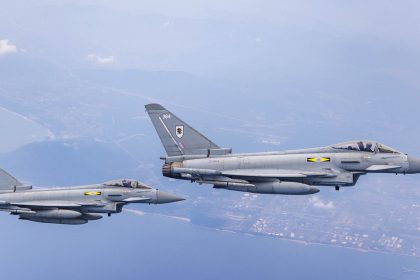
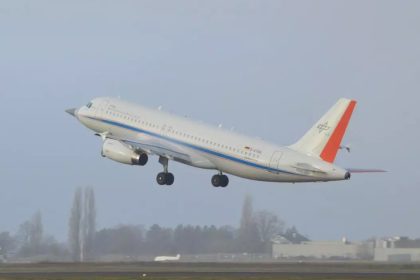
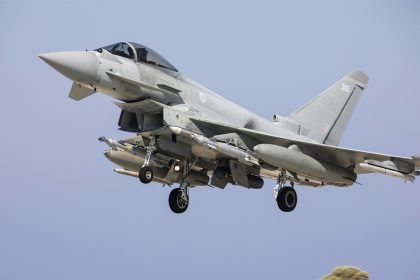
Four Eurofighter Typhoon fighter jets belonging to the UK’s Royal Air Force deployed to Malaysia (where they took part to LIMA – Langkawi International Maritime & Aerospace Exhibition) last week thanks to the support provided by the Italian Air Force Boeing KC-767A, the new aerial refueler on which the future U.S. KC-46 tanker is based.

KC-767A RAF Typhoons

An Italian 767, belonging to the 14° Stormo, deployed from Pratica di Mare airbase to Leuchars and then flew alongside the four British combat planes on their route to Malaysia via Akrotiri (Cyprus), Bahrain and Sri Lanka.

The RAF Typhoon jets of the 1 Sqn took their fuel from the two wing station, plugging their IFR (In Flight Refueling) probes in the baskets of the tanker’s hose and drogue system.

Interestingly, on the first and longest leg of the ferry flight the Italian KC-767A was supported by another aircraft of the same type that refueled it mid-air using the flying boom “piloted” by the “boomer” by means of an adveniristic Remote Vision System.

KC-767 buddy refueling

Image credit: Italian Air Force

Enhanced by Zemanta

All Italian Air Force’s Eurofighter Typhoon units simultaneously deployed to Decimomannu March 20, 2013

Posted by David Cenciotti in : Italian Air Force, Military Aviation , 1 comment so far

Eurofighter Typhoons, belonging to the 4°, 36° and 37° Stormo (Wing), the Italian Air Force units equipped with the European fighter jet recently deployed to Decimomannu to undertake air-to-air combat training.

The Typhoon currently equips the 9° Gruppo (Squadron) and 20° OCU (Operational Conversion Unit) of the 4° Stormo at Grosseto, the 10° and 12° Gruppo of the 36° Stormo at Gioia del Colle and the 18° Gruppo of the 37° Stormo at Trapani.

Deci Typhoons 5

Considered that the 18° Gruppo, from Trapani airbase, was the last squadron to be equipped with the Typhoon, previously flying U.S. F-16s, this is the very first time that F-2000s (that’s the designation used by the Aeronautica Militare) belonging to three different Wings are simultaneously deployed to “Deci” for joint ACMI (Air Combat Maneuvering Installation) drills.

It’s also safe to believe that some Instructor Pilots of the OCU accompanied the front-line fighter pilots in Sardinia, making the deployment the first to feature not only all the Wings but also all ItAF squadrons flying the Typhoon.

Deci Typhoons 2

Noteworthy, one of the aircraft involved in the deployment suffered a landing incident on Mar. 1, 2013.

Deci Typhoons 3

Gian Luca Onnis took the interesting pictures of the Typhoons operating from Decimomannu airbase that you can find in this post, including that of a 18° Gruppo F-2000A with the traditional checkered tail.

Deci Typhoons 6

Image credit: Gian Luca Onnis

Enhanced by Zemanta

“Raptor’s thrust vectoring not essential” Eurofighter pilot says in last chapter of the F-22 vs Typhoon saga February 21, 2013

Posted by David Cenciotti in : Military Aviation , 22comments

A couple of weeks ago, an experienced Eurofighter Typhoon industry test pilot, wrote to The Aviationist to reply to a Lockheed F-35 test pilot who, talking to Flight’s Dave Majumdar had claimed that all three variants of the Joint Strike Fighter will have better kinematic performance than any fourth-generation fighter plane with combat payload, including the Eurofighter Typhoon.

Now the same Typhoon pilot has once again chosen this blog (and I’m honored for this) to explain why thrust vectoring, considered one of the most important F-22 features, is not essential when you are involved in an air-to-air engagement WVR (Within Visual Range).

RAF Typhoons and U.S. Air Force F-22s are currently operating together in the U.S.: the joint mission started with a training exercise called Western Zephyr and will continue next week at the Red Flag 13-3 at Nellis Air Force Base.

Langley Typhoon

As reported in an interesting Defensenews article, the agility of the American 5th generation fighter plane is among the things that impressed British pilots the most.

According to the piece, the commander of the RAF XI Sqn Wing Commander Rich Wells, said:

“Raptor has vector thrust: Typhoon doesn’t,” he said. “What the aircraft can do, it’s incredible. The Typhoon just doesn’t do that.”

Even if it is a matter of fact that the European top class fighter jet lacks thrust vectoring (TV) our source believes that this is not a big deal.

To be honest, the points he raises were already discussed in the article about the outcome of the dogfights between the U.S. Air Force F-22 Raptors and the German Air Force Eurofighter Typhoons during last year’s Red Flag – Alaska, when Americans said the F-22 performance was “overwhelming” while German said the costly stealth fighter was “salad” for the Eurofighter’s pilots lunch.

At that time we said that the F-22 tends to lose too much energy when using TV and unless the Raptor can manage to immediately get in the proper position to score a kill, the energy it loses makes it quite vulnerable.

Anyway, here’s what he wrote to us:

We have all been around long enough to recognize there is not a single sensor able to turn the night into day, nor a unique aerodynamic design feature capable of ensuring by itself air dominance if implemented.

The effectiveness of an air superiority fighter relies on the successful combination of a range of design elements including thrust-to-weight ratio, wing loading, avionics and weapons integration. Furthermore, : appropriate tactics and valuable aircrew training must be developed to exploit the full potential of the weapon system.

Typically, when time comes to decide how to achieve the required “nose pointing capability” for high thrust-to-weight ratio airplanes three solutions are on the table:

- extremely high short term sustained Angle of Attack values (characteristic of twin tailed airplanes);
- High Off-Bore-Sight Weapons, preferably supported by Helmet Cueing;
- Thrust Vectoring.

Thrust Vectoring is one of the design elements that can contribute to create a certain advantage during close air combat by generating impressive pitch and yaw rates, but only in a limited portion of the flight envelope at velocities well below “corner speed”.

However, Thrust Vectoring can also transform in a few seconds an energy fighter in a piece of metal literally falling off the sky, making it an easy prey for those who have been able to conserve their energy.

Moreover, Thrust Vector operation requires the pilot to “create the opportunity” for its usage, spending valuable time in manoeuvring the aircraft to achieve a suitable condition and managing the activation of the Thrust Vector Control.

If you are “defensive” and your aircraft has Thrust Vectoring, you can possibly outturn your enemy, but that most likely won’t prove to be a great idea: an energy fighter like the Typhoon will conveniently “use the vertical” to retain energy and aggressively reposition for a missile or gun shot. Also the subsequent acceleration will be extremely time (and fuel) consuming, giving your opponent the opportunity to tail chase you for ever, exploiting all its short range weapon array.

If you are “neutral”, when typically vertical, rolling and flat scissors would accompany the progressive energy decay, similarly performing machines would remain closely entangled, negating the opportunity for Thrust Vector activation.

If you are “offensive”, probably stuck in a never ending “rate fight”, Thrust Vector could provide the opportunity for a couple of shots in close sequence. Make sure nobody is coming to you from the “support structure”, otherwise that could be also your last move.

Talking of twin tailed aircraft, Angles of Attack in excess of 30-35 degrees are capable of creating drag conditions unsustainable no matter the engine/airframe matching, and developing energy decays intrusive of the tactical flying but also of the flight control system protections. Roll rates would also deteriorate at the higher values of AoA and target tracking ability would quickly decay.

Eurofighter has decided to develop for the Typhoon High Off-Bore-Sight Weapons, supported by Helmet Cueing, to retain energy and target tracking ability while manoeuvring WVR (Within Visual Range) at relatively high but sustainable Angles of Attack. For those who may require some additional AoA, the “Strakes” package is progressing well and soon it will be offered to Typhoon’s Customers. Nevertheless, Strakes is not purely about extreme AoA, but also suitable Roll Rates and manageble energy characteristics. Because in the European way of doing things, an all round balanced solution counts more than a single eye opening performance.

It is a fact that against Eastern produced fighters provided with Thrust Vectoring, throughout the years the Typhoon has showed an embarasing (for them) kill-to-loss ratio.

It is a fact that after some initial encounters between the Raptor and the Typhoon, the situation appears of absolute equity. Too early to say if it is the Helmet Cueing or the Thrust Vector, or how much tactics and training are a player in all this. For sure, we are facing two impressively capable machines.

The typical answer to any critics to the F-22 air dominance is: “since it is stealthy, you should not even consider the possibility of a close encounter with another jet.”

F-22 pilot

Image credit: U.S. Air Force

Even if this can be true, the risk of coming to close range is still high. At a distance of about 50 km the Typhoon IRST (Infra-Red Search and Track) system could be capable to find even a stealthy plane “especially if it is large and hot, like the F-22″ as a Eurofighter pilot once said.

Furthermore, Raptors are not always stealthy as one might believe: for instance, when they carry external store, rejoin with tankers or talk on the radio (secure or unsecure ones) they become more vulnerable to detection.

But this is another story, that we will discuss in the near future…

Enhanced by Zemanta

[Photo Gallery] Typhoons and F-16s at the Winter Hide 2013 exercise February 21, 2013

Posted by David Cenciotti in : Military Aviation , add a comment

The following images were taken at Grosseto airbase, by The Aviationist’s photographers Giovanni Maduli and Alex Fucito.

They show Royal Danish Air Force F-16s, belonging to the Esk 730 from Skrydstrup, and Italian Air Force Eurofighter Typhoons, of the local based 4° Stormo (Wing), training together during the “Winter Hide 2013″ exercise. This is the second time the Danish have brought their jets to Italy to train in the mild Italian climate dogfighting with the Typhoon, one of the world’s most advanced fighter jets.

More information about Winter Hide exercise can be found here.

Enhanced by Zemanta

“No way an F-35 will ever match a Typhoon fighter jet in aerial combat” Eurofighter test pilot says February 11, 2013

Posted by David Cenciotti in : F-35 , 33comments

In an interesting piece by Flight’s Dave Majumdar, Bill Flynn, Lockheed test pilot responsible for flight envelope expansion activities for the F-35 claimed that all three variants of the Joint Strike Fighter will have better kinematic performance than any fourth-generation fighter plane with combat payload, including the Eurofighter Typhoon (that during last year’s Red Flag Alaska achieved several simulated kills against the F-22 Raptor) and the Boeing F/A-18E/F Super Hornet.

“In terms of instantaneous and sustained turn rates and just about every other performance metric, the F-35 variants match or considerably exceed the capabilities of every fourth-generation fighter,” Flyinn said.

According to the Lockheed pilot, (besides its stealthiness) the F-35 features better transonic acceleration and high AOA (angle-of-attack) flight performance than an armed Typhoon or Super Hornet.

RNLAF

Image credit: Lockheed Martin

As Majumdar says in his article, such claims are strongly disputed by other sources. Among them an experienced Eurofighter Typhoon industry test pilot, who tried to debunk all Flynn’s “theories” about the alleged superior F-35 performance.

Here’s what he wrote to The Aviationist:

No doubt the F-35 will be, when available, a very capable aircraft: its stealth design, extended range, internal carriage of stores and a variety of integrated sensors are definitely the ingredients for success in modern air-to-ground operations.

However, when time comes for air dominance, some other ingredients like thrust to weight ratio and wing loading tend to regulate the sky. And in that nothing comes close to a Typhoon, except an F-22 which has very similar values. The F-35 thrust to weight ratio is way lower and its energy-manoeuvrability diagrams match those of the F/A-18, which is an excellent result for a single engine aircraft loaded with several thousand pounds of fuel and significant armament.

But it also means that starting from medium altitude and above, there is no story with a similarly loaded Typhoon.

Dealing with the transonic acceleration:

Transonic acceleration is excellent in the F-35, as it is for the Typhoon and better than in an F/A-18 or F-16, but mainly due to its low drag characteristics than to its powerplant. That means that immediately after the transonic regime, the F-35 would stop accelerating and struggle forever to reach a non operationally suitable Mach 1.6.

The Typhoon will continue to accelerate supersonic with an impressive steady pull, giving more range to its BVR (Beyond Visual Range) armament.

For what concerns AOA:

Angle-of-attack is remarkably high in the F-35, as it is for all the twin tailed aircraft, but of course it can not be exploited in the supersonic regime, where the limiting load factor is achieved at low values of AoA.

Also in the subsonic regime, the angle-of-attack itself doesn’t mean that much, especially if past a modest 12° AoA you are literally going to fall of the sky! Excessive energy bleeding rates would operationally limit the F-35 well before its ultimate AoA is reached.

Eurofighter superb engine-airframe matching, in combination with it’s High Off-Bore-Sight armament supported by Helmet Cueing, has already and consistently proven winning against any angile fighter.

Last, the F-35 is capable of supersonic carriage of bombs in the bomb bay, but the fuel penalty becomes almost unaffordable, while delivery is limited to subsonic speeds by the armament itself as is for the Typhoon.

Concluding (highlight mine):

[...] it is in the facts that while the Typhoon can do most of the F-35 air-to-ground mission, vice versa the F-35 remains way far from a true swing role capability, and not even talking of regulating the skies.

Provided that the F-35 will be able to solve all its problems, and that the raising costs will not lead to a death spiral of order cuts, both the British RAF and the Italian Air Force will be equipped with both the JSF and the Typhoon.

Mock aerial combat training will tell us who’s better in aerial combat.

MM7274_Typhoon

Enhanced by Zemanta


Switch to our mobile site