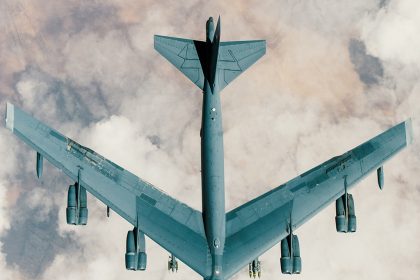
U.S. Air Force says B-1s were not deployed to Guam. So, where did five big bombers go last night? April 6, 2013
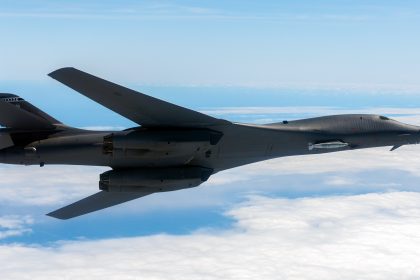
Posted by David Cenciotti in : Military Aviation, North Korea , 26commentsIt looks like the B-1Bs strategic bombers heard last week by milair monitoring expert Steve Douglass did not deploy to Andersen Air Force Base, Guam.
A couple of nights ago, from his monitoring station in Amarillo, Douglass heard a flight of seven Dyess Air Force Base’s 7th Bomb Wing “Bones” asking for weather report for Guam, where they were seemingly going alongside some supporting KC-135s aerial refuelers.
However, the B-1s never landed in the strategic airbase in the Pacific.
Talking to Foreign Policy Killer Apps, U.S. Pacific Air Forces spokeswoman said that the planes are not at Andersen Air Force Base. “The definitely didn’t even stop through,” she added.
Sources at Dyess AFB have confirmed to Douglass that seven planes were launched at night a couple of days ago. Two of them were spares: they returned to the airbase near Abilene, Texas, while the remaining five continued to their final destination.
Unfortunately, the source could not say where the Lancers eventually landed.
Image credit: U.S. Air Force
So, the question is: where did five B-1s deploy to last night?
Even if they did not go to Guam, their flight remain a mystery for at least two reasons:
1) Big bombers (B-1s, B-52s, B-2s) usually deploy in pairs. When more planes have to reach a forward operating base, they usually move individually. Five planes moving together (if not in formation, at the same time) is far from being normal.
2) The route is somehow weird: when they deploy to Europe, Middle East (Thumrait or Al Udeid) or Diego Garcia in the Indian Ocean, B-1s fly eastward, overflying the Atlantic Ocean and then the Mediterranean Sea. The route across the Pacific is unusual.
3) Timing is suspect. The deployment took place few hours after North Korea’s dictator Kim Jong Un said he was going to launch a nuclear attack on Continental U.S.
4) They talked on the radio about Guam (the most important base in the region, to be protected by THAAD anti-ballistic missile defense systems): if they were deploying there to reinforce U.S. presence near North Korea, preparing a preemptive attack that would face little resistance by the obsolete North Korean Air Force, they would keep the information secret by using secure radios.
Maybe. It must not be forgotten that U.S. and NATO planes used to talk in the clear during Libya Air War missions.On the other side, they knew some airband listeners were hearing them and wanted them to spread the news that seven (actually five) bombers were going to Guam.
What’s your opinion. Where were they going (Japan, Thailand, Philippines, ?) and why?
Related articles
U.S. bombers to get an improved stealth weapon. Capable to destroy targets 600 miles away. Useful for Syria, North Korea, Iran or China. August 8, 2012
Posted by David Cenciotti in : Military Aviation, weapons , add a commentThe B-1B “Lancer”, known as “Bone” within the pilot community, is a multi-mission bomber, capable of carrying the largest payload of both guided and unguided weapons in the U.S. Air Force inventory.
It can accommodate up to 24 radar-evading AGM-158 Joint Air-Surface Stanfoff Missile (JASSM) in its bomb bays, twice as many as the B-52. . This GPS-guided cruise missiles with 2,250-lbs warhead, can be fired from more than 200 miles. However, the JASSM is about to be replaced, beginning next year, by a AGM-158B JASSM-ER (extended-range) that can reach a target 600 miles away.
Indeed, later this month, the 337th Test and Evaluation Squadron is scheduled to complete the final-phase of operational testing on the autonomous, air-to-ground, precision-guided standoff missile which shares the same stealthy characteristics of the baseline JASSM, but with an improved range.
The additional reach allows the B-1 (that are being upgraded too) to employ JASSM-ER missiles against fortified, fixed and relocateable high-valuable targets, while remaining well clear of long-range surface-to-air missiles guarding well defended airspace. As those of Syria, Iran, North Korea, China.
The new missile uses its inertial navigation and GPS (global positioning systems) to find its target, and an infrared seeker for pinpoint accuracy right before impact. Noteworthy, the weapon is reported to be extremely jamming resistant and able to operate in “contested and degraded environments”.
[Read also: Upgraded 30,000-lb Massive Ordnance Penetrator bomb ready to destroy deeply buried bunkers in Iran, Syria etc.]
Although the final live flight test will be conducted on Aug. 30 with the B-1 (that is the premier aircraft to employ the new weapon), the JASSM-ER will be capable of employment on the B-2, B-52, F-15 and F-16.
Validation of the Bones capability to successfully perform long range strike missions using the AGM-158 JASSM was tested during Exercise “Chimichanga” in April, that included missions similar to one conducted in Libya in the early stages of Operation Odyssey Dawn.
Image credit: U.S. Air Force
Related Articles
- Upgraded 30,000-lb Massive Ordnance Penetrator bomb ready to destroy deeply buried bunkers in Iran, Syria etc. (theaviationist.com)
- Thanks to the most recent upgrade B-1 bombers will be able to send, receive text messages and be programmed for war. (theaviationist.com)
- Jet-porn: U.S. Air Force B-1 bomber flying low and fast in some of the best “Bone” photos ever taken. (theaviationist.com)
- Photo: Lightning fills the sky behind a B-1 bomber during a late night thunderstorm at Ellsworth Air Force Base (theaviationist.com)
- U.S. Navy replenishes its stock of Tomahawk long-range, conventional attack, cruise missiles. Getting ready for new initial air strikes? (theaviationist.com)
- The story behind this stunning B-1 photo: “RAMA 81 Heavy” across the pond (theaviationist.com)
Photo: Lightning fills the sky behind a B-1 bomber during a late night thunderstorm at Ellsworth Air Force Base August 1, 2012
Posted by David Cenciotti in : Military Aviation , add a commentTaken on Jul. 24 at Ellsworth Air Force Base, South Dakota, by Airman 1st Class Zachary Hada, the following image shows a B-1 bomber on a local apron as a thunderstorm gets closer to the airport.
Image credit: U.S. Air Force
The image was made available to the public as approximately 350 airmen deployed to Southwest Asia to support missions in the U.S. Central Command AOR (Area Of Responsiblity) where the “Bones” will have the “clear focus to eliminate the Taliban and Al-Qaeda threats to ground forces out there,” said Col. Gentry Boswell, 28th Bomb Wing vice commander.
According to the Ellsworth AFB press release, between January 2011 and January 2012, Ellsworth B-1 aircrews from the 37th Bomb Squadron and 34th Bomb Squadron tallied a 99.83 percent mission effectiveness rate, filling more than 3,000 joint tactical air requests while responding to 432 “Troops in Contact” situations and destroying 321 targets.
Along with the above image, such figures should deter Taliban from attacking allied forces in Afghanistan a little bit…
Related Articles
- Jet-porn: U.S. Air Force B-1 bomber flying low and fast in some of the best “Bone” photos ever taken. (theaviationist.com)
Thanks to the most recent upgrade B-1 bombers will be able to send, receive text messages and be programmed for war. June 3, 2012
Posted by David Cenciotti in : Military Aviation , add a commentAccording to a U.S. Air Force release, B-1B strategic bombers are receiving advanced hardware and software upgrades as part of the Sustainment-Block 16 program.
Along with the Vertical Situation Display Upgrade, navigation, radar and diagnostic upgrades in the front station, five new color displays will equip the aft crew station, while weapon systems officers will receive full QWERTY keyboards and new controllers for the Integrated Battle Station software.
Within the upgrades foreseen in the Block 16, believed to give the U.S. Air Force “an entirely new aircraft”, there is also a new MIDS LVT-1 radio, that brings the B-1 into the Link-16 network, allowing the plane to send and receive text messages, imagery and mission assignments, allowing combat commanders the capability to send target sets directly to weapons onboard the B-1.
In this way, command and control assets will send the plane targets electronically, automatically linking into the aircraft system like some mobile phones do with V-cards (electronic business cards) received by means of SMS (Short Message Service), rather than manually entering the coordinates.
Quite soon three 337th Test and Evaluation Squadron aircraft will be modified with the new upgrades. Under the current plan, developmental testing for the entire Block 16 package is expected to begin in March 2013 while operational testing will take place in September 2013.
A recent upgrade package (worth 2 billion USD) brought a brand new email system on board the B-2 Spirit stealth bomber.
Image credit: U.S. Air Force
Related Articles
- Jet-porn: U.S. Air Force B-1 bomber flying low and fast in some of the best “Bone” photos ever taken. (theaviationist.com)
- B-2 stealth bomber to get 2 billion dollar upgrades. Including a new email system. (theaviationist.com)
- B-1s and F-22s involved in a long range strike exercise. Getting ready for North Korea or Iran? (theaviationist.com)
- Pentagon flexing muscles at Pyongyang: B-52 bombers take part in largest U.S. exercise in Korea for the first time (theaviationist.com)
Jet-porn: U.S. Air Force B-1 bomber flying low and fast in some of the best "Bone" photos ever taken. May 31, 2012
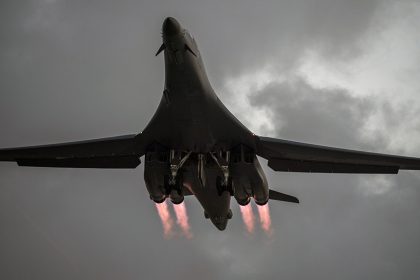
Posted by David Cenciotti in : Military Aviation , 3commentsThe following pictures were taken by Larry Titchenal, on Friday Apr. 27, 2012 during the practice day of the Fort Lauderdale Airshow, in Florida.
Two four-engine variable-sweep wing strategic bombers belonging to the 28th Bomb Wing, based at Ellsworth Air Force Base, South Dakota, made passes around 30 seconds apart.
The first made a high-speed pass whereas the second made a slow pass.
Due to the high speed, the fast pass generated some condensation clouds around the Lancer’s surfaces, engines, and Sniper Advanced Targeting pod. Such clouds are not visual effects of the so called “sonic boom”: when an aircraft flies at transonic speeds (around Mach 1.0), any of its convess parts (canopy, intakes, pod etc.) causes a rapid decrease of temperature and pressure with subsequent creation of the cloud.
The variation in temperature caused by the perturbation of the airflows is called Prandtl-Glauert Singularity.
Image credit: Larry Titchenal
On Mar. 27, 2011, two B-1Bs of the 28th BW took off from Ellsworth AFB on a Global Strike mission to strike Libyan military sites and air defense systems. That mission marked the first time the B-1 fleet has launched combat sorties from the continental United States to strike targets overseas.
More recently, the 28th BW’s “Bones” (from B-One) have been involved in long-range exercise “Chimichanga” alongside F-22 Raptors.
Related Articles
- B-1s and F-22s involved in a long range strike exercise. Getting ready for North Korea or Iran? (theaviationist.com)
- Pentagon flexing muscles at Pyongyang: B-52 bombers take part in largest U.S. exercise in Korea for the first time (theaviationist.com)
- Photo: The most famous U.S. nuclear bomber generates (peace sign) rainbow condensation cloud (theaviationist.com)
- Video: B-2 stealth bomber ground operations at Nellis’s Red Flag (theaviationist.com)
- Low level flying in the age of stealth bombers and standoff weapons: welcome to the famous “Mach Loop” (theaviationist.com)