Tag Archives: Bombardier Global Express

U.S. airborne communication plane could be tracked on the Web for 9 hours during air strike that killed Taliban leaders in Afghanistan

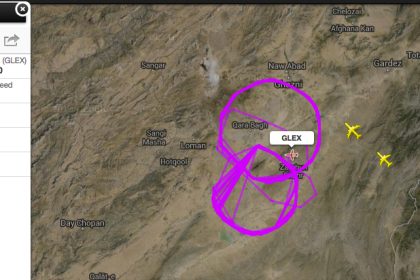
At least seven Taliban militants were killed following a NATO air raid Afghanistan. Noteworthy, a sign of the developing operation may have been a U.S. Air Force E-11A BACN plane orbiting over southeasern Ghazni province, clearly visible on Flightradar24.com.

Although many military aircraft are equipped with Automatic Dependent Surveillance-Broadcast (ADS-B) transponders they are usually turned off during real war operations. In fact, by automatically broadcasting the plane’s callsign, GPS position, speed and altitude, these special transponders provide information about the plane can be received by ground stations, by other nearby aircraft (thus enhancing situational awareness) and also by commercial off-the-shelf or home-built receivers.

Flightradar24 and PlaneFinder have a network of several hundred feeders around the world who make the flight information received by their home kits available for anybody on their websites, or by means of their smartphone apps.

Even though some pilots have confirmed they are well aware of the above mentioned websites and for this reason are instructed to turn off their transponders when involved in real operation, during the opening stages of the Libya Air War, some of the aircraft involved in the air campaign forgot/failed to switch off their mode-S or ADS-B transponder, and were clearly trackable on FR.24 or PF.net.

Three years later, a U.S. plane involved in war mission over Afghanistan could be monitored for several hours as it circled at 41,000 feet to the southeast of Ghazni.

The aircraft did not broadcast its mission callsign, but based on the hex code FR24 could identify it as a Bombardier Global 6000 aircraft, an advanced ultra long-range business jet that has been modified by the U.S. Air Force to accomodate Battlefield Airborne Communications Node (BACN) payload.

Within the U.S. Air Force, the modified jet is designated E-11A.

BACN is technological “gateway” system that allows aircraft with incompatible radio systems and datalinks to exchange tactical information and communicate.

By orbiting at high-altitude, BACN equipped air assets provide a communications link from ground commanders to their allies in the sky regardless of the type of the supporting aircraft and in a non-line-of-sight (LOS) environment. In the rugged, mountainous terrain of Afghanistan, troops are not always able to establish LOS communications with close support aircraft overhead and moving position or relocating to higher ground could be fatal. In such situation, a legacy USAF A-10 attack aircraft could loiter away from the battlefield while using the BACN link to communicate with a special-forces Joint Terminal Air Controller (JTAC) on the ground until all targeting information is ready before “un-masking” and beginning an attack run.

The BACN system is also deployed onboard EQ-4B Global Hawk UAVs.

Anyway, the E-11A could be tracked on FR24.com for about 9 hours, from 21.54 UTC on Aug. 10 to 06.45 UTC on Aug. 11, when the aircraft got out of the flightradar24 coverage while returning back to Kandahar airfield (?). At the same time a NATO air strike in the same zone killed seven Taliban and wounded four.

Next time NATO is preparing a similar operation, the presence of the orbiting E-11A could expose and jeopardize the imminent air strike.

H/T to Jerod Harris for the heads-up.

Image credit: screenshot form flightradar24.com


“New” 41-year old WB-57 Canberra joins NASA fleet of high altitude special operations aircraft

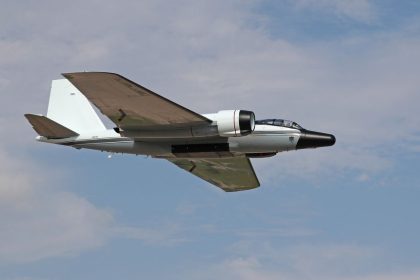
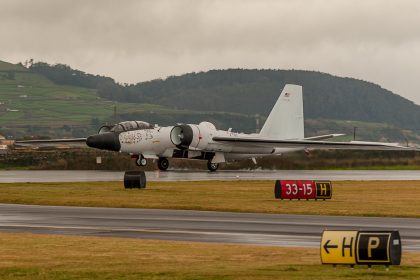
On Sept. 12, NASA’s latest WB-57F, a 41-year old plane with registration N927NA arrived to Ellington Field, Texas, were it joined the other two flying WB-57Fs, NASA 926 and 928.

The aircraft arrived at its final destination after leaving the paint shop in Pinal Airpark Airport Marana, Arizona.

Based at Ellington Field, Texas, but often deployed to different bases, both within CONUS and abroad and, NASA’s Canberras conduct “special operations” alongside scientific research projects (on hurricanes, radiation impact on clouds, and so on).

In Afghanistan these unique aircraft have been used to test Northrop Grumman’s Battlefield Airborne Communications Node (BACN) a technological “gateway” system that allows aircraft with incompatible radio systems and datalinks to transfer information and communicate.

Even if the new aircraft has not been allocated to the BACN program yet, it is quite likely it will soon support its twin Canberras in high altitude relay missions above the U.S. troops in Afghanistan.

Image credit: Christopher A. Ebdon

Enhanced by Zemanta

Networking From on High: Behind the Scenes of NASA’s Spooky WB-57 Jet

At the beginning of December 2012, The Aviationist profiled the return of a NASA B-57 Canberra aircraft from operations in Afghanistan.  In addition to supporting academic and high-altitude meteorological research, these unique aircraft have been used to test Northrop Grumman’s Battlefield Airborne Communications Node (BACN) system and deploy the hardware overseas.

BACN is technological “gateway” system that allows aircraft with incompatible radio systems and datalinks to transfer information and communicate.

The U.S. military uses various datalink systems to exchange tactical information, and many are not capable of working together.  For example, a U.S. Air Force F-15 can use its Link-16 system to exchange target information with a U.S. Navy F/A-18.  However, the F/A-18 could not exchange information with a USAF B-52 or B-1 bomber.  The advanced F-22 can exchange information with other Raptors, but because of security concerns, cannot exchange information on legacy datalinks such as Link-16.

This lack of compatibility is a major obstacle in a theater such as Afghanistan where air assets from many services are called upon to provide support for ground troops of different nations.  Additionally, the complicated joint operations required to engage a modern integrated air defense system are greatly simplified by exchanging target information via datalinks.

The BACN system is also used to link ground troops and Forward Air Controllers (FACs)/Joint Terminal Attack Controllers in a non-line-of-sight (LOS) environment.  In the rugged, mountainous terrain of Afghanistan, troops are not always able to establish LOS communications with close support aircraft overhead.  Moving position or relocating to higher ground could be fatal in a combat situation.

By orbiting at high-altitude, BACN equipped air assets can provide a communications link from ground commanders to their allies in the sky.  For example, a legacy USAF A-10 attack aircraft could loiter away from a battle area while using the BACN link to communicate with a special-forces FAC on the ground.  The A-10 pilot could wait until all targeting information is ready before “un-masking” and beginning an attack run.

The BACN system is also deployed onboard USAF E-11A aircraft and EQ-4B Global Hawk UAV’s.

The E-11A is a derivative of the Bombardier Global Express business jet.  Four of these aircraft were procured by the USAF in 2011 and are operating in Southwest Asia and the Middle East.

The high altitude and endurance capabilities of these three platforms makes them well suited to the persistence battlefield communications support mission.

Michael Glynn for theAviationist.com

Image credit: U.S. Air Force

Enhanced by Zemanta