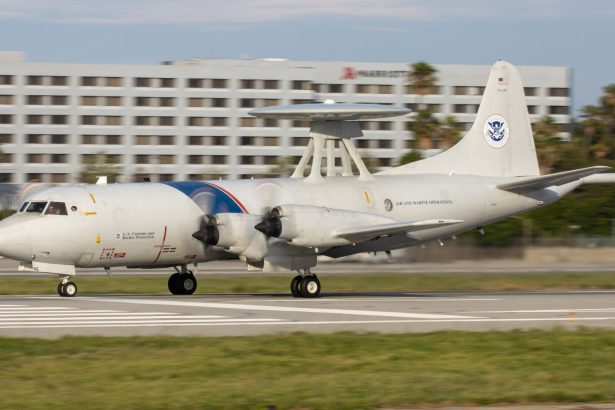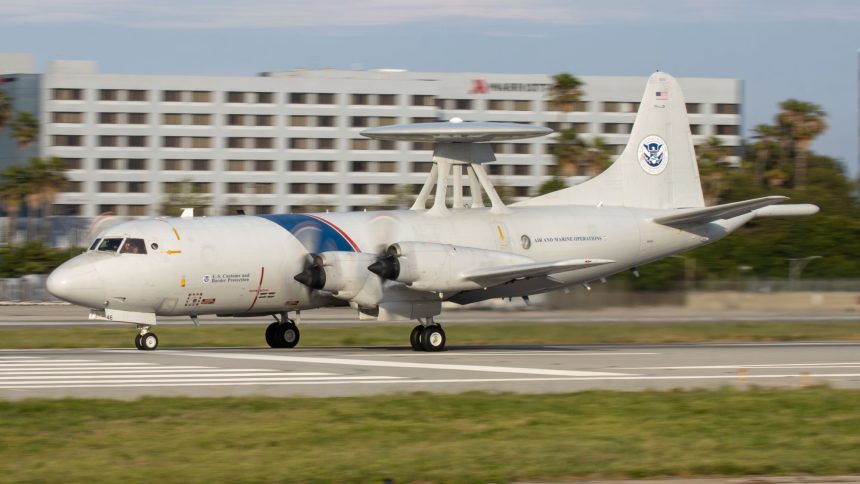
The Customs and Border Protection describes the P-3 AEW as the world’s only law enforcement airborne radar aircraft, supporting the anti-smuggling and border protection mission.
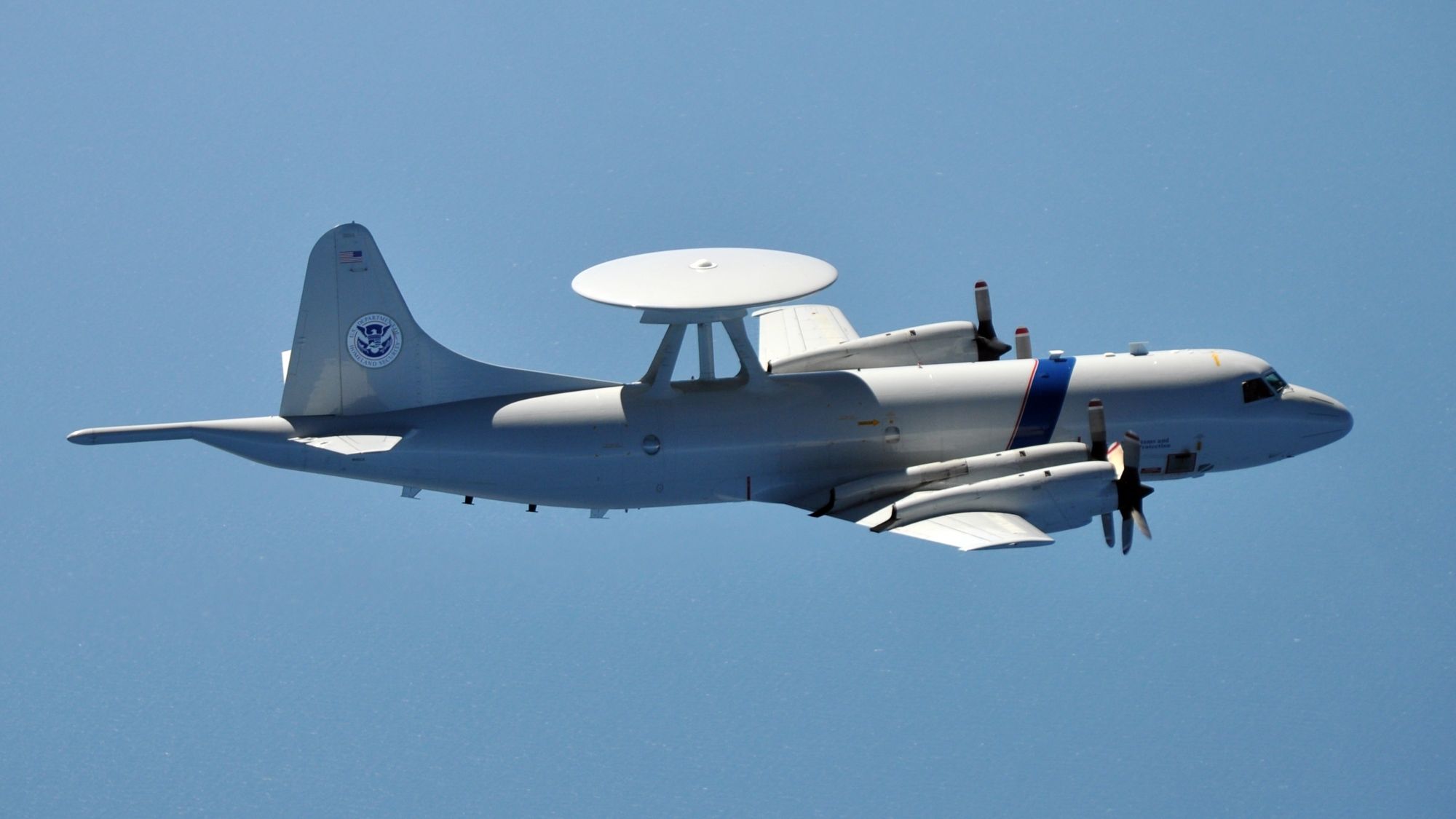
A rarely seen U.S. Customs and Border Protection P-3 Airborne Early Warning & Control (AEW&C) aircraft, used for tracking small boats smuggling narcotics in Pacific and Caribbean waters around Central America, was spotted at California’s Long Beach Airport. The P-3 AEW, as the CBP designates it, is the world’s only airborne radar used for law-enforcement.
Aviation photo journalist Matthew Dawson, a contributor at SkyBlazer Magazine who shared a video of the aircraft taxiing and taking off on his Instagram profile on Apr. 9, 2026, said the aircraft was seen “late in March.” Based on its recent flight history, this date can be concluded to be Mar. 29.
View this post on Instagram
“For unknown reasons in late March this Lockheed P-3B AEW&C flew out of Long Beach Airport for a few days conducting flights over the southern Pacific Ocean! It was really neat to see this bird operating out of the Long Beach airport. Callsign ‘Troy 609’,” said Dawson.
The ‘Troy’ callsign has been commonly associated with this aircraft type, based on flight history in recent years. The aircraft is used in coordination with another CBP P-3-based aircraft, the P-3 Long-Range Tracker (LRT), for the maritime counter-narcotics role.
Dawson also shared with The Aviationist some more images of the elusive P-3 AEW aircraft, whose existence along with the P-3 LRT is public knowledge, but has seldom figured outside the CBP’s counter-narcotics press releases.
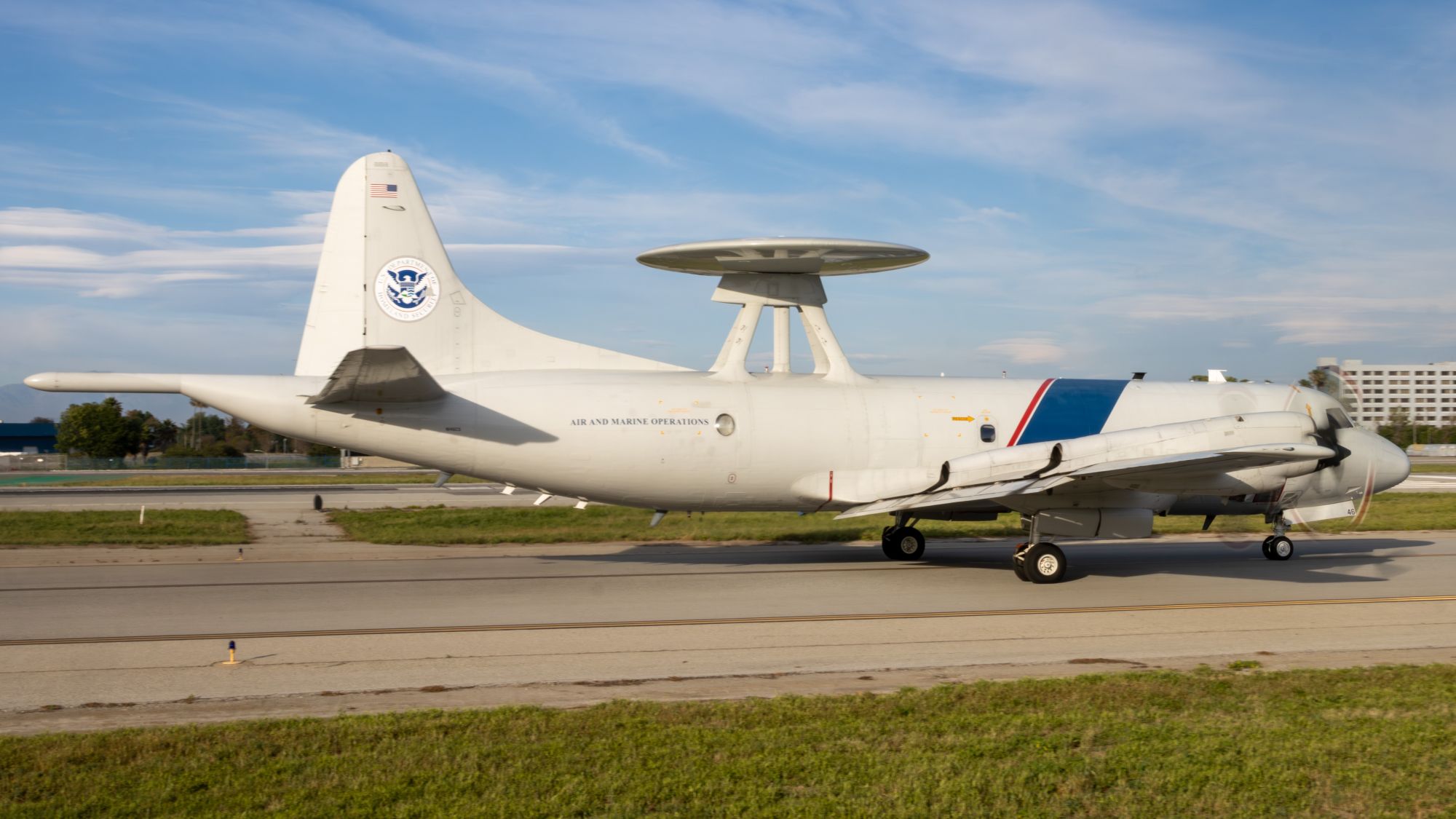
Customs and Border Protection’s P-3 AEW
Both the P-3 AEW and the P-3 LRT are used for “long-range aerial patrols and surveillance missions” in support of the counter-narcotics efforts of the DHS. They fall within the CBP’s Air and Marine Operations, as written on the rear fuselage of the aircraft. The parent Department of Homeland Security (DHS) and the U.S. Customs and Border Protection (CBP) flashes are emblazoned on the vertical stabilizer and the front fuselage, respectively.
The Lockheed Martin P-3C in general has been a popular type for the maritime patrol and surveillance roles in many countries, including the U.S., Germany and Japan. The airframe has also seen other special mission adaptations like the now-retired U.S. Navy’s Signals Intelligence (SIGINT) and ISR EP-3E Aries II aircraft.
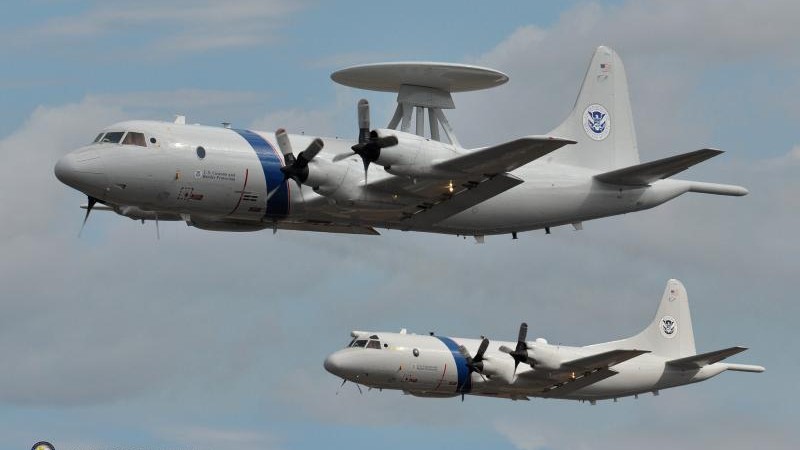
As mentioned in the opening, the CBP’s P-3 AEW is the only law enforcement dedicated airborne radar aircraft in the world, and is flown by the CBP’s Air and Marine Operations (AMO) division.
The aircraft in the photos bears the registration N146CS, and we also know about the existence of at least another airframe, N144CS. Data from FlightAware of N146CS’s track on Mar. 29 shows the aircraft flew a nearly two-hour route off the California coast, taking off from San Clemente island at 7:11 pm (local time), and landed at Long Beach airport, California at 10:13 pm.
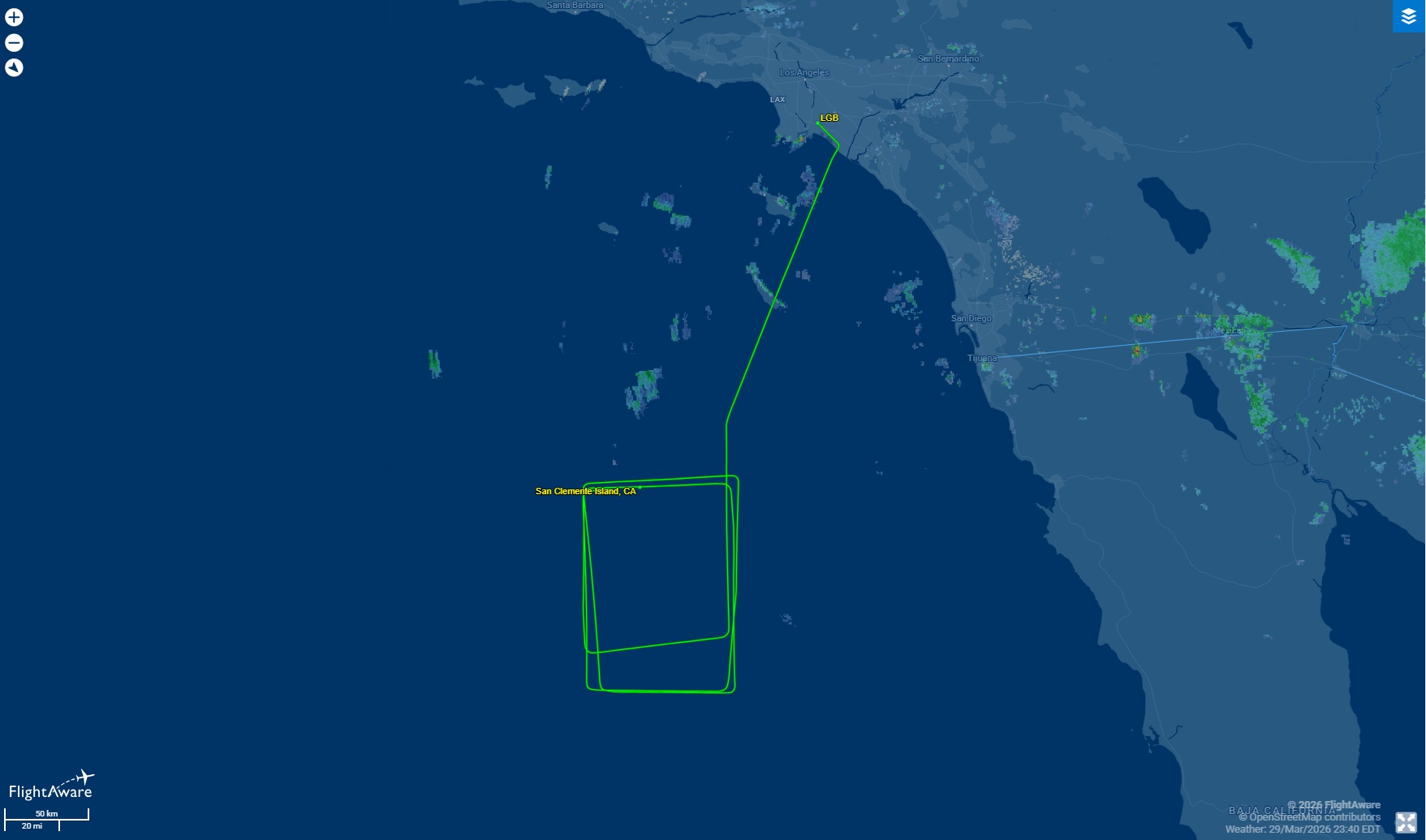
Flying with its ADS-B transponder turned on throughout its patrol, the aircraft flew a circuitous pattern around San Clemente, maintained an altitude of 14,500 feet, and stayed at speeds from 268 to 370 miles/hour.
The two HC-130Js are descending towards Curaçao (🇨🇼). A U.S. Customs and Border Protection P-3B AEW and an AFSOC C-146 Wolfhound are also heading to the region, but the latter two flights are quite regular.
??? // 12-3060 // #AE68B9
TROY072 // N142CS // #A0AA61 pic.twitter.com/dsRJqxDepb
— Bizjets of War (@bizjetsofwar) May 30, 2023
Previous flight tracks have shown both aircraft variants – the P-3 AEW and the P-3 LRT – in the Caribbean Sea, where N142CS was seen in its western part with the call sign TROY072. A P-3 LRT had flown on Apr. 10 just off the northwestern waters of Venezuela, near the islands of Aruba and Curacao.
🇺🇲 Customs and Border Protection P-3B Orion N423SK descendiendo en Curaçao procedente de Jacksonville. pic.twitter.com/YfJ4FmKKzv
— 𝘼𝙧𝙧𝙚𝙘𝙝𝙤 (@Arr3ch0) April 9, 2026
CBP’s P-3 AEW detection and monitoring aircraft
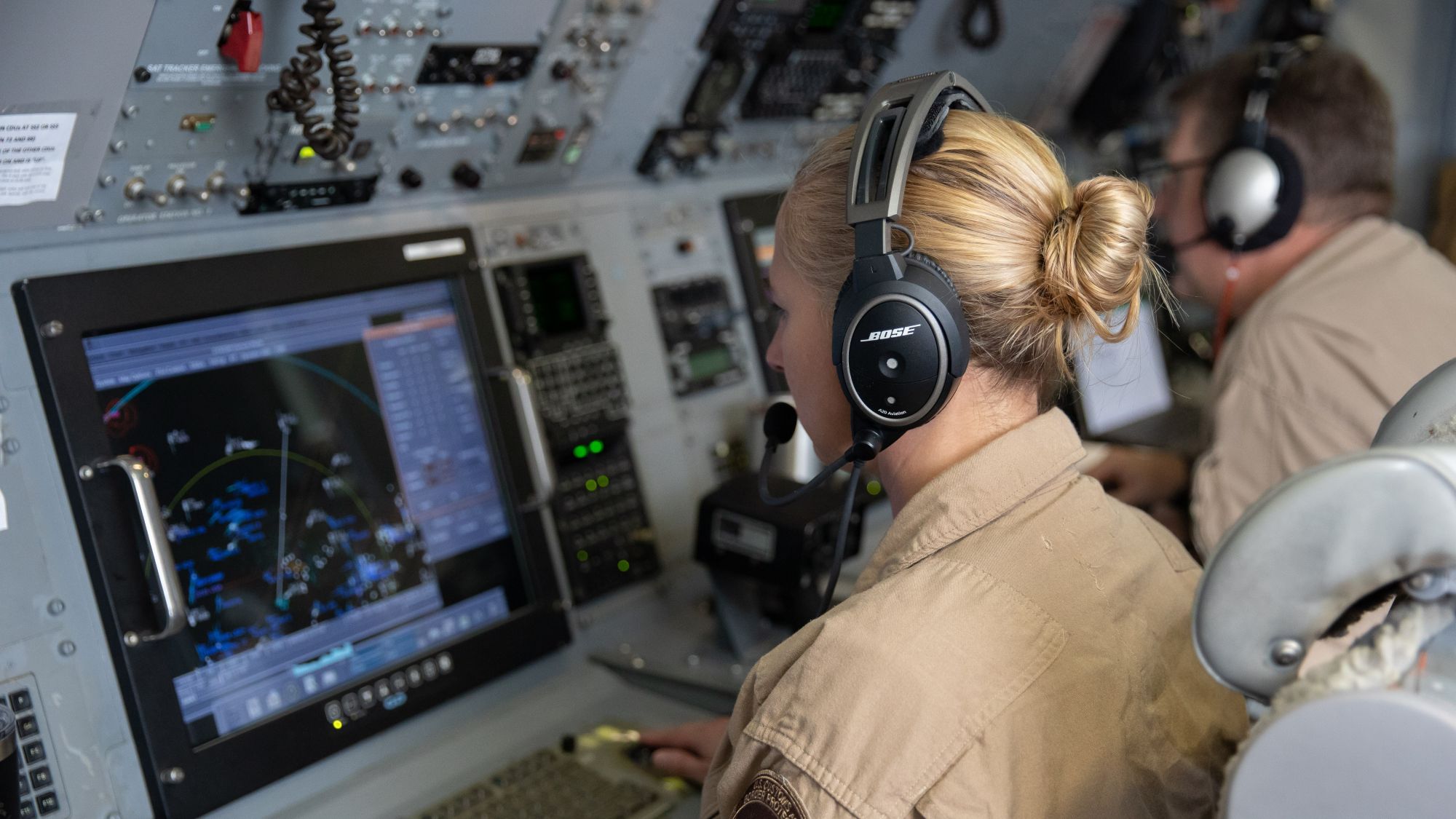
A 2009 archived page from the CBP website says the P-3 AEW uses the AN/APS-145 radar, the same system found on the U.S. Navy’s carrier-borne E-2C Hawkeye. The radar is capable of tracking targets in the air as well as on the sea. Developer Lockheed Martin says that the APS-145 is a doppler radar that operates in the Ultra-High Frequency (UHF) range, can track 2,000 targets, and is resistant to jamming with a Electronic Counter-Counter Measures (ECCM) suite.
The CBP calls the P-3 AEW a “Detection and Monitoring (D&M)” aircraft and, as the “only law enforcement AEW aircraft in the world,” defines it as vital in the agency’s anti-smuggling and border protection mission. “Air and Marine’s P-3s are high-endurance, all-weather, tactical turbo-prop aircraft, which are utilized primarily for long-range patrols along the entire U.S. border, and in source and transit zone countries, throughout Central and South America,” the CBP website said.
The aircraft is operated by a crew of eight, comprising the pilot, copilot, flight engineer, and radar/sensor operators. They are “routinely sent on temporary duty to support the United States and foreign government initiatives to stem smuggling into the United States,” the 2009 page said.
P-3 AEW & P-3 LRT coordinated patrols
More information about the P-3 AEW and the CBP’s drug-busting efforts can be found in a September 2021 feature by the agency. The aircraft is used in missions requiring long overheard station time, hemispheric range, inclement weather and environmental conditions, says the agency and is considered “integral in AMO’s strategy to secure U.S. borders and enforce U.S. laws.”
Both aircraft can fly for 12 hours, with the P-3 AEW having a range of 3,000 nautical miles and a maximum altitude of 26,000 feet, while the corresponding figures for the P-3 LRT stand at 4,000 NM and 28,000 feet.
“Coupled with the P-3 AEW’s ability to detect and track multiple targets, the P-3 LRT can intercept, identify, and track those targets,” explains the CBP. The P-3 LRT has a specialized payload which includes an APG-66 radar, the same installed on early variants of the F-16 Fighting Falcon, and a SeaVue maritime search radar.
There are 14 P-3 LRTs operated by CBP, based at Jacksonville, Florida, and Corpus Christi, Texas. Operating in concert with the P-3 AEW, the two track illegal narcotics in what the CBP calls “in-source and transit zones” in the maritime regions of Central and South America – the Pacific Ocean, Gulf of Mexico and the Caribbean Sea.
Thank you to Matthew Dawson for sharing the images with us, you can find more of his work on Instagram @mattdawson.photography.