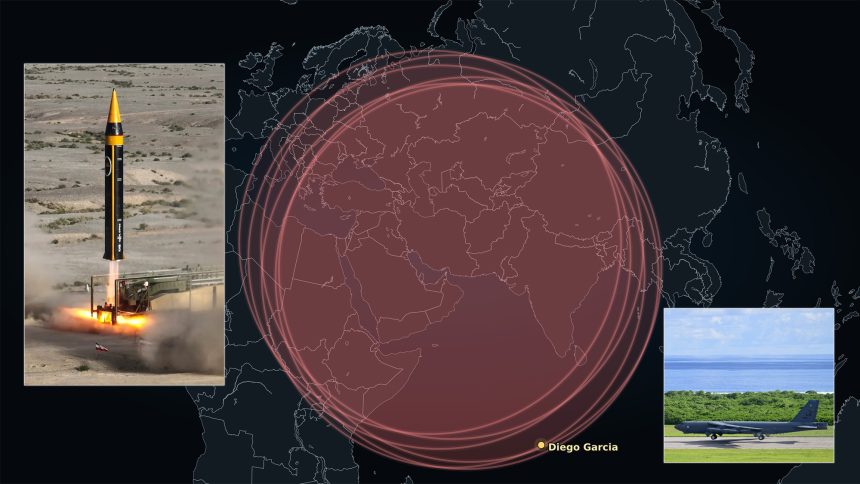
The attempted strike on Diego Garcia would mark a major escalation, highlighting Tehran’s apparent ability to target the strategic U.S.-UK base deep in the Indian Ocean and potentially put parts of Europe within reach.
Iran has launched two missiles at the joint UK-U.S. base at Diego Garcia in the Indian Ocean, about 4,000 km away. Such a distance is well within the range separating Tehran from many European capitals. According to U.S. officials who talked to the Wall Street Journal, one ballistic missile reportedly failed because of a malfunction and did not reach the base, whilst the other was engaged by a U.S. destroyer utilizing an SM-3 interceptor.
Neither of the missiles hit the base, still, regardless of the outcome of the attack, the attempted strike with the IRBM, marks a potential turning point in the conflict. The choice of target, is a telling signal. The United Kingdom has just decided to grant the United States the use of its bases for the strikes, and British assets, as Iranian Foreign Minister Abbas Araghchi announced, have therefore become legitimate targets.
Until now, it had been believed that the intermediate-range missiles available to Tehran were capable of striking targets at a distance of up to 2,000 km. The decision to launch against the Diego Garcia base points to significantly greater capabilities in the weapons still available to the Islamic Republic.
The IRBMs, probably Khorramshahr-4s or another IRBM type, make not only Diego Garcia and other bases in the Middle East, but also many European capitals, potential targets within Tehran’s theoretical reach.
The Khorramshahr-4 is likely the intermediate-range ballistic missile that Iran used in the attempted attack on Diego Garcia, which analysts had previously assessed may have a range of +4,000km, though it had only been proven at between 2,000-3,000km. Such an attack would suggest… https://t.co/bLj7XzvKlz pic.twitter.com/fGMPtDs2Ih
— OSINTdefender (@sentdefender) March 21, 2026
U.S. and Israeli raids have significantly reduced Iran’s missile-launching capabilities. According to figures cited in recent days by U.S. President Donald Trump, Tehran has retained only 8% of its original capability. It is estimated that, before the conflict began, Tehran had at least 1,000 to 1,500 missiles. Among them, the Soumar has a range that is, in any case, below 3,000 km. Sejjil missiles can strike targets at a distance of 2,000 km. Shahed drones can also be used in medium- to long-range raids, considering that they can operate up to 1,700 km from their launch point. Still, despite being degraded, Iran continues to retain the ability to launch kamikaze drones and missiles, most likely relying on mobile launchers that are more difficult for U.S. and Israeli forces to detect and target, especially in dispersed areas in the eastern part of the country.
Although U.S. Chairman of the Joint Chiefs of Staff Gen. Dan Caine said during a briefing on Mar. 4, 2026, that ongoing operations against Iran were shifting from stand-off to stand-in strikes, using precision-guided bombs and shorter-range missiles, the continued use of AGM-158 JASSMs (Joint Air-to-Surface Standoff Missiles) observed on the external pylons of the B-52s departing RAF Fairford, U.K., on Mar. 20, 2026, suggests there is still a fairly significant requirement for stand-off munitions. Secretary of Defense Pete Hegseth claimed on Mar. 13 that only 1% of the munitions being used were stand-off weapons, while also stating that “Iran has no air defenses.”
Diego Garcia
Though officially a British territory and British base, Diego Garcia is predominantly used by U.S. forces. Alongside communications and intelligence gathering facilities, both of which were major justifications for establishing this permanent military outpost in the Indian Ocean, Diego Garcia’s airfield is one of only three locations outside of the continental U.S. equipped with dedicated hangar facilities for the B-2 Spirit, and it can accommodate a vast number of strategic bombers, air to air refuelers, and intelligence gathering aircraft. In 2025, the base saw its first known fighter deployment of F-15E Strike Eagles.
The base has been at the center of dispute earlier this year, over a Diego Garcia Military Base and British Indian Ocean Territory Bill, which intended to formalise and, in essence, ratify the deal signed between the UK and Mauritius in May 2025 that would see sovereignty of the British Indian Ocean Territory (BIOT) ceded to Mauritius in return for a 99-year guaranteed lease of Diego Garcia for continued military use. Upon its expiration, this 99-year lease could be extended for up to 40 years.
Critics claimed that ceding sovereignty places the base at risk of foreign espionage and interference. Just as it was set to head into the final stages of debate, the bill was paused after an amendment by the UK opposition party called into question whether the bill’s effects are in breach of a still-in-effect 1966 agreement between the United States and the United Kingdom regarding military use of Diego Garcia. The first clause of this agreement states that “The Territory shall remain under United Kingdom sovereignty”.