The J-16D has made possibly its first appearance in flight with PL-15 missiles, after being previously shown with air-to-air weapons only in static displays at airshows.
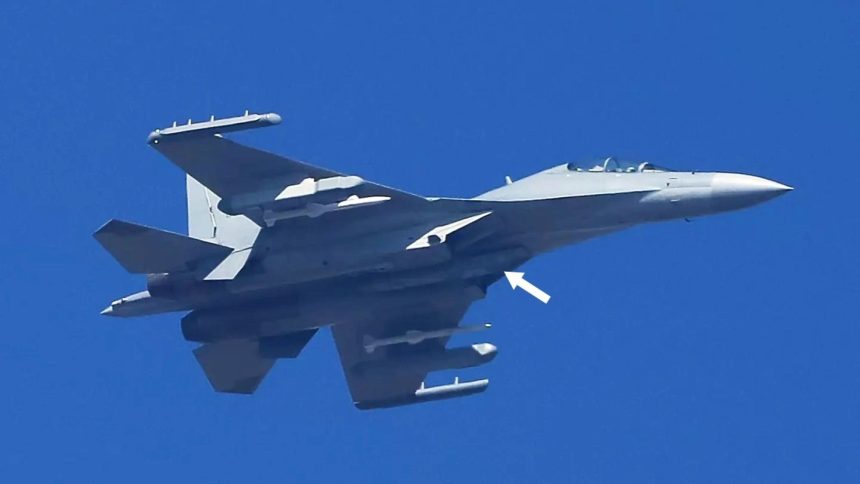
The People’s Liberation Army Air Force’s (PLAAF) J-16D electronic warfare (EW) aircraft was spotted flying with two PL-15 air-to-air missiles (AAM) for possibly the first time in unofficial images that appeared on Mar. 17, 2026. The J-16D is the specialized variant of the J-16, the heavily modified Chinese derivative of the Russian Su-27, which is notably missing the Infrared Search and Track (IRST) and the internally mounted 30 mm gun and includes wingtip pods for EW equipment.
Leading Chinese military aviation analyst Andreas Rupprecht said this is believed to be the first image “of a J-16D carrying two PL-15 AAMs under its wings and three RKZ930-xx jammer-pods.” A third pod is carried on the centerline between the two engines, as denoted by the arrow in the cover image.
It must be noted however that the aircraft could have been flying with the AAM for a while, and possibly even conducted test fires of the weapon. In fact, the PL-15 is already integrated on the standard J-16 variant and, although there was no indication regarding the specialized EW variant, it is likely the capability was retained.
AS far as I remember the first image of a J-16D carrying two PL-15 AAMs under its wings and three RKZ930-xx jammer-pods.
Would be interesting to know, if the J-16D has also a new ARMs available – maybe even the PL-15-based LD-8A.
(Via @太湖军I名) pic.twitter.com/AWX3DbwevL
— @Rupprecht_A (@RupprechtDeino) March 16, 2026
Moreover, the PL-15 looks nearly identical to the anti-radar LD-8A missile, which has been derived from the AAM, and Rupprecht also wondered if the J-16D has carried that missile in the past. The aircraft has also been spotted with six different types of jamming pods over the last two years, in varying combinations and placements – two pods on the wingtips, two under the wings and two under the engines.
Rare view of a J-16D EW aircraft carrying two PL-15 BVRAAMs and three RKZ930 ECM pods including one under the centerline station. We are still waiting for new ARMs like LD-8a to be unveiled pic.twitter.com/gsi8wVfium
— Dan The Man (@tong96083420) March 16, 2026
J-16’s pods and missiles
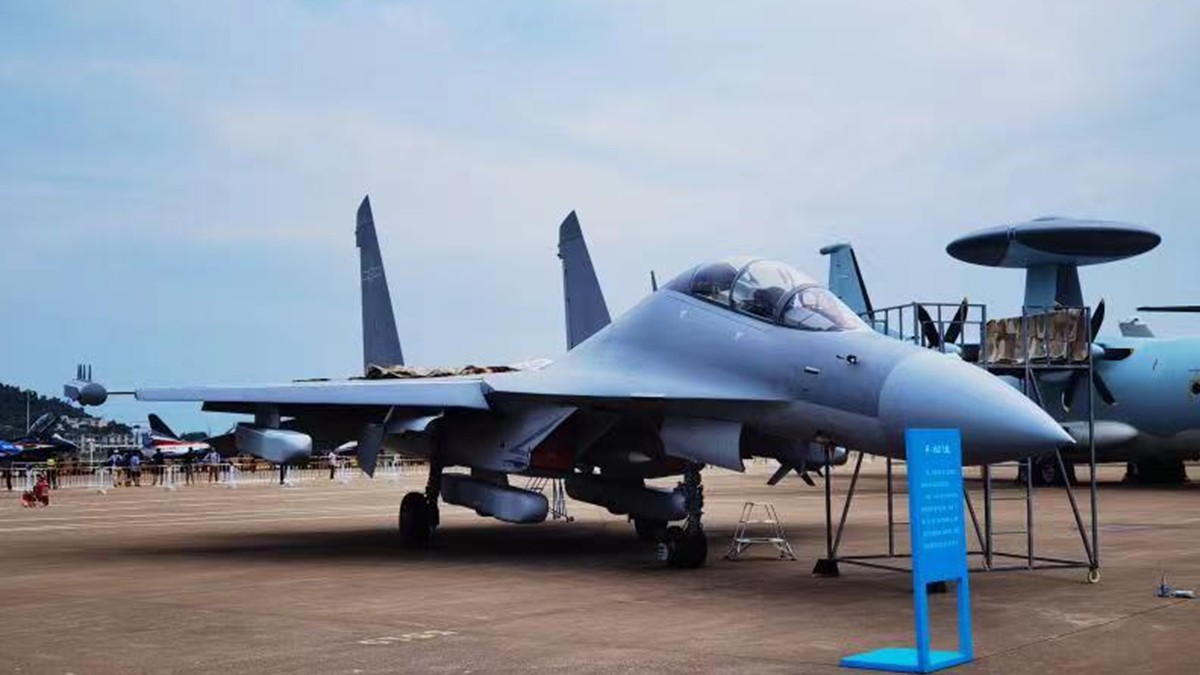
The J-16D was first officially unveiled in the 2021 edition of the Zhuhai Air Show, and since then it has been photographed with multiple types of underwing pods. These belong to the RKZ930 series, which are pods specialized for EW.
In a July 2025 post, ‘Hurin’ shared an image of a J-16D flying overhead with two RKZ930-10s on the middle hardpoints. He also shared an earlier image of the pod, which has tandem pairs of antenna fins on the underside.
J-16D spotted with two RKZ930-10 EW Pod for the first time, has a distinct shape with tandem pairs of belly fin antennas, rear one is bigger with an air inlet and side pairs of air outlets (Immense heat dissipation ig)
Seen at zhuhai before
src @ inSky_1865 /weibo https://t.co/hm7sA5QYAW pic.twitter.com/RRGgQAAp52
— Hûrin (@Hurin92) July 4, 2025
Another image also shows the RKZ930-10 finned pod carried on the port-side wing, along with the older pods under the engines and the starboard wing.
J-16D EW pic.twitter.com/jHhJY3MiwW
— Enis Şenol (@senolenis) February 1, 2026
The same pod with the fins was also seen previously on the J-16D during the 2021 edition of the Zhuhai Air Show, installed under the left wing. This and images of other static displays of J-16Ds have also shown the RKZ930-10 pod with the fins on the left wing, and two PL-15 missiles on the centerline hardpoint between the engines.
However, as we mentioned earlier, so far these appear to be the only publicly documented appearances of the weapon on this specific aircraft. This would thus make the new image possibly the first time the PL-15 was spotted on an airborne J-16.
Moreover, the existence of the highly similar LD-8A anti-radar missile was not yet known in 2021, reducing the possibility of the PL-15 being misidentified on that occasion. In fact, the weapon was first unveiled three years later, at the Zhuhai Airshow 2024.
The images below show the PLAAF land based J-16D Electronic Warfare jet fighter, a variant of the J-16, an advanced fourth-generation, tandem-seat, twinjet, multirole strike fighter. The PLAN carrier based J-15D Electronic Warfare jet fighter has a similar size. They are huge. pic.twitter.com/2bFiabNZz3
— Fay (@FaySue6) April 5, 2024
The LD-8A anti-radiation missile is considered based on the PL-15 beyond visual range air-to-air missile. The latter is reported to have an Active Electronically Scanned Array (AESA) radar seeker and a range of over 200 km.
It is believed the LD-8A exploits the existing long-range design of the PL-15 with a specialized anti-radar seeker, allowing for a quickly deployable SEAD/DEAD weapon. It is likely more advanced variants, comparable to the AGM-88E AARGM, could be in development and might emerge soon.
China’s other EW aircraft
China has two more known specialized EW aircraft. One is the PLA Air Force’s four-engine turboprop Y-9LG EW aircraft, which was first officially captured in clear view in the service’s Falcon Strike exercise with Thailand in 2024. Based on the Shaanxi Y-8/Y-9 aircraft, the Y-9LG has a large ‘balance beam’-type array mounted on the spine, like the KJ-200 Airborne Early Warning and Control (AEW&C) aircraft.
We finally have a clear image of an operational PLAAF Y-9LG (Y-8GX-18) ECM/ELINT type and according to its serial number 30211, it is assigned to the 20th Specialised Division, 58th Air Regiment based at Guiyang-Leizhuang (STC).
(Image by KOREENOR via Planespotter) pic.twitter.com/OF6rZ37Sla
— @Rupprecht_A (@RupprechtDeino) August 29, 2024
The other one belongs to the PLA Navy, which exists in two sub-variants. One is the Short Take-Off Barrier Arrested (STOBAR)-configured J-15D, meant to fly off the Liaoning and the Shandong carriers’ ski jumps. The other is the Electro-Magnetic Launch System (EMALS) Catapult-configured J-15DT, operating from the Fujian flattop.
In Chinese nomenclature, the ‘D’ denotes EW and ‘T’ represents CATOBAR-configured aircraft. What is interesting, however, is that none of the pods on the J-16D and the J-15D/DT appear to have ram air turbines, unlike the AN/ALQ-99 pods of the EA-18G Growler.
The PLAN’s carrier-based catapult-capable EW aircraft J-15DT has a downward-canted nose radome, which shows its AESA radar focuses on attacking surface and air EW targets at sea. The J-15DH’s is not canted. The J-15T has an upward-canted nose radome.
J-15DT, J-15DH, J-15T. pic.twitter.com/PzT4vBbF8u
— Fay (@FaySue6) August 15, 2025
The RATs help generate a significant amount of power for the massive electromagnetic radiation generation and processing requirements. It is unclear whether this means the pods on the J-16D and the J-15D draw all the required power from the aircraft.
J-16D role and mission profile
Some images and a June 2025 Global Times report have suggested that the J-16D is primarily meant to provide electronic support to the J-20, as some analysts doubt the level of EW payload and capability on the stealth fighter – or the extent to which such equipment could be packed into the jet given its air superiority role. These images also show the finned RKZ930-10s being carried by the J-16 on both the wings, while flying in formation with the J-20.
A new electronic warfare pod mounted on the PLAAF J-16D. pic.twitter.com/QlH16XBk4y
— Fay (@FaySue6) July 8, 2025
Indeed … I like this one also very much, especially the J-16D.
(Image via @前站起飞 from Weibo) https://t.co/rIgbCLz7lw pic.twitter.com/cZniKUvRHc
— @Rupprecht_A (@RupprechtDeino) August 11, 2025
GT quoted a November 2021 CCTV report, saying “the J-16D electronic warfare aircraft and the J-20 stealth fighter can operate in tandem, forming a comprehensive aviation electronic warfare system.” Wang Ya’nan, editor-in-chief of Beijing-based Aerospace Knowledge magazine, described a classic Suppression/Destruction of Enemy Air Defense (SEAD/DEAD) mission profile for the J-16D for other aircraft, similar to the E/A-18G Growler.
“It is capable of conducting electronic suppression and deception missions, and can also launch missiles to destroy hostile radar installations or early warning aircraft,” said Ya’nan. “[The] J-16D can further enhance the J-20’s stealth capabilities.”
J-16D ve J-20 pic.twitter.com/BO5SYnjwgv
— Enis Şenol (@senolenis) December 26, 2025
Says a lot, that in this formation, it is a J-16D leading 2x J-20 and 2x J-35A
As important as 5th gen is, high end 4.5th gen dedicated EW is arguably even more premium.
Via by78 pic.twitter.com/4Dxum4O0d9
— Rick Joe (@RickJoe_PLA) July 6, 2025
The J-16D “integrates reconnaissance, offensive and defensive capabilities, and is designed to effectively counter advanced air defense systems, including early warning and detection, communication, interception, and strike components,” GT added. The report was in context of the Shenyang Aircraft Corporation’s (SAC) chief designer Wang Yongqing upholding the J-16D as an “indispensable and irreplaceable asset in the PLA Air Force’s arsenal.”