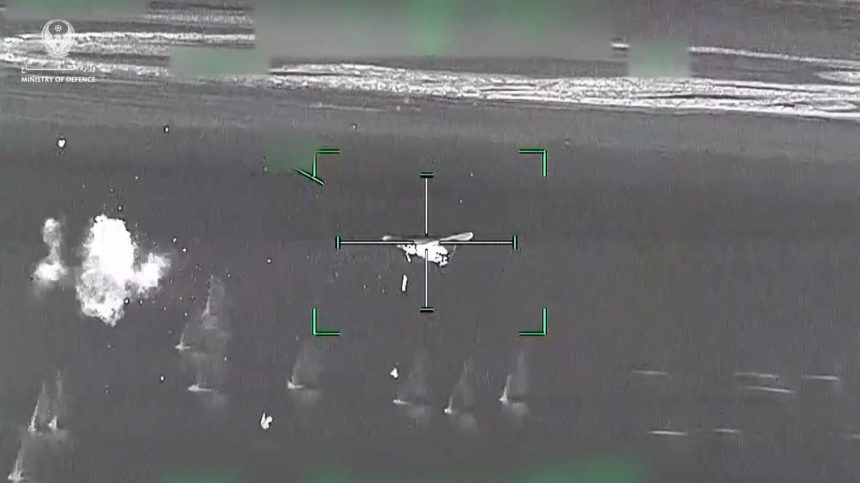
The UAE showed that its AH-64 Apaches and F-16s are actively flying in the counter-drone role, tackling Iranian drones before they can reach their targets.
The United Arab Emirates (UAE) released on Mar. 8, 2026, a video showing footage from an electro-optical system of eight Iranian Shahed-type One-Way Attack (OWA) drones being shot down. Based on the sound of the typically slow rate of fire, acknowledgements of “target destroyed” by one of the crew and airborne position of the engaging platform, we have concluded these are AH-64 Apache attack helicopters employing their chin-mounted M230 30 mm chain gun.
However, on Mar. 9, the UAE MoD also announced the passing of “two members of the Armed Forces following a helicopter crash due to a technical malfunction while performing their national duty.” There were little details at the time of writing.
The UAE Ministry of Defence announces the martyrdom of two members of the Armed Forces following a helicopter crash due to a technical malfunction while performing their national duty in the country today, Monday, March 9, 2026.
The Ministry of Defence extends its deepest… pic.twitter.com/DD1UbISK6i
— وزارة الدفاع |MOD UAE (@modgovae) March 9, 2026
The video released by the UAE confirms the first large-scale operational use of the Apache in the anti-drone role. The helicopter is being actively used among the variety of assets working together to counter the drone threat posed by Iran.
Israel has been the first to employ the AH-64 in this role, with multiple instances recorded, such as the one in November 2024 when the Apache’s M230 was used to shoot down Hezbollah drones. The U.S. is similarly reorienting its own AH-64s to be employed in the counter-UAS role, while also introducing programmable proximity fuzed 30 mm XM1225 rounds.
Additionally, another video also appeared on Mar. 9 showing a UAE F-16E/F Block 60 flying overhead and firing an AIM-9 Sidewinder short-range air-to-air missile (AAM) to engage an Iranian drone. The video shows the jet in a level flight, flying slow at very low altitude to follow and engage what appears to be a Shahed-type OWA.
You are at the beach in the UAE and see a Shahed-136 flying overhead, and later a UAEAF F-16 firing a Sidewinder to shoot down the drone. That’s how crazy the war in the Gulf region is nowadays. pic.twitter.com/w3uCtpdLnz
— The Aviationist (@TheAviationist) March 9, 2026
This comes as Emirati, Qatari and Kuwaiti military authorities reported that they detected and shot down several ballistic missiles and drones launched from Iran on Mar. 8 and 9. The UAE on Monday shot down 12 of the 15 ballistic missiles detected, with three falling into the sea, and intercepted 17 of the 18 UAVs, adding that one “fell within the country’s territory.”
AH-64s shoot down Iranian drones
The infrared footage from the Emirati Apaches’ AN/ASQ-170 Modernized Target Acquisition and Designation Sight (M-TADS) and AN/AAR-11 Modernized Pilot Night Vision Sensors (PNVS) show that all the Shahed drones were propeller-driven, with their two-cylinder turboprop engines visible. The M230 guns are clearly heard firing, and the drones either explode mid-air or disintegrate before crashing.
The UAE MoD’s post on X described the engagement: “Footage showing the UAE’s air defences intercepting and destroying Iranian UAVs that attempted to target the country. There is no compromise when it comes to the nation’s security and sovereignty. The UAE Armed Forces stand ready to deter any threat.”
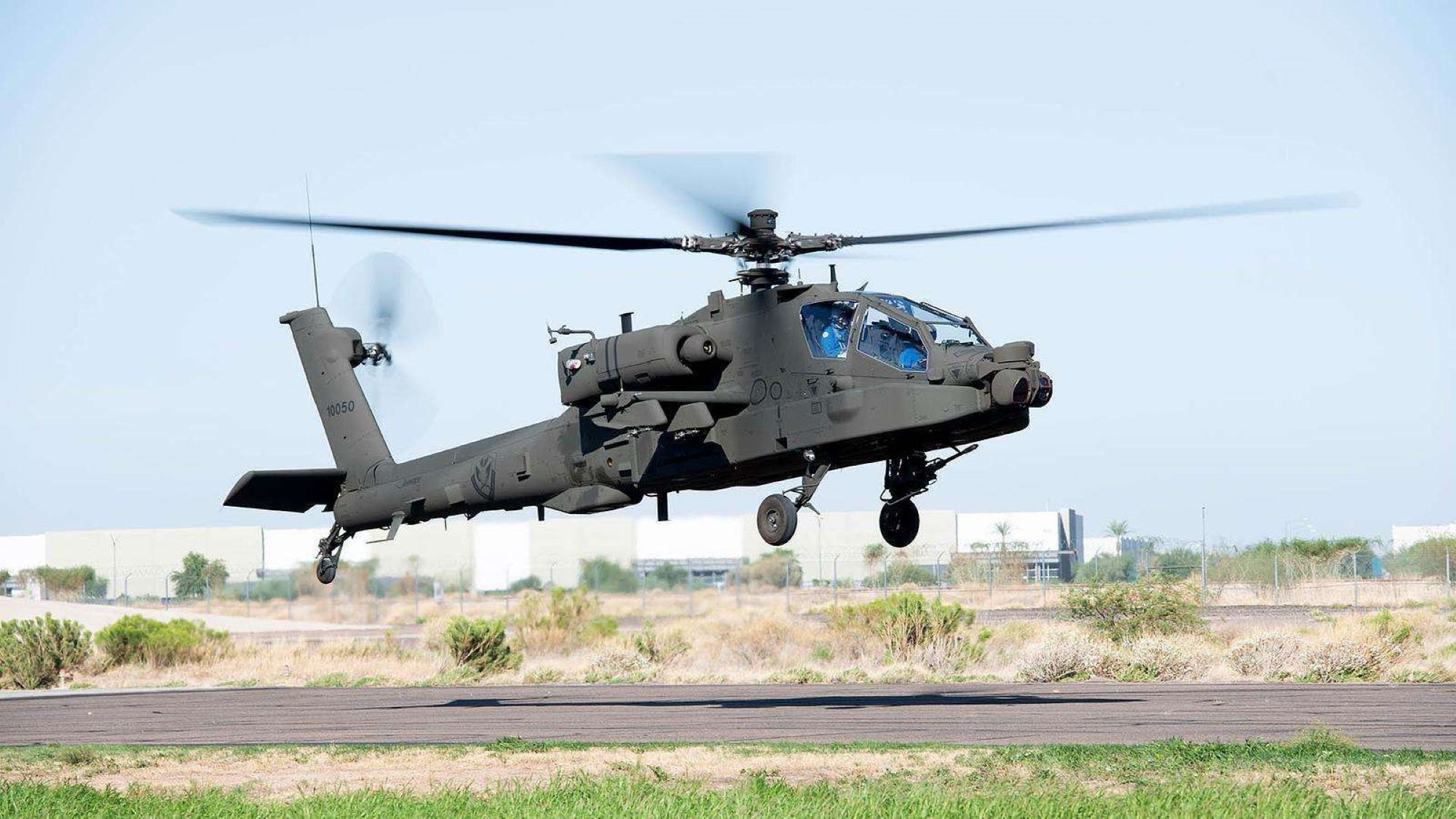
The UAE’s Joint Air Command currently operates a total of 30 AH-64 Apaches, according to the 2026 World Air Forces report, that were purchased in the older ‘A’ variant between 1991 and 1994. These were later upgraded to the AH-64D Longbow Block II standard by 2010 through remanufacture and modernization.
In December 2016, the Defense Security Cooperation Agency (DSCA) approved a Foreign Military Sale (FMS) to remanufacture 28 Apaches to the AH-64E variant and procure nine newly built AH-64Es. The country received the first E-model in August 2023. Thus its future fleet is set to comprise 39 Apache attack helicopters.
Iranian drone and missile attacks continue
Since the start of the Iranian attacks, the UAE says it detected 253 ballistic missiles, destroying 233 of them, with 18 hitting the sea and two landing inside the country. It also detected a total of 1,440 Iranian UAVs, shooting down 1,359 with 81 landing in its territory. The number of cruise missiles “detected and destroyed” stands at eight.
الدفاعات الجوية الإماراتية تتصدى بنجاح للصواريخ الباليستية والجوالة والمسيرات الإيرانية.
UAE Air Defences Successfully Intercept
Iranian Ballistic and Cruise Missiles and UAVs Attacks#وزارة_الدفاع #وزارة_الدفاع_الإماراتية#MOD#UAEMinistryOfDefence pic.twitter.com/YM4PbmNydg
— وزارة الدفاع |MOD UAE (@modgovae) March 9, 2026
Qatar’s MoD meanwhile said that, by the afternoon of Mar. 9, it was attacked by 17 ballistic missiles and six drones coming from Iran, all of which were shot down. The Kuwaiti MoD’s spokesperson Col. Saud Abdulaziz Al-Otaibi said that on Mar. 8 they destroyed three out of seven ballistic missiles, with four being ignored as “they were outside the threat range and posed no danger.” Air defenses meanwhile destroyed two out of five “hostile drones,” while three were “not destroyed.”
“This resulted in two drones targeting the vicinity of Kuwait International Airport, leading to the explosion of fuel tanks. Another drone targeted the building of the Public Institution for Social Security in Kuwait City, resulting in material damage,” further added the statement.
🇮🇷🇮🇱🇰🇼🇺🇸 New footage of Artesh (not IRGC) Arash strike drone launches, which were reportedly used to attack targets in Israel and Kuwait (specifically American forces in Kuwait). The speaker in the video declares that this salvo is in retaliation for the sinking of the IRIS Dena. https://t.co/T4W6jH3Mq3 pic.twitter.com/sshyEQnnOv
— Shahryar Pasandideh (@shahpas) March 9, 2026
The Israeli Defence Forces (IDF) too on Mar. 9 mentioned missiles being launched towards the country from Iran, saying defense systems were operating to intercept them. Official Iranian footage posted by analyst Shahryar Pasandideh on Mar. 7, Mar. 8 and Mar. 9 also showed Iran launching the Arash/Arash-2 OWA drone. The drone is operated by its regular military and not the separate Islamic Revolutionary Guard Corps (IRGC).
Saudi F-15s, Eurofighters shoot down Iranian targets
On Mar. 8, the Kingdom of Saudi Arabia’s MoD released a video of Shahed-type drones being brought down by what could be concluded to be F-15s and Eurofighter Typhoons. The aircraft could have used AIM-9 Sidewinders and Advanced Short-Range Air-to-Air Missiles (ASRAAM) for the engagements.
Footage shows Saudi air defenses intercepting and destroying a number of drones launched toward the Kingdom in recent days.#SaudiMOD pic.twitter.com/G41HjOsm1H
— وزارة الدفاع (@modgovksa) March 8, 2026
With the UAE’s F-16E/F Block 60 similarly using an AIM-9 SRAAM to bring down the Shahed drone, these videos show that the asymmetry still largely persists in tackling OWA projectiles, given that that engaging aircraft are multi-million dollar aerial platforms and have to use weapons that cost more than the drone they need to shoot down.
Only Ukraine has largely managed to bring the cost of engaging Russian Geran drones, using a combination of electronic warfare, ground-based anti-aircraft guns, Sting interceptor drones, and sometimes door guns on military utility helicopters. It now possibly costs Ukraine the same to engage a Russian OWA drone, if not lower, than it takes Russia to launch it.
Industrial capacity to keep churning out drones also decides the cost here, given the massive factory in Russia’s Alabuga and Iran’s unidentified manufacturing sites and underground storage bases.
Three U.S.-made “Patriot” missiles fail to intercept a single Iranian missile over Qatar.
How many billions of Arab oil money and American taxpayer dollars were spent on this garbage ?! pic.twitter.com/ulnqhHJxwD
— Iran Military Monitor ☫ (@IRIran_Military) February 28, 2026
In the West Asian situation, the cost asymmetry with regards to manufacturing is even more acute, given that the Saudi and Emirati F-15, Typhoon, F-16 and Apaches are direct imports, and not manufactured in those countries. Any future upgrades, replenishments or additional buys would be subject to diplomatic, logistical and industrial hurdles.