After a drone struck RAF Akrotiri on Cyprus, Greece has elected to deploy naval vessels and F-16s to the Republic of Cyprus in order to help defend their close ally.
On the evening of Mar. 1, 2026, reports emerged of an emergency situation at RAF Akrotiri, situated within UK sovereign territory on the southern coast of the island of Cyprus. Quickly this materialized into news that the base, which is the UK’s primary hub for Middle East operations and also houses U.S. Air Force U-2 aircraft, had been hit by at least one attack drone likely fired either by Iran or its regional proxies in response to Operation Epic Fury.
Rumors on social media claimed that as many as seven drones had been launched against the base, with six having been downed before impact. According to Cypriot authorities, two more drones headed towards the base on Mar. 2, but were intercepted. The drone that made it through reportedly hit the base’s runway, though official statements have stressed that damage is minimal and operations have been seen to have continued. No injuries are reported.
The strike on RAF Akrotiri last night is deeply concerning, an example of the dangerous and indiscriminate attacks by Iran & its proxies across the region.
Our best assessment is that the drone was fired before the Prime Minister’s statement last night on the US use of UK bases.
— John Healey (@JohnHealey_MP) March 2, 2026
Comment from the UK Ministry of Defence hours after the first attack read: “Our armed forces are responding to a suspected drone strike at RAF Akrotiri in Cyprus at midnight local time. Our force protection in the region is at the highest level and the base has responded to defend our people.”
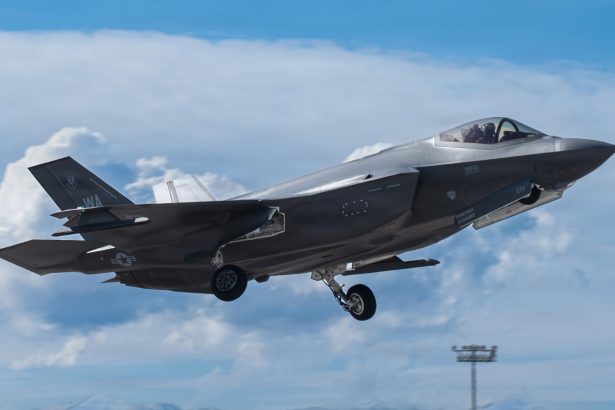
In the immediate aftermath, open source flight tracking sites like Flightradar24 showed the departure of RAF A330 Voyager multirole tanker transports (MRTT) and Eurofighter Typhoon fighter aircraft. Six F-35B Lightning stealth fighters are also stationed at the base as part of the UK’s previous reinforcement measures. Additional force protection measures on the ground were also enacted, with Sovereign Base Areas (SBA) Police dispatched to set up roadblocks at access points and emergency notices sent to residents advising on steps they should take to ensure their own safety.
Two Royal Air Force Eurofighter Typhoon fighter jets, along with an Airbus KC2 Voyager refueling aircraft, have departed RAF Akrotiri in Cyprus following reports that an Iranian drone or missile struck the base. https://t.co/gAug4wgHf9 pic.twitter.com/Fza223WBWR
— Egypt’s Intel Observer (@EGYOSINT) March 1, 2026
Notably, one unusual measure saw messages sent to RAF Voyager aircraft advising pilots to disable their transponders after landing to avoid disclosing exactly where on the base the aircraft would be parked.
Contrary to some speculation on social media, it is not possible to know for certain whether UK ground-based air defence forces – like Sky Sabre missile batteries, and Rapid Sentry counter-uncrewed aerial systems (C-UAS) units – were active at Akrotiri to defend against the attack. According to the UK Defence Journal, part of the reinforcement measures did include C-UAS and air defence capabilities, though the exact types are unknown. We do know that UK C-UAS units are active in Iraq, where they downed a drone heading towards a coalition base.
Greece Steps In
Although the attacks on Akrotiri are focused on sovereign British territory and not towards the Republic of Cyprus itself, there is a clear risk of Cyprus being caught in the crossfire. With limited military capability of its own, the Republic’s close ally, Greece, has stepped in to shield the country.
— Λετυμπιώτης Κων/νος (@letymbiotis) March 2, 2026
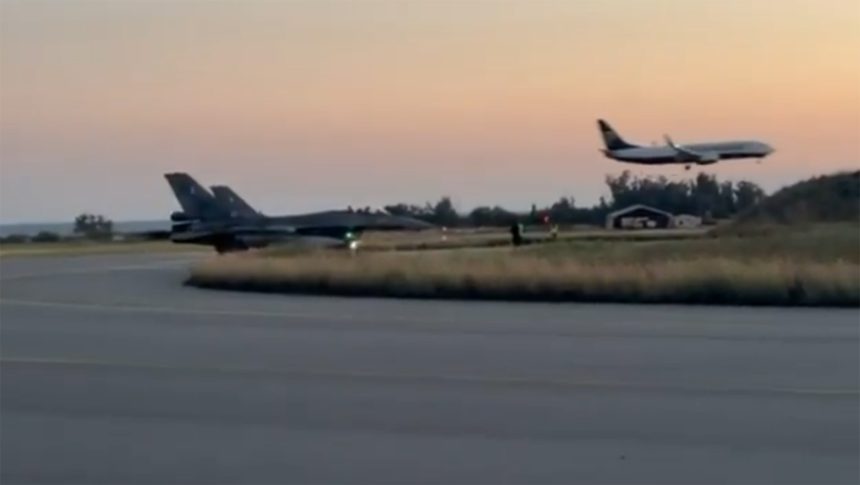
Four F-16V Fighting Falcon fighters from the Greek Air Force, officially titled the Hellenic Air Force, touched down in Cyprus on the evening of Feb. 2.
In addition, Letymbiotis Konstantinos, Spokesperson for the Republic of Cyprus, confirmed that the Hellenic Navy would deploy two frigates to the waters around the island. This includes the Kimon (F-601), the first of four French-designed Frégate de Défense et d’Intervention (FDI – Defence and intervention frigate) vessels ordered by Greece. Kimon was accepted into the Hellenic Navy in only January of this year. The other frigate, officially not identified, is said to carry Greece’s ‘Kentaurus’ C-UAS system.
Greece to deploy multiple warships, fighters to Cyprus after Iranian attacks.
Two Hellenic Navy frigates will be sent: one, the brand-new French-built FDI HN frigate HS Kimon (F-601). pic.twitter.com/aoiw7C57eG
— OSINTtechnical (@Osinttechnical) March 2, 2026
The Kimon itself is equipped with a 76 mm rapid fire naval cannon as well as 32 vertical launch system cells dedicated to Aster 30 surface to air missiles. These are the same missiles as carried by Horizon class destroyers of the French and Italian navies as well as the Type 45 destroyer of the Royal Navy. A Mk 49 Guided Missile Launching System turret is carried above the ship’s hangar, adding 21 RIM-116 Rolling Airframe Missiles for point defence.
Greek Minister for National Defence Nikos Dendias affirmed in a statement that his country would “contribute in every possible way to the defense of the Republic of Cyprus”. Greece and the Republic of Cyprus have been close since the latter’s independence in 1960, sharing languages, ethnicity, and cultural heritage. The Republic of Cyprus controls the south and western parts of the island of Cyprus, while the north/northeast regions are administered as the Turkish Republic of Northern Cyprus – recognised on the international stage only by Türkiye.