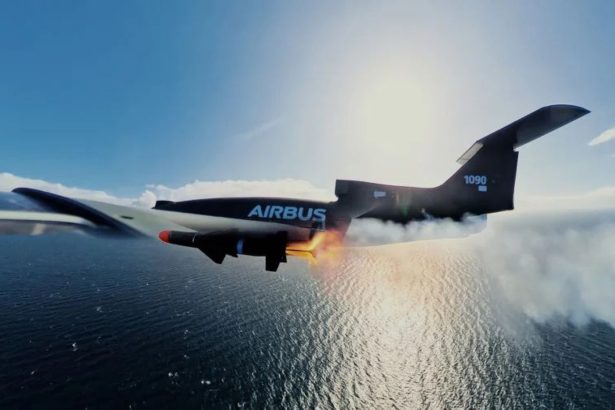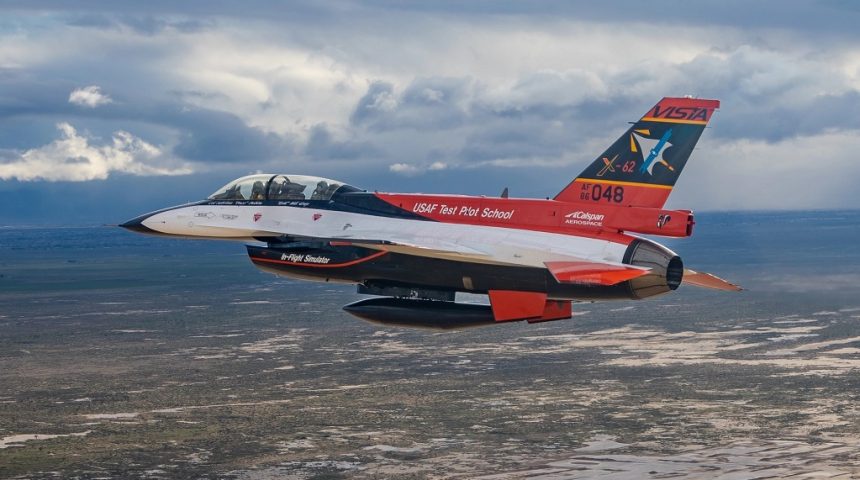
The Have Remy Test Management Project saw USAF Test Pilot School students directly involved in an AI agent’s development, simulation and live trial with Lockheed Martin’s Skunk Works.
The U.S. Air Force’s X-62 Variable Stability In-Flight Simulator Test Aircraft (VISTA) reached a new milestone when Lockheed Martin’s Skunk Works division and the Test Pilot School (TPS) collaborated to develop and train the company’s Artificial Intelligence (AI) agent governing a “missile evasion scenario,” part of a program called Have Remy Test Management Project (TMP).
The Feb. 23, 2026, press release from Lockheed said this campaign, involving simulation – in both the high-fidelity F-16 simulator and the Skunk Works’ Supermassive simulation engine – and live execution, was the first time the X-62 VISTA “hosted a Lockheed Martin AI system with direct control of the aircraft.”
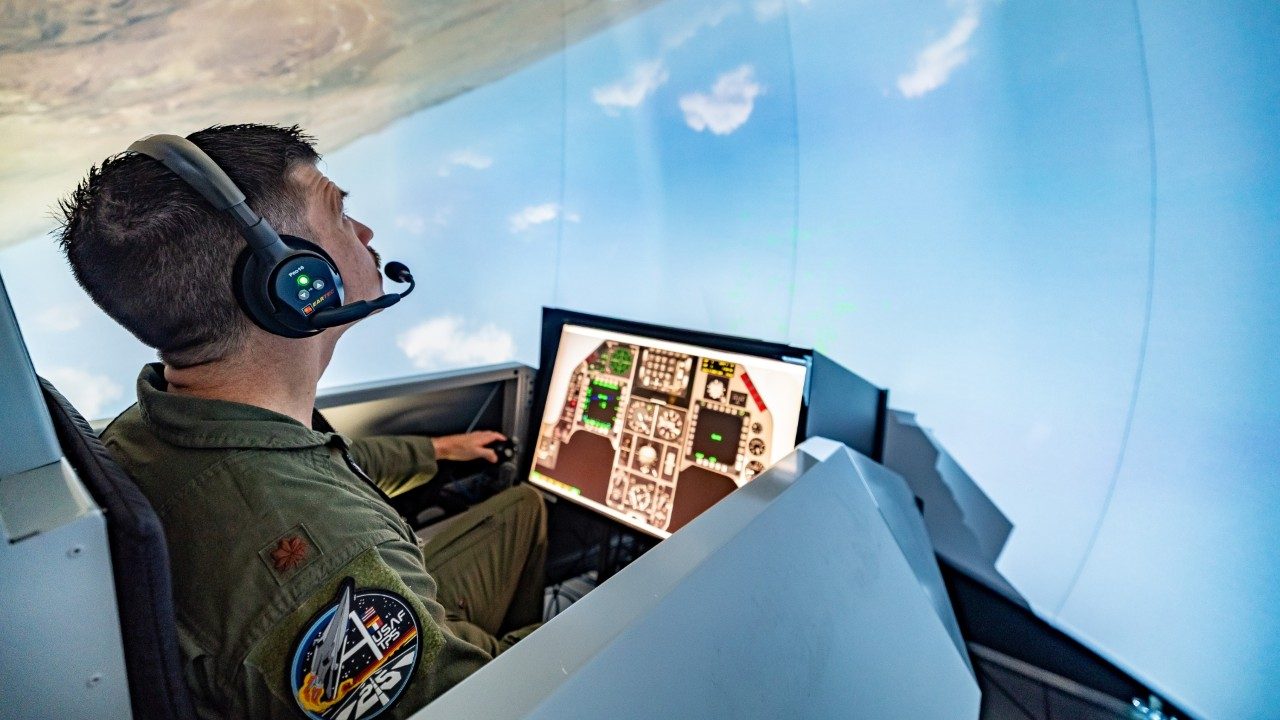
The Have Remy TMP, a “close-knit partnership” between Skunk Works and the TPS – which operates the X-62 VISTA with the parent 412th Test Wing at Edwards AFB, California – helped primarily validate and train Lockheed Martin’s tactical AI with feedback from TPS students. Lockheed engineers then corrected the code and incorporated it into the VISTA within hours.
Skunk Works® teamed up with the @usairforce Test Pilot School (TPS) @TestUsaf to fly and test our autonomous missile-evasion capability. Click for more: 🦨🔗
— Lockheed Martin (@LockheedMartin) February 23, 2026
Missile evasion involves high-g maneuvers, the employment of countermeasures, such as chaff and flares, and electronic warfare jamming to disrupt both the missile and the ground-based radar. It is unclear whether a number of test flights were flown in a long cyclic ‘development-AI training-flight’ loop, or a single linear pathway.
The framing from the statement that comes closest to explaining this element says: “In over 100 test points, TPS students flew the agents under real‑world conditions, demonstrating robust sim-to-real transfer of the autonomous missile‑evasion capability.”
.@LockheedMartin Skunk Works® successfully tests its autonomous missile-evasion capability through partnership with @TestUsaf, the @usairforce Test Pilot School. Click for more:
— Lockheed Martin News (@LMNews) February 23, 2026
X-62 VISTA
Other AI agents that have successfully piloted the X-62 VISTA so far were part of the Air Force Research Laboratory’s (AFRL) Autonomous Air Combat Operations (AACO) and the Defense Advanced Research Project Agency’s (DARPA) Air Combat Evolution (ACE) programs.
In 12 flights between Dec. 1 and 16, 2022, while AACO’s AI agents performed one-on-one beyond-visual-range (BVR) engagements against a simulated adversary, the ACE’s AI agents performed within-visual-range maneuvering, also known as “dogfighting”, against constructive AI red-team agents.
The aircraft is also slated to receive a slew of new capabilities through the Mission Systems Upgrade (MSU), part of an investment from the Test Resource Management Center (TRMC), one of which includes Raytheon’s PhantomStrike Active Electronically Scanned Array (AESA) radar.
The VISTA feeds into broader industry and Air Force autonomous air combat technology and Collaborative Combat Aircraft Development (CCA) efforts. These comprise Anduril’s YFQ-44A Fury, the GA-ASI YFQ-42A Dark Merlin, the Northrop Grumman YFQ-48A Talon Blue, the Kratos XQ-58A Valkyrie, pairing tests of the GA-ASI MQ-20 Avenger with the F-22 Raptor and GA-ASI’s XQ-67A Off-Board Sensing Station (OBSS).
Missile evasion tests
The press release by Lockheed Martin said that the Have Remy TMP integrated TPS students into the “design, test, and evaluation of autonomous agents” for “accelerated development where they:
- Defined a missile‑evasion scenario, demanding split‑second decision‑making and 3D maneuvering at the limits of the VISTA flight-envelope.
- Shaped training of the AI in hours, with billions of simulated missions utilizing Skunk Works’ Supermassive simulation engine.
- Guided development of the AI using a high-fidelity F-16 simulator that allowed virtual testing prior to live execution.
- Provided feedback on novel AI monitoring algorithms that characterize AI agents’ replication of simulated performance in the real-world.”
While TPS students witnessed first‑hand the AI moving from “theory to flight‑ready capability,” Skunk Works’ engineers “got access to the USAF X-62A VISTA high-performance autonomy testbed to evaluate their technology,” added the release.
The Supermassive simulation engine-F-16 simulator-live flight route saw Skunk Works’ engineers continuously refining the AI’s performance by matching its real-world behaviour in simulation. AI engineers developed, debugged, and “tested updates in hours – pushing updates to VISTA in the field with confidence that the system would perform as expected.”
“This real-to-sim transfer capability allows engineers to immediately integrate lessons learned from live flight into the AI autonomy stack,” said the company.
📰 The @usairforce has awarded Raytheon a contract to equip the autonomous X-62A Variable In-flight Simulation Test Aircraft with a PhantomStrike radar. More: https://t.co/68NiUL9QKe
📸: U.S. Air Force pic.twitter.com/t7DMYgegXt
— RTX (@RTX_News) December 19, 2025
“The Have Remy TMP showcases Lockheed Martin’s unique ability to develop and test highly competent tactical AI while leveraging a hands‑on partnership that brings Air Force TPS students directly into the AI development loop,” continued Lockheed Martin. “By proving that autonomous agents can be safely monitored, understood, and controlled in real time, we are turning the vision of human‑machine teaming into an operational reality – making future missions safer, more effective and decisively dominant.”
Missile evasion in combat
The AI agent may very well find its way into Lockheed Martin’s Vectis stealth loyal wingman, which the company might pitch for the CCA’s Increment 2 phase.
Higher order tasks like evading missiles autonomously are also part of the subsequent evolution the next generation of CCAs would be expected to have. The current ones would freeze the elementary hardware, design, networking technology and most importantly logistics, tactics, concepts and command tasking procedures.
NEWS: X-62 VISTA to receive radar and sensor capabilities through an investment by the Test Resource Management Center.
Enhancements will push X-62 to evaluate more complex #AI and #autonomy scenarios with the #USAF Test Pilot School. @HQ_AFMC
More- https://t.co/cuKi89MCnR pic.twitter.com/A331fXATXy
— Edwards Air Force Base (@EdwardsAFB) December 18, 2025
After tasking, the combat role would be represented by off-board weapons release, while the drone would possibly also act as off-board sensors, after autonomously taxing, taking-off, holding Combat Air Patrols along pre-set waypoints, returning-to-base and landing. A recent video by Anduril about the first flight of its YFQ-44A Fury CCA with an inert AIM-120 AMRAAM shows control room footage of its operation and command tasking for these operation modes.
The X-62 VISTA is also the right candidate for testing autonomous missile evasion AI software, given that it is set to receive the PhantomStrike radar, making it both an off-board sensing, and off-board weapons release platform. For safety purposes, the X-62A is flown with test pilots to disengage the AI agent if needed.
This is what we wrote while reporting on the PhantomStrike for the X-62:
“The addition of the PhantomStrike will allow seeing both whether the AI agents can identify/discriminate potential threats upon detection (off-board sensing) and how they maneuver and respond with simulated air-to-air missile fire (off-board weapons release). Air Force, AFRL and DARPA testers can then use Machine Learning (ML) to train and refine their action.”
Fight Unfair. https://t.co/y4ZGSjVxaG pic.twitter.com/Jnzk6i3W1m
— Anduril Industries (@anduriltech) February 23, 2026
The U.S. Air Force routinely tests countermeasures, with one such exercise in August 2025 testing the radar, missile warning systems and countermeasure dispensers of HH-60G Pave Hawk and HH-60W Jolly Green II combat search and rescue helicopters in response to a simulated attack by an F-15D Eagle. The test may have assessed their sensitivity, response time to radar and missile targeting at various ranges and modes – active, passive or Track While Scan (TWS).