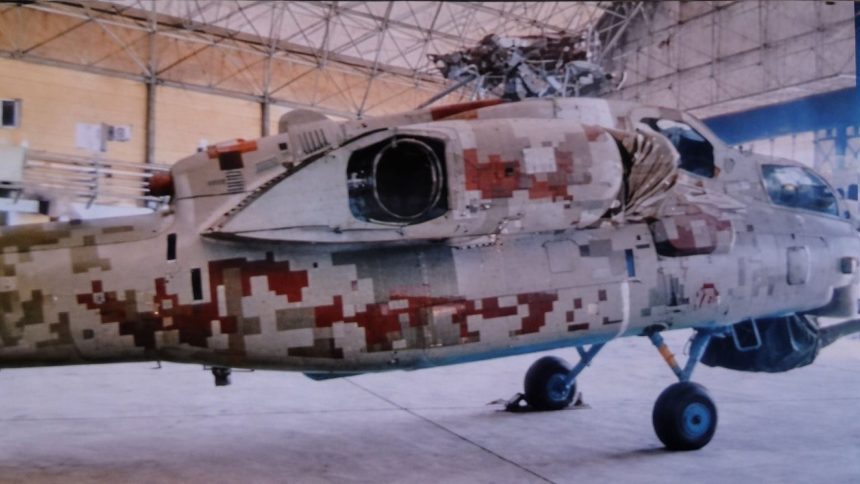
Recently emerged images show a Mi-28NE helicopter in a hangar geolocated in Iran, following reports of multiple Russian Il-76MD cargo aircraft flying into the country.
Photos emerged on Jan. 28, 2026, show what has been described as a single Mi-28NE Havoc in an Iranian facility. Open-Source Intelligence (OSINT) profiles later geo-located the pictures of the aircraft, bearing only a pixelated desert camouflage and no markings, to the Pars Aerospace Services Company in Tehran.
Now largely believed to be true and confirmed by independent Iran defense profiles, the arrival of the attack helicopter in the country was first hinted by journalist Mohamad Taheri on Jan. 3. The reports about the delivery follow claims about a Russian Mi-28NE deal with Iran which circulated periodically since 2023, both in Iranian reports and statements by its senior military leadership.
Given the serious diplomatic and escalatory constraints associated with transferring the long overdue Su-35S fighters, Mi-28NE attack helicopters appear to be the easiest asset for Russia to transfer to Iran at the moment. The ‘NE’ is the export variant of the final production Mi-28N iteration, which was first introduced in the Russian military in 2009.
🇷🇺🇮🇷 It is believed that Iran has received the first batch of Mil Mi-28NE attack helicopters ordered in Russia.
Photos of a Mil Mi-28 helicopter in digital desert camo stationed in a hangar have emerged on social media.
The arrival of the first Havocs in Iran was also… pic.twitter.com/SgZxwy9ivP
— Status-6 (War & Military News) (@Archer83Able) January 28, 2026
West Asia on the boil again
The development comes amid a rising U.S. military buildup, as the Middle East braces for another round of clashes between Tehran and Washington – and possibly Israel. The USS Abraham Lincoln’s (CVN 72) Carrier Strike Group (CSG) also arrived in the Central Command (CENTCOM) Area of Responsibility (AOR) last week, and more assets are on the way.
The U.S. and Iran had clashed last year amid Tehran’s confrontation with Israel, and B-2 Spirit bombers struck Iranian nuclear facilities in Operation Midnight Hammer. Domestic protests against dire economic conditions and inflation had become violent and riotous, with both sides claiming excesses, spilling over internationally with the U.S. and Israel voicing support for the demonstrators.
Broader diplomatic engagements between Syrian President al-Sharaa and the United Arab Emirates’s (UAE) President Mohamed bin Zayed with Russian President Vladimir Putin are being perceived as preparing ground to deescalate any war and spillover that might occur.
Geo-Location of the warehouse where the recently delivered to Iran Mil-28 helicopter photo is taken.
Pars Aerospace Services Company in Tehran.
35.69899, 51.29459 pic.twitter.com/VV7ruGVPWj
— Mehdi H. (@mhmiranusa) January 28, 2026
Mi-28 in Iran
The Mi-28 seen in the photo is in a partially disassembled state, given the main rotors missing from the rotor hub and the engine intake covered, while bearing a pixelated desert camouflage. This clearly suggests it was transported aboard larger Russian cargo haulers, possibly Il-76MDs that have frequently flown between the two countries throughout the war.
On Jan. 1, two days before Mohamad Taheri’s post on X about the Mi-28, ‘Open Source Intel’ wrote in a post he tracked five Russian Il-76s heading to Tehran in the two preceding days. The routes used go over the Caucasus mountains in Georgia, Armenia and Azerbaijan.
Speculations about the cargo in those flights have ranged from Shahed-type One Way Attack (OWA) drones to Iranian-made short and medium-range tactical ballistic missiles. It is not known whether these were carrying the Mi-28s, or were associated with the evacuation of Russian diplomatic staff, as was reported in June 2025, or Russian engineers working at the Bushehr nuclear plant, as per a Jan. 29 statement by Russia’s nuclear corporation.
انشا الله خوب سربازی کنی#میل_28#mil_28 pic.twitter.com/f5dM6VKpOz
— Mohammad Taheri (@MohamadTaheri90) January 3, 2026
We are far from knowing how many Mi-28 Iran has ordered, and how many have been delivered. The one example in the picture also does not bear any Iranian markings and insignia, which would determine whether the helicopters would be used by the Islamic Republic of Iran Air Force (IRIAF), the Iranian Ground Forces or the Islamic Revolutionary Guard Corps (IRGC).
Nevertheless, this would make Iran the fifth operator of the helicopter, after Russia with 113 Mi-28s, Algeria with 42, Iraq with 17 and Uganda with 4, as per the 2026 World Air Forces report that counted figures up to December 2025. The goal behind the transfer of this first helicopter could also be largely symbolic, serving to signal to the U.S. and Israel.
However, it is doubtful how much Moscow can follow through with actual support and military defense, given that the two countries do not have a mutual defense treaty. Also, with the ongoing industrial effort to replace losses sustained by the Russian military in Ukraine, it is unclear which timelines should be expected for the delivery of further helicopters.
Flight-tracking data from Flightradar24 shows at least five Russian Il-76 cargo aircraft flying to Tehran in the past 48 hours, pointing to a spike in undeclared Russian deliveries to Iran. pic.twitter.com/jLP8bz45iA
— Open Source Intel (@Osint613) January 1, 2026
Previous reports about Mi-28s for Iran
The first hint about Mi-28s meant for Iran emerged in a Jan. 24, 2023, Institute for the Study of War (ISW) report, which quoted a Tasnim News Agency editorial arguing for a joint Russo-Iranian production deal that also covered the Ka-52 Alligator. Other reports quoted a November 2023 statement by Iran’s deputy defense minister Brigadier General Mehdi Farahi: “Plans have been finalized to introduce Sukhoi Su-35 fighter jets, Mil Mi-28 attack helicopters, and Yak-130 jet trainers into the combat units of the Army.”
The Su-35 saga has seen multiple instances of reports mentioning an imminent delivery, however the aircraft have still to be delivered. The Iranian Yak-130s meanwhile are operating successfully with the IRIAF, and are meant for training pilots on the upcoming Su-35s – whenever they will arrive.
BREAKING:
Iran has recieved MI-28 attack helicopters from Russia. pic.twitter.com/oEsqVx2qMW
— Current Report (@Currentreport1) January 3, 2026
The Russian Mi-28Ns remain active on the frontline in Ukraine, frequently figuring in Russian Ministry of Defence (RuMoD) publicity material, firing unguided rockets at Ukrainian ground positions. Quite a few have been lost to Man-Portable Air Defense Systems (MANPADS), especially in the early months of the war.
Mi-28N(M) smacked by Ukrainian AA FPV over Kursk, Russia pic.twitter.com/EUWxQEF9nV
— Cᴀʟɪʙʀᴇ Oʙsᴄᴜʀᴀ (@CalibreObscura) August 7, 2024
The helicopters also remain vulnerable to First-Person View (FPV) drones, with one Mi-28 captured being struck by a Ukrainian UAV in an August 2024 video, and another such kill in Sep. 2025. Nevertheless, it would be an upgrade compared to the aging AH-1J currently operated by Iran.
BREAKING ✴️
A ruSSian Mi-28 helicopter was destroyed by an FPV drone by pilots of the 59th Brigade of the Unmanned Systems Forces.
MADYAR 🇺🇦
29.09.25 pic.twitter.com/5uSH0LSZ2d
— 𝔗𝔥𝔢 𝕯𝔢𝔞𝔡 𝕯𝔦𝔰𝔱𝔯𝔦𝔠𝔱△ 🇬🇪🇺🇦🇺🇲🇬🇷 (@TheDeadDistrict) September 29, 2025
Russia-Iran ties
Kremlin’s spokesperson Dmitry Peskov had revealed in June 2025, just days before the U.S. Air Force’s Operation Midnight Hammer on Iranian nuclear sites, that Russia had offered to store excess Iranian enriched Uranium for safekeeping. Russia was also willing to act as a mediator with the U.S. and Israel to reduce tensions.
This shows how Russia’s support to Iran at the moment is largely diplomatic. Any military equipment transfer to Tehran, at least in the foreseeable future, would be minor, and would do little to tilt the balance of military capabilities before Israel. The Mi-28 transfer to Iran could thus be seen in this light.