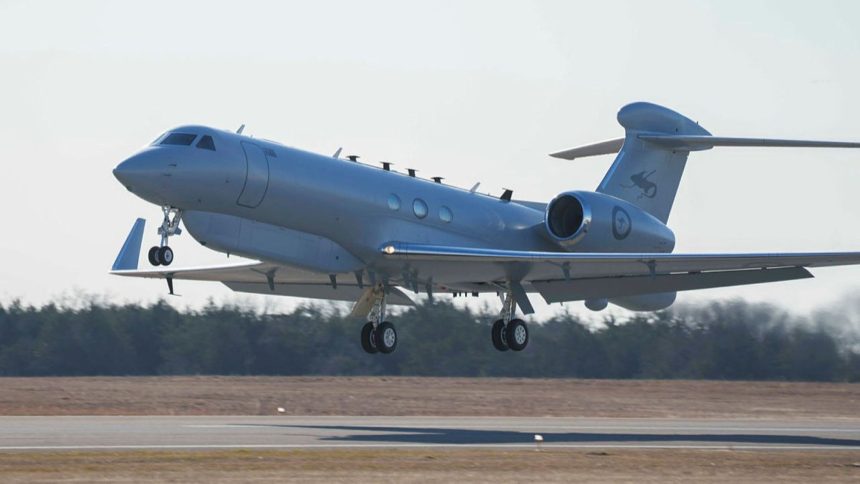
The MC-55A Peregrine will enhance the Royal Australian Air Force capability to patrol its surrounding strategic maritime spaces, while networking with other dedicated assets.
Australia’s Minister for Defence Industry Pat Conroy and L3Harris announced on Jan. 24, 2025, that the Royal Australian Air Force (RAAF) received its first MC-55A Peregrine Intelligence, Surveillance, Reconnaissance, Electronic Warfare (ISREW) aircraft. The aircraft is the first of four, with three other airframes currently in the U.S. ahead of future deliveries.
The aircraft had however reached RAAF Base Edinburgh in Adelaide, South Australia, on Jan. 22, as shown by photos captured by aviation photographer ‘Airman94’. The aircraft flew a multi-leg journey from L3Harris’ facility in Greenville, Texas, stopping over at Davis-Monthan AFB, Arizona, Hickam AFB, Hawaii, Wake Island and finally Andersen AFB, Guam.
The U.S. State Department approved on Jun. 23, 2017, Australia’s purchase of up to five of these Gulfstream G550 jets modified with a host of specialized systems. Two years later, Canberra announced on Mar. 18, 2019 the $1.6 billion AISREW program for four of these platforms under Project AIR 555.
The Peregrine has landed! 🦅
Named after one of the best precision hunters in the world – the MC-55A Peregrine leads the way.
Our first Intelligence, Surveillance, Reconnaissance and Electronic Warfare aircraft – it’ll help our @AusAirForce see more and know more. pic.twitter.com/oMl2bblqba
— Pat Conroy MP (@PatConroy1) January 24, 2026
Upon delivery, L3Harris said that the airframe in question was delivered to the RAAF by the U.S. Air Force, and the remaining aircraft will remain in the latter’s “possession while supporting RAAF training and pre-delivery requirements.” The company has also established a field service team in Australia to work alongside local industry partners for in-country support.
Feeling genuinely grateful today. The RAAF MC-55 Peregrine has finally been delivered to Adelaide, following an incredible route: KGVT > KDMA > PHNL > PWAK > PGUA > YPED, A huge milestone for Australian aviation and capability — honoured to watch it happen. 🇦🇺✈️ #RAAF #MC55… pic.twitter.com/js5M6KGm1L
— Airman94 🇦🇺 (@airman941) January 22, 2026
Australia’s Project AIR 555
The MC-55 aircraft still bears its U.S. registration, N584GA, which was first photographed by aviation photographer SR_Planespotter on Sep. 11, 2023, at the time still in a factory paint scheme, coming in to land at Majors Airport in Greenville, Texas. By January 2025, SR_Planespotter had also captured N540GA at Greenville, Texas, and also shared images of tail number N542GD with The Aviationist.
The aircraft, which now also bears the logo of the RAAF’s No. 10 Squadron on the vertical stabilizer, and will be based at RAAF Edinburgh, South Australia. The unit previously flew the RAAF’s two AP-3C Orion aircraft, converted into the ELINT/SIGINT role in the 1990’s Project Peacemate. Those two aircraft flew for the last time on Dec. 5, 2023, following a commemorative route from RAAF Edinburgh along the South Australian and Victorian coastlines before retiring.
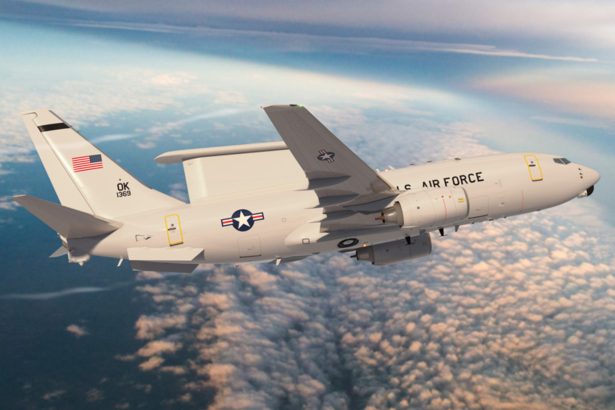
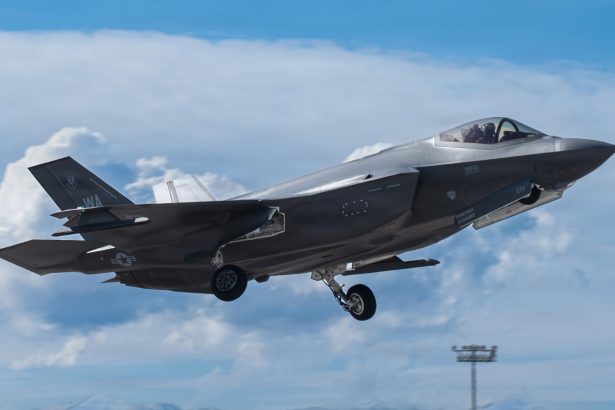
The MC-55A Peregrine’s primary role would be linking in a single network other electromagnetic sensing and strike platforms like the RAAF’s F-35A Lightning II, E-7A Wedgetail AEW&C (Airborne Early Warning and Control) aircraft and the E/A-18G Growler. The MQ-28A Ghost Bat collaborative combat aircraft (CCA), and particularly the MQ-4C Triton unmanned ISR aircraft and the P-8A Poseidon will become a part of an extended web of networked ISR fleet, trading optical, radar and electronic surveillance data.
We’ve delivered the first MC-55A aircraft to the @usairforce for Australia’s new Peregrine fleet, providing the @AusAirForce with advanced electronic warfare and ISR capabilities. This specialized aircraft enhances multi-domain operations, supports mission planning, and ensures… pic.twitter.com/Uz2UtLoCHn
— L3Harris (@L3HarrisTech) January 24, 2026
Broader allied defense diplomatic initiatives encompass the U.S., Australia and the United Kingdom cooperating in the electromagnetic spectrum with their RC-135V Rivet Joint/RC-135W and the EA-37B Compass Call EW/SIGINT aircraft.
Vital ISR and EW capability
Minister Conroy pointed in his X post that the aircraft has been named after the Peregrine Falcon, “one of the best precision hunters in the world.” He further added the new platform will help the RAAF “see more and know more.”
EXCLUSIVE: The Royal Australian Air Force says it now has one of the world’s most advanced spy planes adapted from an aircraft usually used by celebrities. 7NEWS can bring you an exclusive look at the so-called Peregrine jets in South Australia. @telester pic.twitter.com/k2zUjnb1Bg
— 7NEWS Adelaide (@7NewsAdelaide) January 23, 2026
In a longer statement, Defence Australia said the MC-55A’s arrival marks “a major milestone in strengthening the nation’s sovereign defence capability.” The statement described the MC-55A as “a long-range, surveillance and reconnaissance aircraft designed to deliver multiple sources of intelligence” that can “detect, disrupt, deter, and if necessary defeat threats.”
“The MC-55A will be a key component of Australia’s broader ISR enterprise, complementing platforms such as the P-8A Poseidon and MQ-4C Triton, and forming a critical link in the nation’s sovereign network of surveillance and electronic warfare assets,” explained Defence Australia. “Operated by Number 10 Squadron, the MC-55A Peregrine will be based at RAAF Base Edinburgh, South Australia.”
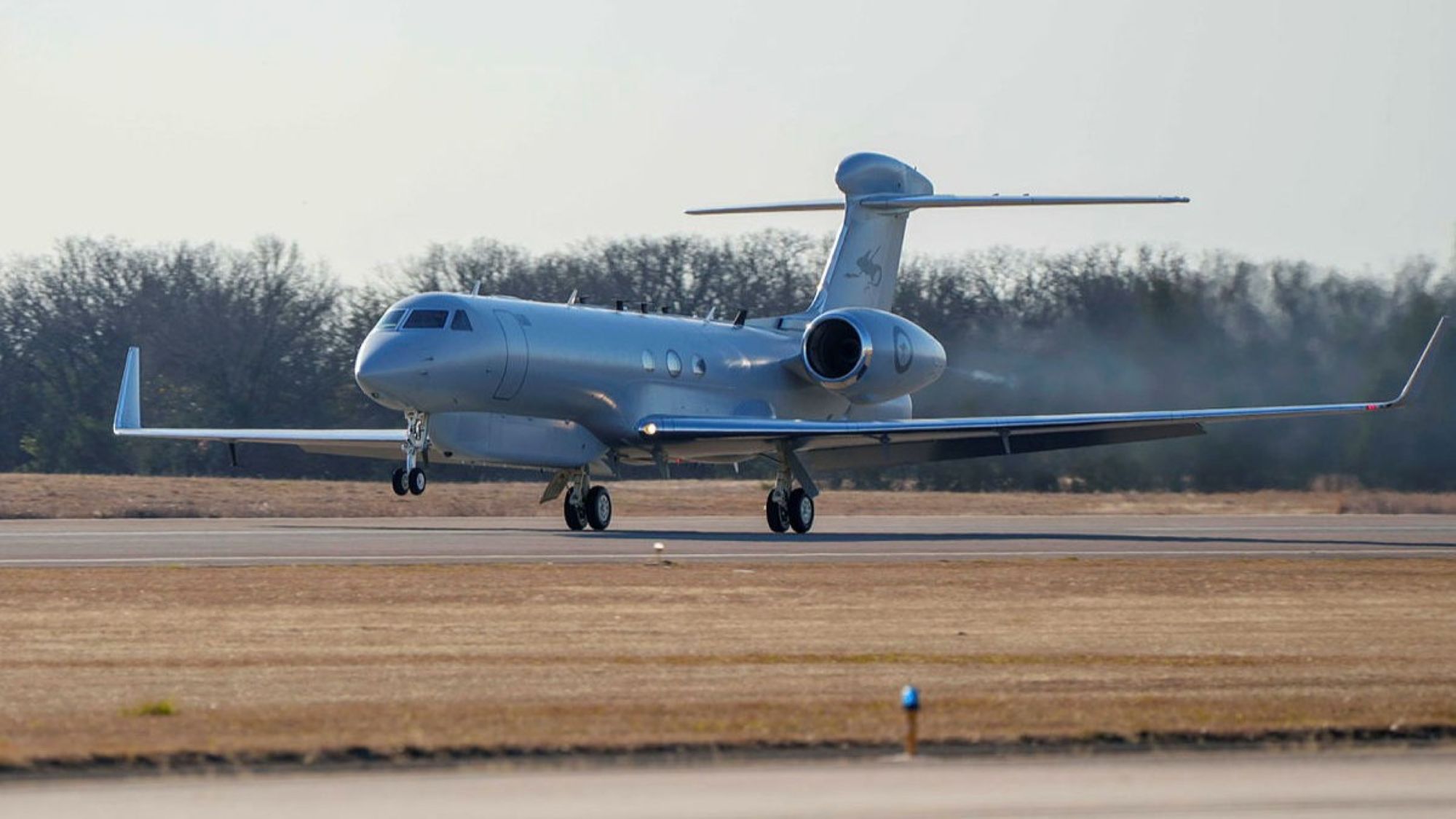
Minister for Defence Richard Marles called the MC-55A’s arrival a “significant step” towards “strengthening Australia’s ability to monitor and protect its strategic interests, including key maritime approaches.” He further added “This capability will integrate seamlessly with allied and partner systems, enabling the Air Force and ADF to share intelligence with security partners like the United Kingdom and United States.”
RAAF chief Air Marshal Stephen Chappel said the airborne EW/SIGINT capability through the MC-55A was identified in the 2024 Integrated Investment Program to provide “important intelligence information to support ADF missions.”
L3Harris’ president for ISR, Space and Mission Systems Jason Lambert called the MC-55A Peregrine “a force multiplier in delivering critical data for long-range targeting, regional deployments and effective mission planning.” He further added “The specialized aircraft will give the RAAF information superiority and serve as strategic assets for future Australian Defence Force operations.”
The first MC-55A Peregrine for the @AusAirForce arrives at L3 Harris Greenville for test flight 2 in its completed, fully modified state. pic.twitter.com/wkRSrhBTFs
— 𝗦𝗥_𝗣𝗹𝗮𝗻𝗲𝘀𝗽𝗼𝘁𝘁𝗲𝗿 (@SR_Planespotter) January 22, 2025
L3Harris’ release also mentioned “ongoing software and hardware upgrades will help ensure the Peregrine stays ready to meet evolving threats and future mission needs.” This could be a reference to the $404 million Baseline 2 upgrade that the Defence Security Cooperation Agency (DSCA) notified on Aug. 6, 2025 it had approved for Australia.
The program includes major and minor modifications; spare parts; consumables and accessories; repair and return support; U.S. government and contractor engineering; technical, and logistics support services; and other related elements of logistics and program support.