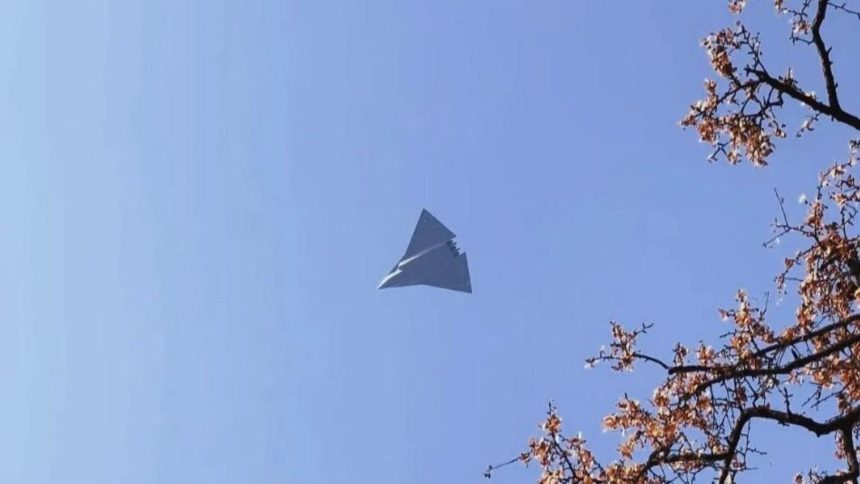
The supposed third J-36 prototype emerged exactly a year after the first one was spotted in December 2024.
Chinese military aviation observers observed what they believe to be a third prototype of the J-36 next-generation aircraft, after photos and videos of it flying overhead emerged on the afternoon of Dec. 25, 2025. They have also maintained this is the aircraft’s first test flight, with a J-10C seen flying beside it as a safety chase aircraft.
Leading Chinese military analyst Andreas Rupprecht said: “Apparently this year China‘s Christmas surprise is not a super-fancy new type, but – itself most impressive – the maiden flight of the third J-36 prototype.” Should the J-36’s third prototype be confirmed, China would now have a total of five next-generation tailless aircraft, including the three J-36 prototypes, the Shenyang J-XDS/J-50, and a third unidentified jet.
It appears that Chengdu Aircraft Corporation (CAC), the facilities where the J-36 is frequently photographed, has concurrently produced three prototypes with different configurations of the engines’ intake and exhaust, the landing gear, along with possibly a host of other unidentified avionics, sensors and software modifications to reduce the time required before the serial production and operational fielding.
Apparently J-36 #3 had it’s FF https://t.co/d17F9Q73la pic.twitter.com/QN5xKvD9bJ
— Hûrin (@Hurin92) December 25, 2025
Given the health of China’s economy, self-sustaining defense industrial base, and all-domestic aerospace supply chains, the huge financial and logistical cost of pursuing five next-generation jets must be negligible for Beijing. This would otherwise be extremely prohibitive for many countries already struggling to sustain their existing fighter fleets.
We also do not know whether these new Chinese jets can be called 6th generation, as we had explained before. In fact, the classification is still a subject of military and engineering debate, largely emanating from defense marketing campaigns.
A jet could be anywhere between a Gen. 5+ or Gen. 6, depending on who you ask. What needs to be noted nevertheless is the consistent, steady emergence of new aircraft and weapons from Chinese factories, which has a PR motive in itself to display China’s technological prowess.
#3 J-36 with J-10C chase plane
TVC and dsi as expected https://t.co/QvOlDKNAqg pic.twitter.com/giMm67bl24
— Hûrin (@Hurin92) December 25, 2025
Third J-36 prototype
We can see little differences between the second and the third prototype, mainly owing to the low resolution of the image that has been taken from a considerable distance and thus doesn’t show any features of the engine intakes and the underside. The aircraft appears to retain the 2D-thrust vectoring control (TVC) nozzles that end before the wing’s trailing edge, as seen in the second prototype that appeared on Oct. 28.
That second prototype, as we noted in our coverage here at The Aviationist, beside the 2D-TVCs, was also differentiated by the main landing gear being in a side-by-side arrangement, rather than the tandem configuration like the first prototype, and revised side intakes with possibly a Diverterless Supersonic Intake (DSI) configuration, instead of the caret-shaped ones on the first.
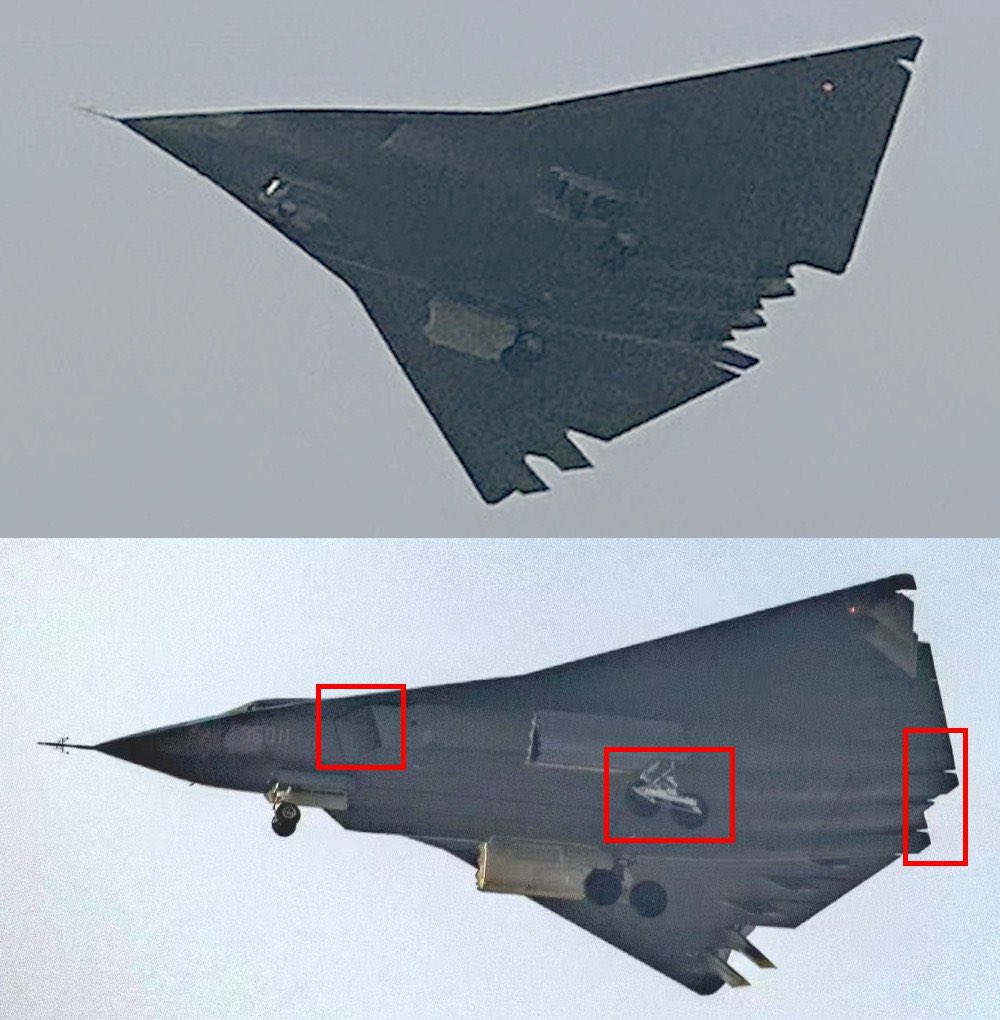
In the newest prototype, the landing gear is also retracted, so we are unable to see if that feature has been altered in any way. Another distinguishing feature is that the third prototype is missing a flight data probe on the nose, seen prominently in the first two J-36 aircraft, although this doesn’t indicate whether the jet is closer to serial production.
The jet’s tactical role is also an area of speculation. The J-36 is so far believed to be anywhere between a heavy-fighter, firing a volley of extremely long-range AAMs like the PL-15 and PL-17, and an extremely stealthy surface-strike weapon, taking out strategic targets.
Since recently too many faked Images of the J-36 were posted and this one looks almost too good to be true I would say, let‘s be sceptical again! 🤔 https://t.co/7VpVOerxE9
— @Rupprecht_A (@RupprechtDeino) June 6, 2025
We asked Rupprecht about what differentiates this third J-36 prototype from the others, and he told us “there don‘t seem to be any differences – maybe the already no longer attached pitot.” However, he also said the info about the third prototype “comes from credible posters, thumbs are usually very credible in telling things around CAC and are said to know even more.”
Closer look at the J-36’s exhausts
March and November also saw the emergence of rear-aspect images of the J-36’s first and second prototypes, respectively, which need some attention, especially amid China also parallely churning new jet engines. The image in March showed the first J-36’s exhausts reasonably clearly, showing recessed-like arrangement similar to that on the YF-23.
J-36 pic.twitter.com/UbF44AHV4w
— OedoSoldier (@OedoSoldier) March 29, 2025
The November image of the second J-36’s showed the TVCs and the split trailing edges. The exhausts appear similar to a composite material casing seen on the F-22 Raptor, and were also clearly visible on the stunningly and surprisingly clear image of the J-XDS that appeared while it was taxiing. These exhausts do appear to share the 2D top and bottom composite TVCs seen on an exhibition display of the “Taihang” WS-10 late in September.

TVCs for a large tri-engine jet like the J-36 could make up for lack of aerodynamic maneuverability arising from an unstable tailless design. However, a 2D TVC however operates only in the ‘pitch’ and ‘roll’ axes of flight, and not the ‘yaw’ axis which could be covered only with a 3D TVC and could be useful for a tailless aircraft.
Thus, an explanation could be that the composite TVCs mainly have an infrared signature-reducing role. Conical exhausts also offer greater thrust outputs, although pure speed might not be a priority for the J-36’s intended mission set.
The external accessories have also clearly been improved, making the engine look more streamlined. Most importantly, this type of “Taihang” engine uses a 2D thrust-vectoring nozzle similar to that of the F-22A fighter.
2/ pic.twitter.com/AVH6wMBjb0
— 𝔗𝔥𝔢 𝕯𝔢𝔞𝔡 𝕯𝔦𝔰𝔱𝔯𝔦𝔠𝔱△ 🇬🇪🇺🇦🇺🇲🇬🇷 (@TheDeadDistrict) September 26, 2025
China’s 5th Gen fighter jet aero engine which is the next generation of WS15/F119/F135:ACE(Adaptive Cycle Engine) , has produced a complete physical prototype, and has tested on the ground and engine altitude simulated test facility. This is the Chinese version of GE XA100. pic.twitter.com/mpUswSqK7t
— 冬夜雪域冰莲炎 (@SnowLotusFlame) November 2, 2025
Early in November, images also emerged of a presentation slide that suggested China had completed ground tests of its own Adaptive Cycle Engine (ACE), similar to GE Aerospace’s XA102 and Pratt & Whitney XA103, one of which might power the F-47 NGAD (Next-Generation Air Dominance) fighter. Adaptive cycle engines introduce a third stream of airflow and adjust the bypass ratio, allowing the pilot to choose fuel-efficient or performance efficiency modes.