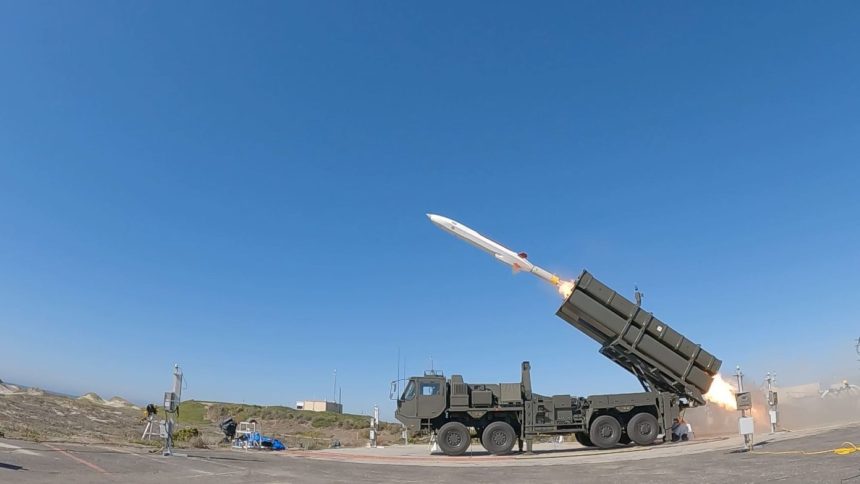
The image show a live-fire test of the upgraded Type 12 Surface-to-Ship missile conducted between October and November 2020 in California.
The Japanese Ministry of Defense (MoD) released on Dec. 19, 2025 more images and information of live-fire tests of its upgraded Type 12 Surface-to-Ship Missile (SSM) that were conducted between October and November 2020. The missile was captured in sharper detail compared to the photos released on Dec. 6, 2024.
The 2024 images were from a series of seven demonstrations held between October and November. Those images were still slightly blurry, and were taken from a distance that did not fully show the weapon’s faceted design and other aesthetics.
Persistent tensions with China and North Korea had prompted Tokyo to conduct a series of domestic standoff missile development programs and foreign buys to deter aggression and undertake pre-emptive strikes. These include a Hypersonic Velocity Gliding Projectile Vehicle (HVGP), an Hypersonic Glide Vehicle (HGV)-type that is boosted just around the Earth’s atmosphere by powerful boosters. This was tested in California in March 2024.
Then, in April 2025, Japan contracted Mitsubishi Heavy Industries to develop a new long-range surface-to-ship/surface-to-surface precision missile. Japan is also buying the U.S.-made AGM-158 JASSM, which can be deployed from the Japan Air Self-Defense Force’s (JASDF) F-35s and F-15s.
Additionally, in January 2024, Tokyo ordered 400 BGM-109 Tomahawk Land Attack Missiles (TLAM) for the JMSDF’s (Japan Maritime Self-Defense Force) warships.
防衛省・自衛隊は、我が国への侵攻部隊を早期・遠方で阻止・排除するためスタンド・オフ防衛能力を強化し、この能力を早期に構築するため12式地対艦誘導弾能力向上型(地発型)について発射試験を行い、本試験において飛しょう等が予定どおり確認されました。https://t.co/MH2P93LLQZ pic.twitter.com/zYveXgru1B
— 防衛装備庁 (@atla_kouhou_jp) December 19, 2025
On Aug. 29, 2025, Japan also announced plans to formally deploy the upgraded Type-12 and the HVGP between 2025 and 2027. These missiles meet what the MoD describes as a “counter-strike” capability, meant to rapidly respond to aggression in a short timeframe.
Broader defense-diplomatic efforts include Japan’s participation in the sixth generation GCAP program, and enhancing collaboration with participant nations U.K. and Italy to firm up its fifth-generation F-35B Lightning II capability.
The tests in late-2020
The statement released by the Japanese MoD states the military objective behind the development and possession of such a weapon, and the trial parameters, images of which are mysteriously being released only now.
“The Ministry of Defense and the Self-Defense Forces will strengthen their stand-off defense capabilities in order to intercept and eliminate invading forces against Japan at an early stage and at a long distance. Recently, we conducted a test launch of the Type 12 Surface-to-Ship Missile with Improved Capability (Locally Launched), one of our domestically produced stand-off missiles, as detailed below, and confirmed the planned flight, indicating that development is nearing completion. We plan to complete development of the Type 12 Surface-to-Ship Missile with Improved Capability (ground-launched) within this fiscal year, and will continue to work steadily towards the early establishment of stand-off defense capabilities.”
12式地対艦誘導弾能力向上型(地発型・艦発型)最初の発射試験が実施された。
地発型は2025年度まで、艦発型は2026年度まで、空発型は2027年度までに開発を完了する計画。
ぜひとも抑止力としてのスタンド・オフ防衛能力の早期構築を。 https://t.co/I1HCLfUOIa pic.twitter.com/qPV8EhWK2h
— 黄門市長👴🏻 (@khomonshichyo) December 6, 2024
Like the HVGP, these tests too were conducted in California, in the U.S., as we mentioned earlier. While the test range has not been explicitly mentioned, a known facility in that region is the Vandenberg Space Force Base (SFB), that might have offered the testing range facility, telemetry tracking, and possibly missile recovery.
We do not know whether a mock floating target was involved. The location away from the western Pacific also keeps away North Korean and Chinese optical, radar and electronic snooping.
The MoD said the first launch of the upgraded Type 12 took place on Oct. 8, 2020, with the remaining six firings taking place on Oct. 16, Oct. 29, Nov. 14, Nov. 19, Nov. 21, and Nov. 27, 2020.
Missile design
The new Type 12 SSM has an asymmetrically-shaped nose cone, with the top showing a more noticeable slope than the bottom. The rest of the body is highly faceted, and the launch from the mobile four-tube Transporter-Erector Launcher (TEL) captures the weapon’s boost phase, with the booster still attached, before it falls off.
P1 is Upgraded Type 12 SSM that withstood various tests on the ground (Prototype)【Courtesy of Mitsubishi Heavy Industries, Ltd.】https://t.co/OfVj3Ch9gU pic.twitter.com/yaOGdnQZII
— 笑脸男人 (@lfx160219) July 12, 2024
In the December 2024 images of the missile’s test, part of five demonstrations between Oct. 4 and Nov. 1, 2024, the weapon can also be seen from rear without the booster, with its main air-breathing motor ignited. The top-mounted wings are also deployed here. These tests were conducted at the Aeronautical Equipment Research Institute on Niijima Island.
The missile’s ventral air-intake is fused tightly with the body and almost appears flush with the airframe, suggesting the premium placed on low-observability (LO). The previous tests from 2020 however do not capture the wings being deployed. Overall, the missile broadly adheres to the design seen in the scale model inside a testing facility that was published in Japan’s annual defense white paper in July 2024.
3…2…1…Blast off!
The Second Artillery Brigade of the Japan Ground Self-Defense Force launched a Type 12 Surface-to-Ship Missile at 📍 Beecroft Weapons Range, NSW during Exercise Talisman Sabre 2025.#YourADF #StrongerTogether #TS25 #TalismanSabre25 @JGSDF_pr @jointstaffpa pic.twitter.com/K3An0RMRmp
— Defence Australia (@DefenceAust) July 22, 2025
As for the reason behind releasing pictures of the missile after years, this might be attributed to Prime Minister Sanae Takaichi’s comments over Taiwan that have triggered a rebuttal from the People’s Republic of China (PRC). Beijing has demanded the leader withdraw her comments.