An AH-1Z conducted a low-altitude test firing of the Red Wolf over the Atlantic Test Range in September 2025, adding to 45 demonstrations already performed for the U.S. military.
L3Harris announced on Dec. 19, 2025 a live-fire test of its Red Wolf launched effects vehicle over the Atlantic Test Range which was held in September. The test was described by the company as “a successful low-altitude test firing” as a part of the Marines’ Long-Range Attack Missile (LRAM) missile capability.
L3Harris also released an image of the U.S. Marine Corps AH-1Z Viper carrying two of the missiles on its stub wings. An UH-1Y Venom is also accompanying the flight.
The LRAM is the general description of the Red Wolf missile that the Marines assigned to a significantly differently designed weapon first seen in a November 2024 test at Yuma Proving Grounds in Arizona, which Naval Air Systems Command (NAVAIR) revealed in February 2025 – the first time the existence of the missile was reported. The test was described as a Long-Range Precision Fire (LRPF) trial under the broader Precision Attack Strike Missile (PASM) Program of Record (PoR) specifically for a maritime fires capability, part of L3Harris’ family of systems.
The wait is over.
Introducing Red Wolf ᵀᴹ and Green Wolf ᵀᴹ, the first vehicles in our expanding pack of launched effects systems. pic.twitter.com/d4oG7fgeE4
— L3Harris (@L3HarrisTech) July 17, 2025
By May 2025, L3Harris identified that missile as the Red Wolf, and, by July 2025, the company unveiled the Green Wolf variant too, describing that weapon as a “non-kinetic EW (Electronic Warfare), EA (Electronic Attack), DLIR (Detect Identify Locate and Report)” munition. The Red Wolf is meanwhile a kinetic strike weapon.
The Marines’ primary need was to exceed the limited reach shown by even the extended range variants of the Hellfire, like the AGM-114R-4, or the JAGM’s ‘MR’ variant, that could only touch distances of 21 miles and 10 miles, respectively. L3Harris claims the weapon has high subsonic speeds, a 200+ nautical mile range at low altitudes and an endurance of over 60 minutes.
Red Wolf design in the latest test
The latest test is among the 45 test fires and demonstrations that L3Harris had previously said it had conducted so far for “multiple DoD customers” and “matured” the design over the course of the campaign. This explained the vastly different design configuration from the first November 2024 trial off the AH-1Z Viper, the U.S. Army’s Project Convergence Capstone 4 multinational exercise in 2024 and the company’s subsequent official unveilings.
#ICYMI Long Range Precision Fires (LRPF) was successfully executed at Yuma Proving Grounds in Yuma, AZ, Nov 2024. The event was completed with an AH-1Z Viper launching a single weapon by way of a wireless application. #MakeAnImpact #MarineCorpsAviation https://t.co/jpvGJEDwjR pic.twitter.com/RBksnVLsup
— NAVAIR (@NAVAIRNews) February 14, 2025
We had analyzed here at The Aviationist that these could be different baseline designs of the Red Wolf and Green Wolf or a result of the design’s evolution, while covering the tactical scenarios and capabilities of the Red and Green Wolf in our previous reports.
In the latest image, the Viper is carrying two Red Wolfs, and the missiles have a X-form tail, while the protruding air-breathing ventral intake seems to be absent. The official images by L3Harris released in May and July however showed both the Red and Green Wolf with a conventional tail, a bottom vertical stabilizer, low-mounted fold-out wings, a shovel-like nose, a highly faceted overall body and the two intakes moved to the side. The image is also highly blurry and we do not see a side or a front-aspect shot to identify other design similarities or differences.
However, given the differences, we cannot exclude that this image is only representative and shows a test of the previous variant. There is also no image of the weapon actually being fired.
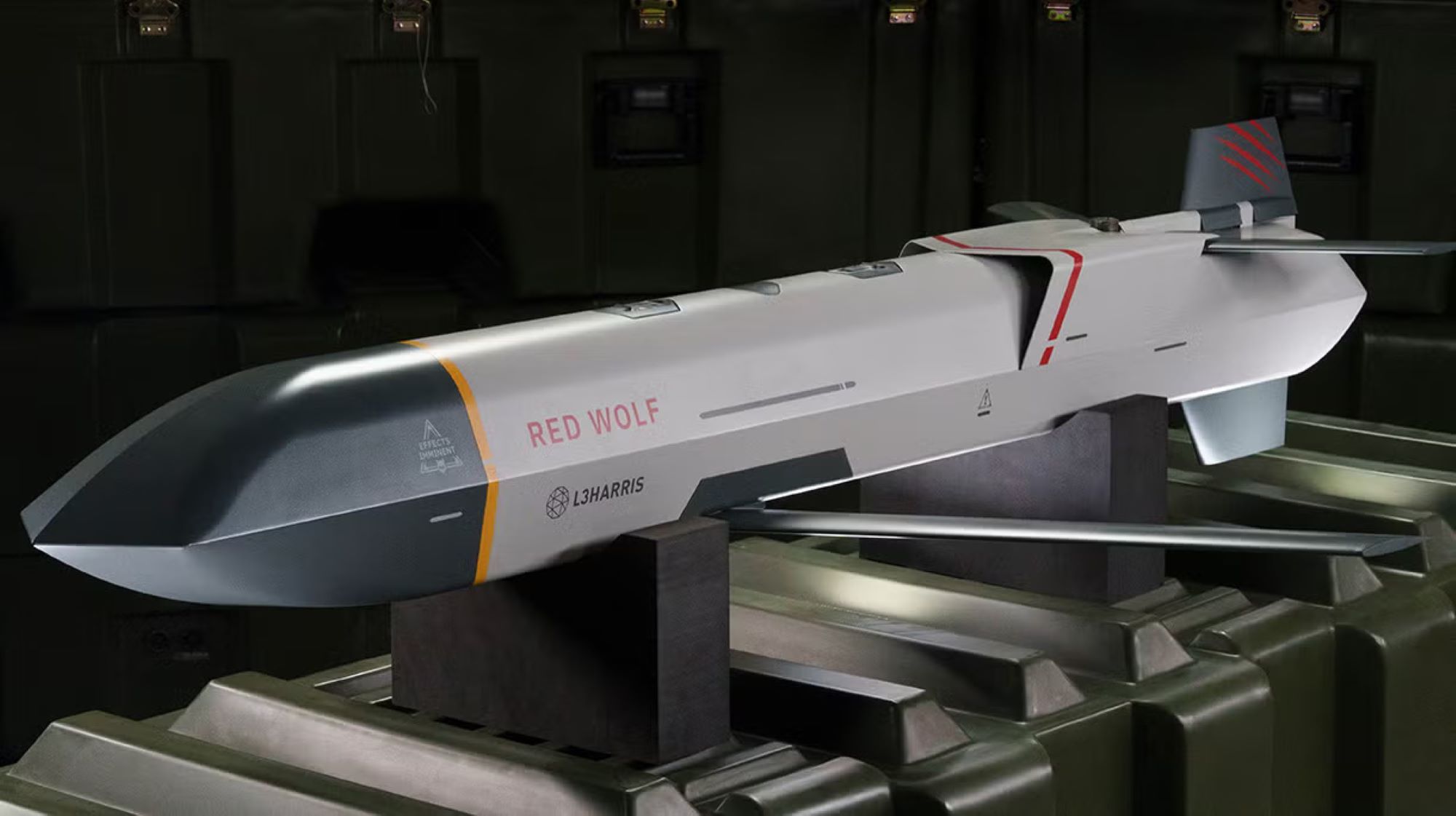
Neither the company nor the Marines have so far publicized a test with the EW-capable Green Wolf. With the need to throw “affordable mass” into maritime warfare, according to L3Harris, the priority could be trialling a classic kinetic capability weapon first, before progressing to ones in the electro-magnetic spectrum realm. A future order by NAVAIR for initial Lots for the Red Wolf will reveal the direction in which the program is heading.
Test parameters
L3Harris’ current statement said the Red Wolf, “mounted to the pylon of an AH-1Z Viper helicopter […] successfully launched and engaged a sea-based target” as a part of the LRAM capability demonstration, while also participating “in the targeting network, highlighting its operational relevance.” As we had noted before, this is consistent with previous Marine Corps’ drills with AGM-179 JAGM missiles fired from AH-1Z Vipers against a maritime target in the Indo-Pacific and L3Harris’ concept videos showing the Red Wolf striking the main sensor mast of a PLA Navy Type 52D destroyer.
With 45 flights and counting, Red Wolf ™ and Green Wolf ™ ensure warfighters have a critical battlefield edge when it matters most. Learn more: https://t.co/FS2PrpoJCx #AUSA2025 pic.twitter.com/het0wEiJBh
— L3Harris (@L3HarrisTech) October 7, 2025
The goal might be to temporarily blind the ship’s main sensors and open the doorway for larger follow-on strikes by AGM-158C LRASM (Long-Range Anti-Ship Missile) or the Joint Strike Missile (JSM). L3Harris’ president of space and airborne systems Ed Zoiss said the test “validated Red Wolf’s advanced tracking and targeting capabilities, further demonstrating its ease of use and integration across platforms.”
“We’ve now proven our launched effects vehicles will help provide our warfighters the asymmetrical advantage they need to handle increasingly sophisticated threats without the need to enter into adversary weapon engagement zones,” Zoiss said in the Dec. 19 release. L3Harris again mentioned the several tests held so far, and referred to the Marine Air-Ground Tablet (MAGTAB) that it used in the November 2024 test at Yuma Proving Grounds, Arizona.
Smart. Lethal. Ready for the fight. ✅
Red Wolf ™ and Green Wolf ™ give warfighters a critical battlefield edge when it matters most. Learn more: https://t.co/z0xLUAb6fy#DubaiAirshow pic.twitter.com/Gy3HYxkDXV
— L3Harris (@L3HarrisTech) November 19, 2025
“This live-fire test over the Atlantic Ocean was the latest in a series of multi-service air and ground-launched demonstrations that integrated L3Harris’ ‘wolf pack’ of launched effects vehicles into existing combat platforms, including the first time a Marine Corps rotary-wing platform employed a weapon system using a tablet-controlled device,” further said the statement.