Official descriptions suggest the CH-7 has an ISTAR role, which would allow it to send back data on enemy vessels in the western Pacific and guide long-range maritime strike missiles.
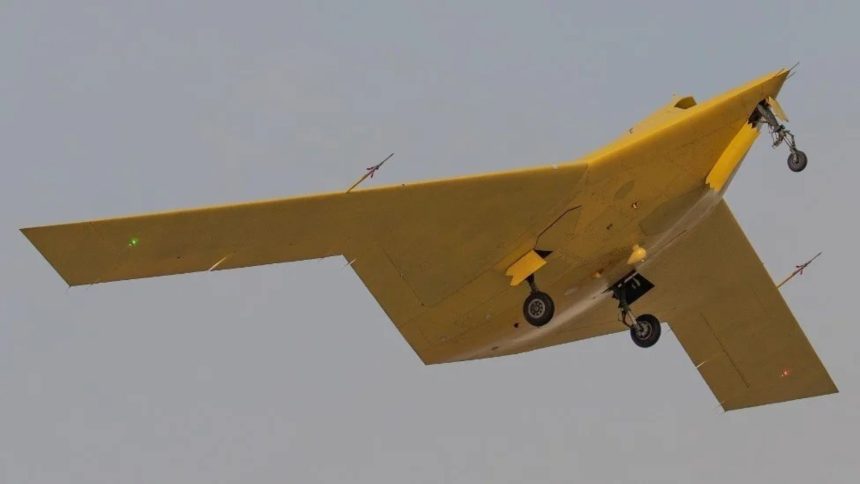
China’s CH-7 flying-wing high-altitude surveillance drone conducted its maiden flight from a facility in northwestern China, Chinese reports said, marking the beginning of its flight testing phase. It is not clear when the test flight took place, with both official and unofficial Chinese sources mentioning the event was “recent.”
While the flight tested the basic flight and handling characteristics, this and future flights will test its core mission payloads for what reports suggest is a classic ISTAR (Intelligence, Surveillance, Target Acquisition and Reconnaissance) role.
Developed by the 11th Academy of the China Aerospace Science and Technology Corporation (CASC), the drone may be equipped with a series of active and passive optical, electronic, infrared sensors and sensor fusion technologies, according to a description of the drone’s capabilities and role by CASC officials in Global Times.
https://t.co/bO7zcFSNYi pic.twitter.com/Eg0zA5hB1Z
— Hûrin (@Hurin92) December 15, 2025
GT mentions the CH-7 also has weapons bays, but we are yet to see any evidence of internal stores in overhead shots, clearly capturing the aircraft’s ventral side. The “stealth” unmanned vehicle would fly high over the western Pacific for theater-level surveillance, sweeping up preliminary targeting data for PLA Air Force, Navy and Rocket Force ahead of hostilities.
Same airframe or another prototype?
Interestingly, the UAV was captured flying in an unofficial video from the ground on Nov. 11, 2025, with two canted vertical stabilizers. Before that video, the drone had been seen only in a tailless form in official footage, concepts and display models.
Leading Chinese military aviation analyst Andreas Rupprecht therefore wonders whether this was the same airframe, or another prototype.
And so the question again is, what was this ?
Another CH-7 prototype with vertical fins and now it flew without or are two different UAVs? pic.twitter.com/nVa9GTJb2X
— @Rupprecht_A (@RupprechtDeino) December 15, 2025
In Nov. 2024, on the sidelines of the Zhuhai Air Show, a live model of the CH-7 was featured for the first time. The aircraft rolled on the runway, bearing a factory yellow primer and a flight data probe (pitot tube) on both the wings. It also showed two pairs of joints on either side of the flat exhaust to support the vertical stabilizers.
If this is the same airframe (with vertical stabilizers) from the video that appeared a month ago on Nov. 11, 2025, it means the aircraft had flown before in the run to that flight and the latest officially maiden flight test. However, those two joints are missing on the CH-7 model from the latest, officially announced, test flight.
Besides the official unveiling of the GJ-11 also another flying wing UAV/UCAV – namely the CH-7 – was seen for the first time flying; however quite surprisingly with additional tails attached. pic.twitter.com/YCG04PCBdr
— @Rupprecht_A (@RupprechtDeino) November 11, 2025
There are patches near the exhaust where the joints are placed, suggesting the joints themselves may be removable, adding to further confusion whether the airframe seen in the latest test flight and the one captured in the Nov. 11 video are the same.
It also seems that the current flight took place at the Pucheng Airport, operated by the China Flight Test Establishment, the same facility from where the Jiutian drone-swarm mothership recently flew.
Additionally, the current images show two pitot tubes and a factory yellow primer, and the same four circular, square and rhombus-shaped antenna sensors above the engine intake. These could be meant for satellite transceivers and long-range data links needed for the ISTAR role to trade reconnaissance information with PLA Navy and PLA Rocket Force assets that would undertake the bulk of the surface and maritime fires.
Testing
Descriptions on GT and Shanghai Eye put the CH-7 (also known as the Rainbow 7 or Cai Hong-7) in the HALE (High-Altitude Long-Endurance) category. GT quoted CASC’s Li Jianhua: “The primary objective of the CH-7’s inaugural flight was to effectively validate […] most basic flight characteristics […] the rationality of its design scheme and the progress of its key technological breakthroughs.”
IIRC this is our first look at the flying wing CH-7 stealth UAV (doesn’t seem Psed)
src 梦漪迟/wb pic.twitter.com/XZk8J08Gfb
— Hûrin (@Hurin92) November 8, 2024
The lack of vertical stabilizers eliminates a reflective surface for radars, but inherently results in an aerodynamically unstable flight. To counter the problem, the CH-7 has to use powerful flight control computers with advanced control laws algorithms.
Flight control systems also need to be highly redundant and resilient with multiple backups, in case of failures – a not-so-uncommon event in aviation history. The CH-7 therefore “requires testing for a greater number of critical technologies, making the process more challenging.”
The CH-7’s tailless flying-wing aerodynamic configuration with a high aspect ratio has been described as a “complex system.” Li told GT the drone “also inherently faces issues with directional stability. These factors collectively increase the difficulty and, consequently, elevate the risks associated with its maiden flight.”
CH-7(彩虹-7) ステルスUAV pic.twitter.com/Tn6NWhY1Sy
— お砂糖wsnbn (@sugar_wsnbn) November 8, 2024
The unmanned aircraft can autonomously taxi, take-off and land, GT added, indicating how these semi-autonomous capabilities for elementary maneuvers are now a staple for uncrewed aerial systems.
“During the maiden flight, the CH-7’s basic performance, including autonomous taxiing takeoff and landing, attitude control, and trajectory tracking, was validated. The test flight results were highly successful, fully aligning with the predetermined design specifications and simulation model outcomes,” Li said.
Capabilities and battlefield role
CASC designers have placed a premium on stealth, incorporating “radar wave-absorbent designs” and “stealth coating” along the “leading edges, access panels, landing gear bay covers, and weapon bays, among other components.” Moreover, “Specialized treatment is even applied to screws, collectively endowing the CH-7 drone with exceptional low observability,” GT added.
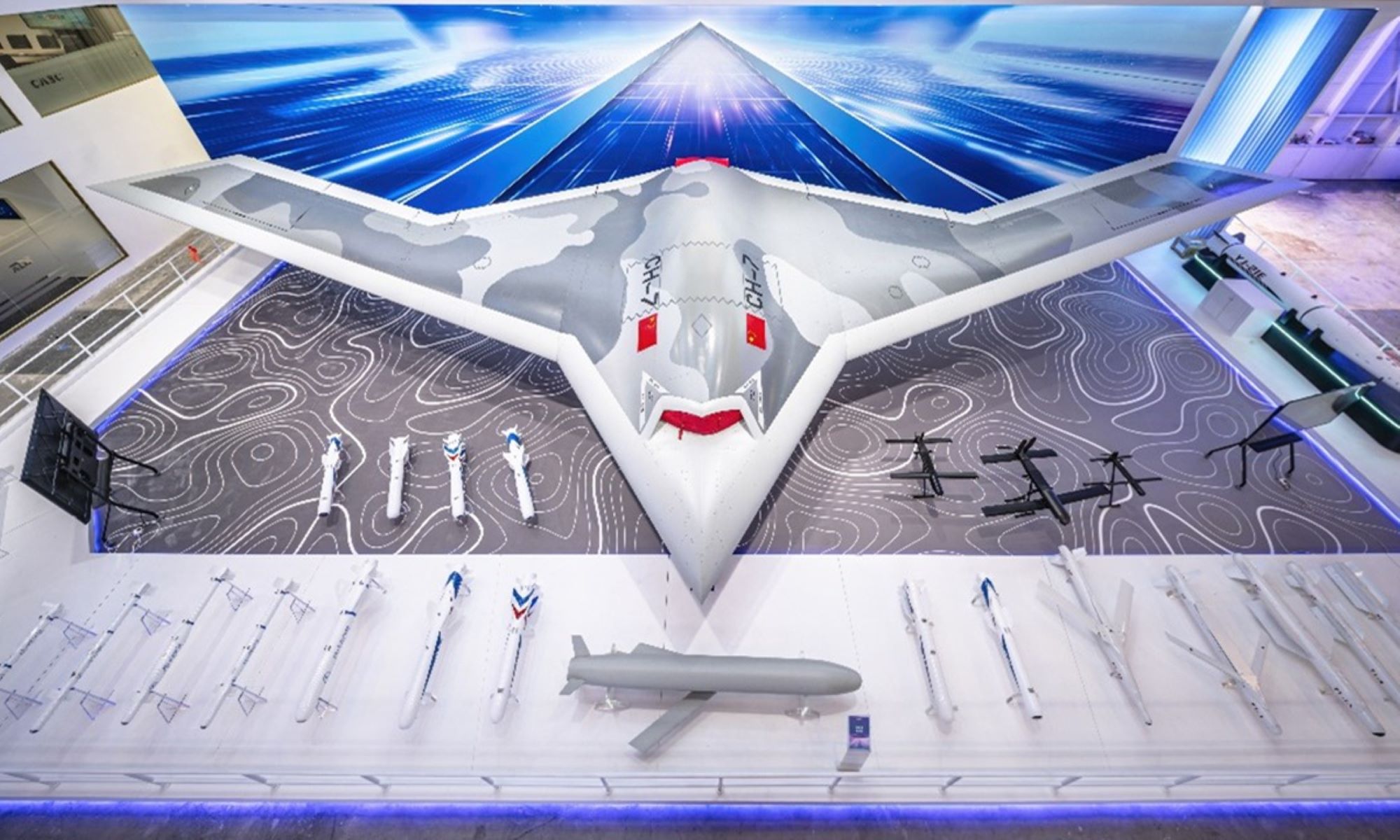
The design leverages “visible light and infrared sensors” for “ground observation and data support requirements under complex conditions,” unidentified CASC officials told GT. The role for which it has been designed involves “long-duration patrols over target maritime areas,” and “upon detecting a target,” relaying the information back to rear command via the data link.
However, the drone can also provide “mid-course guidance or even terminal guidance for long-range strike weapons,” suggesting the drone’s integration in the use of China’s DF-21D ASBM (Anti-Ship Ballistic Missile) and the air-launched ship-killing KD-21.
CH-7 again pic.twitter.com/6iRZOUlX17
— Hûrin (@Hurin92) October 29, 2024
GT claimed the CH-7 has an “onboard radar” for “maritime surveillance” of “large surface vessel targets.” Such systems, which could also be Synthetic Aperture Radars (SAR), would be used to take a radar ‘picture’ to distinguish targets of interest from the nearby clutter. However, this or protruding electro-optical ball turrets are not seen in the latest flying example of the aircraft.
Rin Sakurai contributed to this report.