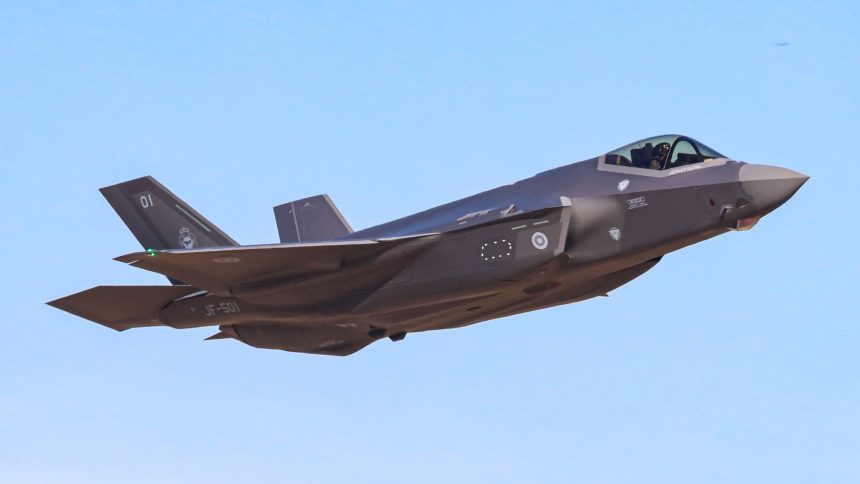
The Finnish Air Force’s first F-35 conducted its first flight on Dec. 8, ahead of the official rollout ceremony next week.
The Finnish Air Force has announced the maiden flight of its first F-35A Lightning II from Naval Air Station Joint Reserve Base Fort Worth, Texas, where Lockheed Martin’s production facilities are based, on Dec. 8, 2025. The aircraft, with the serial JF-501, flew ahead of the official rollout ceremony on Dec. 16, which will also see the participation of Finland’s President Alexander Stubb.
JF-501
The final assembly took a year and finished on time, as airframe was scheduled for completion in Autumn 2025. This was reported when, during a visit to Lockheed Martin’s plant on Oct. 28, 2024, retired Finnish Air Force colonel and current Finnish F-35 program director Henrik Elo signed his name on the bulkhead of what would become JF-501.
The factory test flight was conducted from the Naval Air Station Joint Reserve Base Fort Worth, TX, on 8 DEC 2025, at 2.55 PM local time. #JF501 will be presented to the public at a rollout ceremony at the @LockheedMartin Fort Worth facility on 16 DEC 2025. #ilmavoimat 2/2 pic.twitter.com/Ur6uOni1Mf
— Ilmavoimat (@FinnishAirForce) December 9, 2025
The aircraft was moved out of the final assembly line at the end of October 2025. The aircraft was later painted in the full Finnish Air Force colors and started ground testing.
According to the Finnish government, the first F-35 fighters will enter into service in 2026 to start the training of Finnish personnel in the United States. Later that year, the first F-35 will also arrive in Finland, assigned to the Lapland Air Wing.
Finland’s F-35s
Finland has ordered 64 examples of the conventional take-off and landing F-35A variant to replace its current fighter force of F/A-18C/D Hornets, beating competition from Boeing’s F/A-18E/F Super Hornet and Saab’s Gripen E/F.

The Finnish Air Force ordered its Hornets in 1992, with approximately 55 F/A-18Cs and 7 F/A-18Ds remaining in service today. Notably, this means that the F-35 order is, accounting for attrition, a like-for-like replacement in terms of numbers, contrasting many nations who have ordered fewer F-35s than the jets they are replacing.
All of Finland’s F-35s will be delivered equipped with the Technology Refresh 3 (TR-3) package. TR-3 is a major electronics upgrade for the F-35, offering higher processing power and an open architecture philosophy which will allow quicker and simpler integration of future technologies, sensors and weapon systems onto the type.
Speaking at the Fort Worth plant, Henrik Elo noted the symbolic but important milestone in the delivery of his country’s new aircraft: “I am very pleased that we are progressing in building the various capability areas of our F-35 as planned. The forward fuselage signing event is a minor but symbolically important milestone in the manufacturing process of the aircraft fleet.”
The deliveries of the F35s are expected to start in 2026, with the first eight aircraft delivered to Ebbing Air National Guard Base, Arkansas. Ebbing ANGB hosts the F-35 training for the personnel from Finland and several partners.

According to the current schedule, Finland will see its first delivery of F-35s touch down at Rovaniemi Airport by the end of 2026. There they will join HävLLv 11 (11 Squadron) of the Lapland Air Wing, which guards the airspace of Finland’s northern territory. Karelia Air Wing, based at Kuopio Airport in south-east Finland, will receive its F-35s from 2028.
These bases, which are Finland’s only two full-time operational fighter bases, are both around one hundred miles from the Russian border, and ideally placed to launch fighters for intercept tasks over the Barents and Baltic seas. With Finland’s recent accession into NATO, the nation has taken an active role in the alliance’s joint air defense initiatives and this integration will likely continue in the future.
Finland will join a small selection of F-35 operators using the drag chute modification pioneered by and currently unique to the Royal Norwegian Air Force. Only Norway, the Netherlands, Belgium, Finland and Canada are presently confirmed to have chosen the option, owing to their cold climates.
The drag chute, which is housed in a small fairing between the aircraft’s twin tail fins, is designed to assist braking on potentially icy runways. While any external fairing will affect the F-35’s stealth characteristics to some degree, Lockheed Martin says the drag chute system has been designed to minimize its impact to the overall radar cross-section (RCS) of the aircraft.