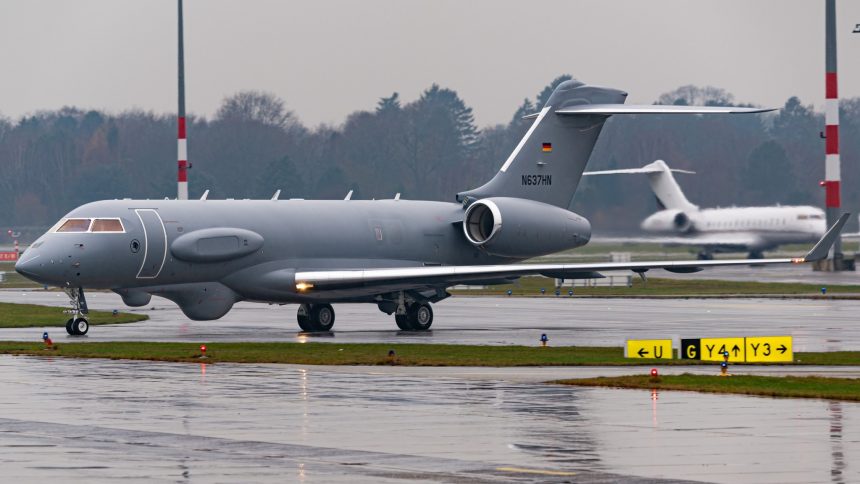
After leaving Hamburg in early 2024, the first PEGASUS returned to Germany to receive the dedicated Kalætron Integral SIGINT suite by Hensoldt.
Germany’s first PEGASUS (Persistent German Airborne Surveillance System) SIGINT (Signals Intelligence) aircraft, based on the Bombardier’s Global 6500 business jet, was photographed at Hamburg airport on Dec. 4, 2025. The aircraft arrived there for the next phase of its transformation, with the installation of the dedicated Kalætron Integral SIGINT suite by Hensoldt which will be carried out by Lufthansa Technik.
According to flight tracking, the aircraft, registration N637HN, arrived in Hamburg directly from the Bombardier Flight Test Center (BFTC) in Wichita, Kansas. While there, the jet underwent the required airframe modifications, which include new fairings installed on the sides and below the fuselage, and the subsequent trial flights.
The images of N637HN were captured by aviation photographer Niclas Rebbelmund, who kindly allowed us to include them in this article, and published them on his Facebook and Instagram pages, ‘NJPR Photography’ and ‘niclashco’, respectively.
Nicht besonders überraschend, aber die neuen PEGASUS-Flugzeuge scheinen für das Taktische Luftwaffengeschwader 51 in Jagel vorgesehen zu sein. https://t.co/ti9Otrxzgq pic.twitter.com/egnuHeqjIL
— Der Aktenfresser (@DerAktenfresser) December 6, 2025
PEGASUS SIGINT aircraft journey
The jet arrived in Hamburg is one of three aircraft to be used by the Luftwaffe (German Air Force) in the future to fill the gap left by the retirement of the Breguet BR1150 Atlantic aircraft in 2010. The program is a collaborative effort between Bombardier Defense, Lufthansa Technik and Hensoldt, and involves Lufthansa procuring the three aircraft from Bombardier, modifying the airframe, conducting flight testing at BFTC, and integrating Hensoldt’s Kalætron Integral ELINT/SIGINT/COMINT suite in Germany.
According to Luftarhtnews & Planespotting aus Hamburg, N637HN, which as we mentioned is a Bombardier Global 6500 aircraft, had left Hamburg airport on Apr. 6, 2024, to receive the series of external modifications. On Mar. 19, 2024, N637HN, was also photographed at Hamburg in a fully white paint scheme ahead of the departure.
LPaH reported at the time that the Global 6500 had arrived at Lufthansa Technik (LHT) Hamburg facility on Aug. 23, 2021, from the Bombardier facility in Toronto, Canada, flying with the registration C-GOMN. LHT then on Oct. 23, 2024, announced the first flight of the aircraft from Wichita, which most likely could be N637HN itself.
Future
A Lufthansa Technik spokesperson told Hartpunkt in an August 2025 report that two of the three aircraft that have already been “externally modified” were at the time undergoing flight testing at Wichita’s facilities. This has now led up to the PEGASUS N637HN returning to Hamburg on Dec. 4.
N637HN touched down on runway 23, before taxiing to the Lufthansa Technik’s hangar. The aircraft still bears the “experimental” marking on the fuselage and, following the pending Hensoldt’s Kalætron Integral SIGINT suite integration, it should receive Luftwaffe insignia. LPaH however pointed to the logo of the Tactical Air Wing 51 “Immelmann” already present on the front fuselage.
The jet’s future registration is expected to be 14+20 and it would be based in northern Germany, but the Bundeswehr is yet to decide whether to assign it to Hohn Air Base or Jagel Air Base. This airframe is expected to be delivered to the German Armed Forces (Bundeswehr) by 2027, with the other aircraft following suit.
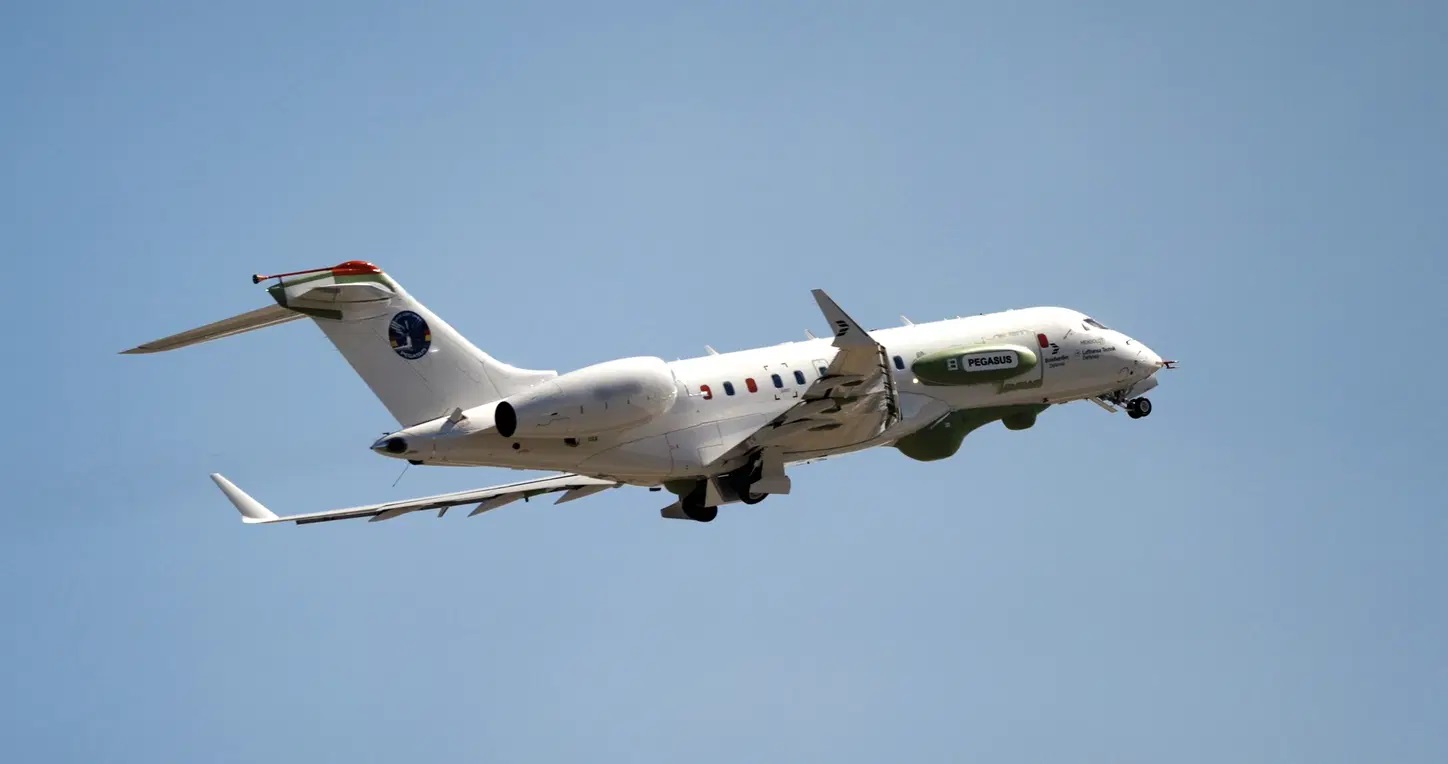
“In addition to the system integration of PEGASUS, Lufthansa Technik Defense is also responsible for regulatory certification at the complete aircraft level. The design work for integrating the mission system, the additional civil and military avionics systems, and the aircraft cabin has already been completed. Production of the interior components has also begun to ensure that they can be installed immediately upon the aircraft’s arrival at the Special Mission Aircraft Competence Center in Hamburg,” Hartpunkt mentioned.
Hartpunkt has also previously reported, quoting unnamed sources in the Bundeswehr, that Berlin has an actual need for an additional three to six such systems.
Kalætron Integral and Germany’s SIGINT capability
Kalætron Integral is an airborne SIGINT solution that provides a “comprehensive strategic asset for wide-area reconnaissance, mastering the challenges posed by today’s electromagnetic spectrum,” says Hensoldt. The system integrates intelligence gathered from both radar signals (ELINT) and communication signals (COMINT) in a single package which covers the entire electromagnetic spectrum with continuous frequency coverage from less than 30 MHz to 40 GHz.
Hensoldt also says on its website that Kalætron features highly automated workflows powered by machine learning and AI algorithms, which accelerate the decision-making while reducing the workload of operators. This allows one to obtain a constantly evolving view of the electromagnetic order of battle, combining insights from various platforms in all domains into a single intelligence picture.
In my excitement at hearing even more #Germany defence news today, I jumped the gun with my earlier pronouncement on #PEGASUS first flight (always best to disclose an embargo at the start of the call rather than the end, I find)… 1/6 pic.twitter.com/pGSekXmJwn
— Gareth Jennings (@GarethJennings3) October 23, 2024
The Kalætron Integral system was fielded by Hensoldt after Germany initiated the PEGASUS program in 2020. This followed the cancellation of the RQ-4E Euro Hawk unmanned ISR program with a single aircraft, and later dropping, upon briefly considering, the MQ-4C Triton.
The combination of superior altitude and long range enables the Kalætron Integral system to cover vast areas at a safe distance from potential threats, says the producer, with a detection range of about 400 km. The website further states the system features “exceptional accuracy, high sensitivity, a broad frequency range and extended time on station,” without delving into details.
Combined with Germany’s new P-8A Poseidon maritime patrol and anti-submarine warfare’s organic Electronic Support Measures (ESM) capability, the PEGASUS will go a long way in swooping up electronic emissions and building an electronic order of battle in the North Sea and Baltic Seas. These regions are seeing persistent and increasing Russian Naval, tactical and strategic aviation activities.
Special thanks to Niclas Rebbelmund for allowing us to use his pictures. Make sure to follow him on Facebook and Instagram for more!