Japan reports two ‘lock on’ incidents near Okinawa as advanced radar technology blurs the line between routine tracking and a hostile threat. Here’s everything you need to know.
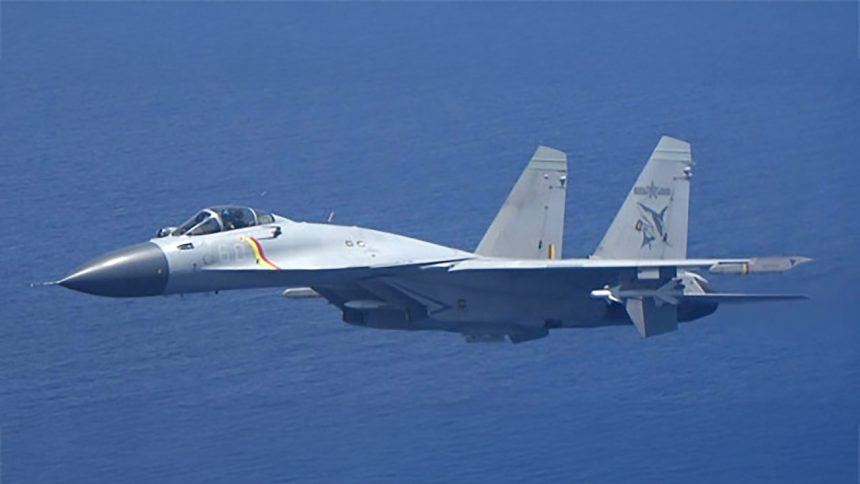
Japan has lodged a formal protest with China after two Chinese Navy J-15 fighter jets, operating from the aircraft carrier Liaoning, repeatedly conducted radar lock-on against Japan Air Self-Defense Force F-15s flying air defense identification zone (ADIZ) missions southeast of Okinawa on Dec. 6, 2025. According to the Ministry of Defense, the incidents occurred twice within a three-hour window and is considered a dangerous act well beyond what is necessary to ensure safe flight operations in international airspace.
中国軍機による自衛隊機へのレーダー照射事案についてご報告いたします。
レーダー照射は2回ありました。… pic.twitter.com/wykKChEOhA
— 小泉進次郎 (@shinjirokoiz) December 6, 2025
Here’s the English translation of the official statement:
We hereby report on the incident of radar lock-on by a Chinese military aircraft against an Air Self-Defense Force aircraft.
There were two instances of radar lock-on.
First, between approximately 4:32 p.m. and 4:35 p.m. on December 6 (Saturday), in the airspace over the high seas southeast of Okinawa’s main island, a J-15 fighter aircraft that had taken off from the Chinese Navy’s aircraft carrier “Liaoning” intermittently conducted radar lock-on against an Air Self-Defense Force F-15 fighter aircraft that was implementing air defense identification zone (ADIZ) measures against the subject aircraft.
Second, between approximately 6:37 p.m. and 7:08 p.m. on the same day, in the airspace over the high seas southeast of Okinawa’s main island, a J-15 fighter aircraft that had taken off from the Chinese Navy’s aircraft carrier “Liaoning” intermittently conducted radar lock-on against a different Air Self-Defense Force F-15 fighter aircraft—one distinct from the one in the first incident—that was implementing air defense identification zone (ADIZ) measures against the subject aircraft.
This radar lock-on incident constitutes a dangerous act that exceeds the scope necessary for the safe flight of aircraft. We view the occurrence of such an incident with utmost regret, and we have lodged a strong protest with the Chinese side while making a stern demand for measures to prevent recurrence.
Note that there was no damage to the Self-Defense Force aircraft or its personnel.
The Japanese report is disputed by the PLAN spokesperson, Wang Xuemeng, who said:recently, the Chinese Navy’s Liaoning aircraft carrier formation conducted normal carrier-based fighter flight training in the sea and airspace east of the Miyako Strait, with the training areas announced in advance. During this period, Japanese Self-Defense Force aircraft repeatedly approached and harassed the Chinese Navy’s training sea and airspace, seriously disrupting the normal training on the Chinese side and posing a grave threat to flight safety. Japan’s relevant hype is completely inconsistent with the facts. We solemnly demand that Japan immediately cease its slandering and smearing, and strictly restrain frontline actions. The Chinese Navy will take necessary measures in accordance with the law to resolutely safeguard its own safety and legitimate rights and interests.”
【海军新闻发言人就辽宁舰航母编队远海训练发布消息】中国人民解放军海军新闻发言人王学猛海军大校表示,日前,中国海军辽宁舰航母编队在宫古海峡以东海域正常组织舰载战斗机飞行训练,事先公布了训练海空域。期间,日本自卫队飞机多次抵近中国海军训练海空域滋扰,严重影响中方正常训练,严重危及飞行…
— ChinaNavy (@China_Navy) December 7, 2025
What’s a radar lock-on?
A radar lock-on traditionally refers to the moment when a fighter’s radar transitions from general surveillance to a specific fire-control mode that designates another aircraft as a target for weapons use. Historically, this transition has been unambiguous because mechanically scanned radars needed to move from Track-While-Scan (TWS), which maintains situational awareness on multiple aircraft, to Single Target Track (STT), which concentrates radar energy on a single target. In STT, the radar provides continuous and precise updates on range, closure, altitude, and heading, enabling the guidance of radar-homing missiles. This shift is immediately recognizable by the opposing pilot’s Radar Warning Receiver (RWR), which classifies the signal as fire-control targeting and triggers visual and acoustic warnings. A lock-on is therefore a clear signal of hostile intent, as it represents the final step before a missile can be launched.
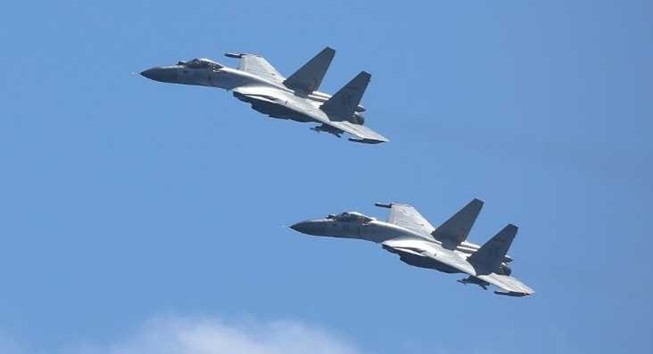
Modern Active Electronically Scanned Array (AESA) radars have significantly changed how radar lock-on is performed and perceived. Unlike legacy mechanically scanned radars, which must shift into an overt Single Target Track mode to support missile guidance, AESA systems can electronically steer multiple narrow beams and focus energy with great precision while still appearing to conduct broad surveillance. They employ Low Probability of Intercept (LPI) techniques such as rapid frequency hopping, highly directional beams, and reduced sidelobe emissions. These methods are specifically designed to make radar signals blend into background noise and become difficult to detect by older or less capable Radar Warning Receivers (RWRs).
As a result, an AESA-equipped fighter can provide mid-course guidance to radar-homing missiles without generating the kind of distinct fire-control signature that would traditionally trigger a lock-on alert in the targeted aircraft. Advanced RWRs may still detect subtle changes associated with increased tracking energy or datalink activity, but the warning can arrive much later in the engagement. In extreme cases, the first clear indication of hostile intent may be the missile’s own seeker activating, leaving only seconds to react.
This evolution introduces ambiguity that did not exist in earlier generations of radar technology. Pilots can no longer rely solely on their RWR to determine when they have been designated as a weapons target. Instead, they must interpret the geometry and behavior of the opposing aircraft to assess whether a missile launch may be imminent, making threat evaluation far more challenging in crowded or contested airspace.
12/7、クズネツォフ級空母「遼寧」を含む複数の中国海軍艦艇が、沖縄本島と南大東島の間の海域を北東進し、喜界島の東約190kmの海域を東進していることを確認しました。また空母「遼寧」からの艦載戦闘機等の発着艦を確認しました。#防衛省・自衛隊 は、引き続き #警戒監視・情報収集… pic.twitter.com/pIDkcmlkn7
— 防衛省統合幕僚監部 (@jointstaffpa) December 7, 2025
“Hostile intent”
Despite these sensor advancements, international rules of engagement continue to distinguish clearly between hostile intent and hostile act. Hostile intent is demonstrated by an action that prepares the use of force against another asset. Hostile act indicates that force has been used, or that its use is imminent and unmistakable. Radar lock-on, including silent fire-control behavior enabled by AESA radars, remains categorized as hostile intent. However, because AESA tracking can be difficult or impossible to detect, pilots must increasingly rely on evaluating the kinematics of the encounter rather than sensor warnings alone.
The context in which a lock-on occurs is therefore more important than ever. Pilots assess a combination of distance, closure rate, nose-on positioning, visible weapons configuration, proximity to sovereign airspace, and any aggressive or unpredictable maneuvering. Hard maneuvering at close range combined with a radar lock-on can be perceived as a potential hostile act, because the targeted aircraft may have seconds to decide whether a missile is already in the air. Situations like this increase the risk that a defensive counteraction triggers further escalation, leading rapidly from a tense intercept to a serious incident.
For this reason, safe intercept procedures remain a cornerstone of professional military aviation. Even in politically sensitive areas, such as those surrounding Chinese naval operations in the Western Pacific, most air forces adhere to recognized international norms: visual identification, predictable formations, and clear communications where possible. Employing radar lock-on against a foreign aircraft operating legally in international airspace is not considered standard practice. It is a deliberate display of pressure, and nations routinely lodge formal protests whenever such incidents occur.
As AESA radars, long-range weapons, stealth platforms, and electronic warfare systems continue to evolve, aerial encounters will increasingly occur with fewer traditional warning cues, narrower reaction windows, and greater risk of misinterpretation. This makes professionalism and adherence to established intercept protocols more critical than at any time in recent decades. Anyway, a lock on is signal of hostile intent that demands caution, composure, and impeccable judgment to prevent a dangerous incident from escalating into an armed confrontation.
A current NATO fighter pilot who wishes to remain anonymous contributed to this article.