.
jump to navigation

Camp Bastion attack could be U.S. Marine Corps Harrier fleet’s ground zero September 22, 2012

Posted by David Cenciotti in : F-35, Italian Air Force, Italian Navy, Military Aviation , 4comments

As already explained, the recent Taliban attack on Camp Bastion, that cost the U.S. the worst air loss to enemy fire in one day since the Vietnam War, almost wiped out the entire U.S. Marine Harrier force in Afghanistan: besides killing two Marines, including the Commanding Officer of Marine Attack Squadron (VMA) 211, six AV-8B+ aircraft were destroyed and two more severly injured.

Since the VMA-211 “Avengers” had deployed to Afghanistan with 10 airframes, only two Harriers survived the insurgent attack in one of the strategical airbases in Afghanistan (aircraft that were immediately returned to the U.S.).

In other words, in a matter of a hours, the U.S., that had moved VMA-211 from Kandahar to Camp Bastion on Jul.1 to have the planes closer to where the troops need support, not only lost one of its most valuable CAS (Close Air Support) platforms in Afghanistan, but also about 1/15th of the entire American Jump Jet fleet.

Even though you may believe that the loss of 8 Harriers is not a big deal when you have a fleet of 120+ such planes, you have to consider that  about 15 planes are TAV-8B two seater jump jets used for training purposes, along with about the same amount of single seaters.

Moreover, of the remaining Harriers (about 100), not all airframes can be used in combat with the same effectiveness, because the U.S. Marine Corps, along with the upgraded AV-8B+ (like those destroyed at Camp Bastion), that features the APG-65 Radar and the Litening pod, flies also the less capable AV-8B.

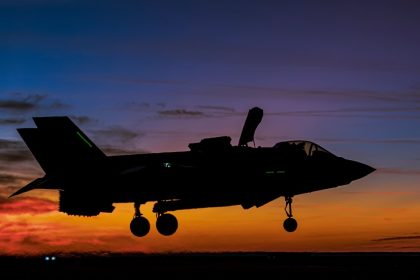
Hence the extent of losses suffered in Afghanistan is higher than the 7 percent and could be a big deal for the U.S. Marine Corps that has to carefully ration the employment of the Harriers if it wants to keep the AV-8B+ in service beyond 2030, when it will eventually be replaced by the F-35B.

Well before the Camp Bastion attack, to increase the availability of spare parts and extend the life of the Harrier, the Marines procured second hand RAF Harrier GR9s.

Image credit: U.S. Air Force

The second generation AV-8B Harrier, developed in the first ’80s, was well suited for U.S. Marine Corps requirement for a Close Air Support aircraft able to give effective tactical support to amphibious landing operations. Over the years, it was also upgraded to carry AMRAAM missiles, JDAMs (Joint Direct Attack Munitions), and today the plane (operating also with both the Spanish and Italian Navy) is able to undertake CAS missions, naval Theater Air Defense and precision Air-to-Ground tasks.

That’s why the Harrier is so important for the U.S. Marine Corps.

Beyond the AV-8B+

The USMC and the Italian Navy plan to replace their Harriers with the F-35B, the STOVL (Short Take Off Vertical Landing) version of the JSF (Joint Strike Fighter) conceived for Jump Jet users: U.S. Marines, IT Navy and Royal Navy / Royal Air Force (the first “international” F-35 is the F-35B BK-01 / ZM135, that made its maiden flight in April 2012). Althought it’s not among the AV-8B+ operators, the Italian Air Force is expected to operate 15 F-35Bs along with 60 F-35As.

The STOVL aircraft will be a swing role platform suited to be effective in a net-centric environment, where it will perform both sensor and shooter roles. But it will not be fully operational before the late 2020s, and the USMC is planning to upgrade its Harriers in order to keep them in service until a significant amout of F-35Bs will be operational.

Not only the USMC will have to upgrade the jump jets.

Probably, both Spanish and Italian Navy will have no choice but to upgrade their Harriers, which could be really effective with SDBs (Small Diameter Bombs) and new avionics, considering that the Air Superiority within a naval group area of operations is provided by the combination of both airborne and ship-based capabilities.

Nevertheless, since it doesn’t partecipate to the JSF program, Spain will probably lose its embarked fixed wing component if it doesn’t acquire the F-35B.

Written with The Aviationist’s “Skipper”

Commanding Officer of the Harrier squadron decimated at Camp Bastion among the Marines killed in the Taliban attack September 17, 2012

Posted by David Cenciotti in : Military Aviation , 15comments

The Marine Attack Squadron (VMA) 211 “Avengers” that was decimated on Friday Sept. 14, when a force of insurgents attacked Camp Bastion, in Helmand, has not only lost two Marines and eight of the ten AV-8B+ Harrier jets deployed in Afghanistan.

According to UTSanDiego.com, Marine and family sources have confirmed that Lt. Col. Chris “Otis” Raible, commanding officer of the Yuma squadron is among the killed in action of the unprecedented attack that resulted in the destruction of six jump jets and significant damage (possibly beyond repair) to two more Harriers belonging to the VMA-211, the unit he commanded.

The VMA-211 is part of the 3rd Marine Aircraft Wing headquartered in San Diego at Marine Corps Air Station Miramar.

Raible led the “Avengers” when the unit, deployed to Afghanistan in April 2012, relocated from Kandahar Airfield to Camp Bastion on Jul. 1 and he’s depicted in most of the images released by the U.S. Marine Corps to give account of the transfer.

Image credit: U.S. Marine Corps

Camp Bastion was in close proximity to all the units they supported and this gave the VMA-211 the opportunity to conduct more combat operations and communicate more effectively with the ground combat element.

Unfortunately neither Raible nor the rest of the “Avengers” could predict the attack that cost the U.S. the worst air loss to enemy fire in one day since the Vietnam War, that has rendered the Squadron unable to support the troops in the ground and compelled the Marine Corps to fly the remaining two airframes back home.

Image credit: U.S. Marine Corps

U.S. amphibious assault ship to be moved into position to support Noncombatant Evacuation Operation in Libya? September 13, 2012

Posted by David Cenciotti in : Aircraft Carriers, Libyan Uprising, Military Aviation , add a comment

“Where are the carriers?” is believed to be the first question a U.S. President asks his closer advisors each time America has to deal with a crisis.

In this case, the attack on the Benghazi consulate, that cost the life of the U.S. Ambassador to Libya Chris Stevens and three others, has compelled the Pentagon to send a Fleet Antiterrorism Security Team (FAST), an expeditionary group of skilled and very well equipped Marines capable to reinforce U.S. security forces at embassies and other key installations around the world.

Along with the FAST team, reportedly moving from Rota, Spain, drones, and the USS Laboon and USS McFaul destroyers, equipped with Tomahawk cruise missiles, sailing towards the Libyan coasts, it is quite likely that even an amphibious ship with a MEU (Marine Expeditionary Unit), capable to perform NEOs (Noncombatant Evacuation Operations), will be dispatched in the Mediterranean sea in preparation for the possible evacuation of the U.S. diplomatic mission.

Image credit: U.S. Marine Corps

A MEU is made of 2,200 Marines and sailors deployed as a Marine air-ground task force (MAGTF) that includes a Marine infantry battalion equipped with tanks, amphibious assault vehicles, light artillery as well as Mv-22B Osprey tilt-rotor aircraft, AV-8B Harrier combat planes, UH-1N Huey and AH-1Y Cobra helicopters.

The nearest such MEUs is the 24th Marine Expeditionary unit, with Marine Medium Tiltrotor Squadron 261 operating on board the LHD-7 “Iwo Jima” a Wasp-class amphibious assault ship.

Although the “big deck amphibious warfare ships” is deployed as “a theater reserve force for U.S. Central Command and is providing support for maritime security operations and theater security cooperation efforts in the U.S. Navy’s 5th Fleet area of responsibility” the Iwo Jima is probably already moving into position.

NVG Video: MV-22 Osprey tilt-rotor aircraft conduct leaflet drop in Afghanistan during PSYOPS mission September 6, 2012

Posted by David Cenciotti in : Military Aviation , add a comment

On Aug. 22, U.S. Army soldiers belonging to the 349th Psychological Operation Company (POC), Regional Psyops Support Element, Regional Command Southwest, conducted a leaflet drop above Helmand province, Afghanistan.

The air drop, consisting of be-on-the-look-out leaflets in support of Information Operations, was conducted to deliver information to areas of Helmand province unreachable by conventional communication.

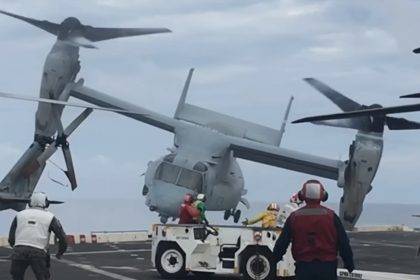
The PSYOP mission was flown by U.S. Marine Corps MV-22B Osprey aircraft from Marine Medium Tiltrotor (VMM) 365, 3rd Marine Aircraft Wing (Forward).

“Air Force’s CV-22 Osprey tilt-rotor aircraft accident report is a total distortion of the facts” top aviation expert says. September 4, 2012

Posted by David Cenciotti in : Aviation Safety, Military Aviation , 5comments

The Air Force Special Operations Command has released the results of the investigation into the Jun. 13, 2012 accident of a CV-22B. The tilt-rotor aircraft, which was assigned to the 1st Special Operations Wing, was flying in a two ship formation when it crashed at approximately 6.45 pm local time during a training mission to the north of Navarre, Florida on the Eglin Range.

All five of the 8th Special Operations Squadron aircrew were seriously injured but none suffered life threatening injuries.

Image credit: U.S. Air Force

The AFSOC, commander convened an Accident Investigation Board to investigate the crash and the circumstances surrounding it and designated Col. Hans Ruedi Kaspar, 23rd Air Force vice commander as the board president.

The Accident Investigation Board President released his findings and said that there was clear and convincing evidence that the cause of the crash was the crew’s failure to keep the aircraft clear of the lead aircraft’s wake. The result of this was an “uncommanded” roll to the left along with a rapid loss of altitude which resulted with an impact with the terrain.

The aircraft was destroyed upon impact with the loss valued at approximately 78 million USD.

Although Pentagon press secretary George Little speaking to reports recently said: “The Osprey is a highly-capable aircraft with an excellent operational safety record, which includes more than five years of worldwide deployments and 140,000 flight hours,” the safety record of the tilt rotor aircraft, in spite of the DoD, Air Force and Marine Corps claims, has been much debated in the recent past.

Even the loss of a U.S. Marine Corps tilt rotor aircraft that crashed in Morocco during African Lion joint exercise, with two marines killed and two other severely injured in the crash, and few other safety occurrences (that got a special attention on media attention even though they were quite normal) contributed to fuel concerns in those who believe the aircraft is unsafe.

Among them there is A. Rex Rivolo, who is Chief Technology Officer of an aerospace corporation in Virginia, has seventeen years experience in DoD Test and Evaluation community as senior advisor to the Office of Secretary of Defense and served as the principal analyst for the MV-22 and CV-22 at the Institute for Defense Analyses (IDA), a nonprofit organization paid to do independent research for the Pentagon.

Rex has some strong credentials: he was a pilot for six years at the US Air Force and 22 years at the Air National Guard. He has some 7,500 flight hours in both tactical fighter planes and helicopters, including 531 combat missions with the F-4E Phantom in Vietnam. He has earned 5 Distinguished Flying Crosses, 28 Air Medals.

“The findings of the Accident Investigation Board (AIB) for the CV-22B, tail number 06-0032, crash on 13 June 2012 are a total distortion of the facts and a blatant attempt to blame the pilots for a very serious design flaw in the V-22 aircraft” he told The Aviationist.

The serious safety concerns over the V-22 response to interactions with proprotor wakes of another V-22 were raised as early as 1996 when pilots began reporting incidences of uncommanded roll during flights of multiple aircraft.

“I personally observed several instances of this while flying on the V-22 in the late 1990s as an observer supporting the Pentagon’s Director, Operational Test & Evaluation (DOT&E) during the V-22 operational test period. In their desire to meet cost and schedule milestones, these concerns were given little attention by Bell-Boeing and the USMC management team and they consequently mounted a strong campaign to discredit these concerns with DOT&E. This effort, supported by some of the world’s best aeronautical engineers and pilots convinced DOT&E that the problem was indeed minor and the concerns were overblown.”

“Following the 2000 crash at Marana in which uncommanded roll due to wake intrusion was a possible contributing cause, I recruited Professor Gordon Leishman, one of the world’s top rotorcraft scientists, to investigate the phenomenon using numerical simulation” Rivolo told The Aviationist.

The result of these calculations clearly indicated that V-22 rotor wake intrusion could be a serious hazard to V-22 because of the side-by-side design: “Based on these concerns, I succeeded in resurrecting the issue with DOT&E and the Director demanded that a test and evaluation program be designed and executed to quantify the seriousness of the phenomenon.”

“This test and evaluation program, known as Test Request 65 (TR-65), was designed by DOT&E, Bell-Boeing and the USMC. The TR-65 document, dated 9 June 2000, described over 23 pages of test sequences to be performed to evaluate proprotor wake interactions in the V-22. Eighteen months later, TR-65 was scrapped based on the then current flight experience in which no uncommanded rolls were experienced in the aircraft during formation flight. Based on a strong Bell-Boeing and USMC push to dismiss a “non-issue”, DOT&E acquiesced and TR-65 was never completed.”

As a consequence, the pluri-decorated former combat pilot says, the CV-22 Flight Manual, known as the “Dash-1”, contains only minor guidance in Section V (Operating Limitations) on formation flight position to avoid wake intrusion.

Rivolo believes that if TR-65 had been executed to completion, the uncontrollable rolls experienced by V-22 when intruding into another V-22 wake would have clearly been demonstrated along with the dangers of the phenomenon.

The entire text from Section V of the Dash-1 regarding formation flight limitations Rivolo sent us reads as follows:

FORMATION FLIGHT LIMITATIONS
1. VTOL/CONV mode formation flying requires a
minimum cockpit-to-cockpit 250 ft separation and 25 ft
step up; step up is to be maintained all the way to landing.
The requirement for step up is designed to prevent
asymmetric wake interactions caused when one rotor
on the trail aircraft encounters the wake of the lead aircraft.

2. During APLN mode formation flight, maintain a
minimum cockpit-to-cockpit separation of 250 ft along
the bearing line. With less than 50 ft step up/down,
avoid lead aircrafts’ 5-7 O’clock.

“There are “Cautions” or “Warnings” throughout the Dash-1 concerning serious flight safety issues in various phases of flight but none on wake intrusion – a phenomenon that can result in an uncontrollable roll and consequent crash. This would certainly seem to warrant a “Caution” or a “Warning” within the Flight Manual.”

Rivolo says that as a consequence of the nonexistent TR-65 test results, the Dash-1 seriously underplays the significance of wake intrusion in V-22.

“It is noted that the Formation Flight Limitations in the Flight Manual only address a “minimum” separation; once outside that separation pilots can “legally” fly anywhere they wish in proximity to other formation aircraft. Unfortunately, the aircraft wakes remain active well outside this minimum separation and pilots can fly into them with catastrophic results. That the pilot was well outside of the minimum spacing limitations for formation flying is verified by the AIB in their Report which states:

“Although the MC did not maintain the required 25 feet of vertical separation from the MLA, the MA was two- to three-times the 250 feet and 375 feet distances referenced above and still encountered the MLA’s wake”

Rivolo believes the accident was clearly not caused by “pilot error” but it was the direct result of a basic design flaw in V-22 – the side-by-side rotor configuration and its susceptibility to rotor wakes.

“This accident will happen again and again,” he says.

Richard Clements contributed to this post.


Switch to our mobile site