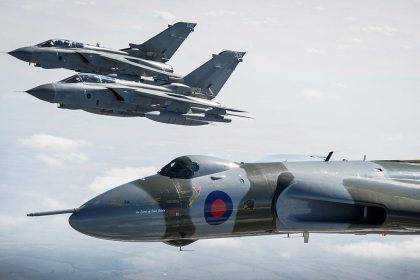
Saudi Arabia’s upgraded Tornado fighter bombers and new Typhoon jets on delivery April 30, 2013
Posted by Jacek Siminski in : Military Aviation , add a commentSome interesting Saudi Arabian combat planes have visited Malta International Airport on their way home last week.
On Apr. 23, a RSAF Tornado upgraded under the TSP (Tornado Sustainment Program), have made a stopover in Malta. The Saudi strike fighter, wearing the typical desert color scheme with the RAF roundel and a TSP flag on the tail, was one of the final two upgraded to the standard that will enable the RSAF to operate the medium-range strike fighters until at least 2020.
TSP includes upgrades needed to employ a wide array of precision guided munitions: Brimstone, Storm Shadow, Paveway/Enhanced Paveway-series bombs etc. In other words, RSAF TSP Tornados are quite similar to RAF Tornado GR4s.
On Apr. 25, two two-seater Eurofighter Typhoons on delivery from BAe Warton made a stopover in Malta.
Image credit: Brendon Attard
The two RSAF Typhoon jets in the typical two-tone color scheme followed the same route staged for the delivery flight of the previous examples: Warton – Toulouse (France).
They departed from Malta on Apr. 26, destination Taif airbase (reportedly via Sharm-El-Sheikh, Egypt).
Written with David Cenciotti
Related articles
Wargames in the Negev: Italian combat planes train with the Israeli Air Force. Again. February 8, 2013
Posted by David Cenciotti in : Italian Air Force, Military Aviation , 2commentsThe news was kept confidential until the Israeli Air Force released some interesting details on its website but the Italian Air Force has just finished its third annual deployment in Israel, the last of a series of joint exercises between the two air forces.
Image credit: IAF
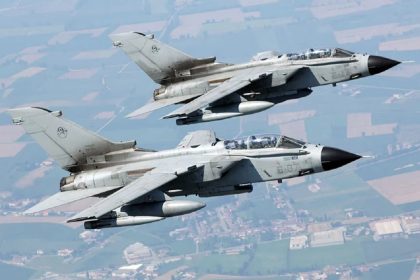
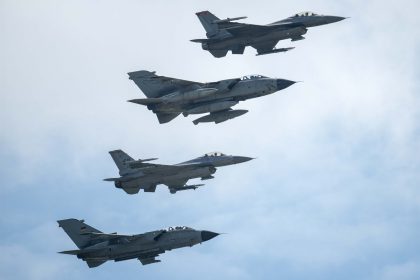
AMX and Tornado combat planes conducted joint drills with jets of the Israeli Air Force from Ovda airbase, southern Israel.
The two-week exercise saw the Italian planes fly in a simulated air war scenario: the training included sorties against aerial threats, live firing against ground targets, and very low level flying.
The Italian pilots enjoyed the oppotunity to share their experience with the combat proven Israeli crews and operate at much lower altitude than that allowed in Italy.
Along with the AMXs and Tornados, the F-16s of the 140 Sqn “Golden Eagle” from Nevatim and F-15s of the 133 Sqn “Knights of the Twin Tail” from Tel Nof.
The last of series of exercises that have seen planes of both nations cooperate during reciprocal visits reaffirms the strong ties between Rome and Tel Aviv in the defense field.
On Jul. 19, 2012, Israel’s Ministry of Defense signed a contract worth 1 billion USD for 30 Italian M-346 Master as replacement of the aging Air Force’s fleet of A-4 Skyhawks, used as advanced trainers for combat pilots designated for fighter jets.
On Jul. 20, it was announced that Israel’s IAI will supply the Italian Air Force with two Gulfstream G550 Eitam conformal airborne early warning (CAEW) aircraft as part of “a larger Government-to-Government agreement between Israel and Italy [worth 1 billion USD] that includes aircraft, engines, maintenance, logistics, simulators and training, provided also by other Israeli and international companies.”
Image credit: IAF
Related articles
RAF Tornados involved in "marathon" seven-hour mission to defend US and Afghan forces in Afghanistan April 20, 2012
Posted by David Cenciotti in : Military Aviation , add a commentRAF Tornado GR4s from 617 “The Dambusters” Squadron, belonging to the 904 Expeditionary Air Wing at Kandahar, have helped to defend US and Afghan forces from an insurgent attack in Helmand province, as part of a marathon mission lasting over seven hours.
Two of the RAF Lossiemouth-based “Tonkas”, had already spent 3 hours providing armed overwatch for British and American troops when the emergency call came in. The bombers, flying a CAS (Close Air Support) mission, were requested to fly 300 nautical miles north west, near the Turkmenistan border to provide support to a joint United States and Afghan National Security Forces patrol under repeated small arms fire (a condition known as TIC – Troops in Contact).
The British bombers conducted a typical high speed – low altitude passage over the insurgents: a show of force at 100 feet and 500 knots that persuaded the Taliban to retire to the cover allowing the ground patrol to withdraw to safety.
Image credit: Jez B/Flickr
The 617 Squadron Tornados were airborne for three hours prior to the call for assistance and the entire marathon seven-hour 45-minute flight required four aerial refuelings worth 20,000 litres of fuel each.
According to the UK’s MoD, in the same week, the squadron also conducted one “show of presence” (a higher-level flypast designed to indicate the presence of a supporting combat plane) and four lower-level shows of force.
617 Sqn’s crews are currently flying in Afghanistan with the new Helmet Mounted Cueing System (HMCS), a system that projects symbology on the helmet’s visor so the pilot can read the flight parameters and other information of interest, regardless where he is looking.
Image credit: U.S. Air Force
Related articles
- Dambusters test adveniristic helmet for RAF Tornado crews. Most advanced combat planes have similar helmets, except the F-22. (theaviationist.com)
- RAF’s weapon of choice in Libya to be upgraded as export opportunities emerge (theaviationist.com)
- Low level flying in the age of stealth bombers and standoff weapons: welcome to the famous “Mach Loop” (theaviationist.com)
Dambusters test adveniristic helmet for RAF Tornado crews. Most advanced combat planes have similar helmets, except the F-22. April 5, 2012
Posted by Richard Clements in : Military Aviation , add a commentAccording to a press release issued today, BAE Systems has developed a new helmet mounted cueing system for Royal Air Force Tornado GR4 crews.
Similarly to American Joint Helmet Mounted Cueing System (JHMCS) or the Eurofighter Typhoon’s Helmet Mounted Symbology System (HMSS) the system projects information in front of the pilots eye giving instant information of points of interest.
The RAF raised the Urgent Operational Requirement last April (2011) and the system is now being tested operationally by 617 Squadron of the RAF, which has a very rich history of using new technology in combat.
Image credit BAE Systems
The squadron was formed in 1943 at RAF Scampton during world war two and was specifically formed with hand picked crews who flew modified Avro Lancaster bombers to deliver the ground breaking Barnes Wallis designed “Bouncing Bomb” on an attack on four dams in the Rhur Valley (Germany). Later in the war, it was the first squadron to drop the 21,000lb “Grand Slam” on German U-Boat pens, and it was also the first RAF Squadron to use Storm Shadow operationally during operation “Telic” in Iraq during 2003.
History has repeated itself since this new system has been integrated onto aircraft which are now operational in the hostile theater of Afghanistan.
In the BAE’s press release Wing Commander Kurt Hill, FAST Tornado Capability Manager said: “The Tornado HMCS capability has greatly enhanced the crews situational awareness and resource management, enabling the rapid identification of points of interest in the Homogeneous Afghan environment.”
Martin Taylor, BAE Systems Combat Air Support Director said: “Over the coming months, we will continue to work with the customer, to provide the capability across the wider Tornado fleet.”
The new Helmet Mounted Cueing System (HMCS) has passed all of its operational requirements and is now making it easier to indentify the enemy on the ground in very fluid firefights.
Image credit: Richard Clements
The integration of the HMCS on the Tornado fleet shows that both fighter and bomber combat planes might need to improve their situational awareness and capability to engage ground targets with helmets that project symbology on the visor. However, even if U.S. F-15C/D, F-16 Block 40 and 50 and F-18C/D/E/F pilots use the JHMCS and the F-35 will have a similar helmet, the multirole F-22 Raptor won’t have one.
Here’s what The Aviationist wrote about the lack of helmet mounted display on the F-22 in a previous post about the Eurofighter Typhoon HMSS:
“There are various reasons why the most advanced (and much troubled) air superiority fighter lacks both helmet mounted display and HOBS (High Off-Boresight) weapons: confidence that capability was not needed since no opponents would get close enough to be engaged with an AIM-9X in a cone more than 80 degrees to either side of the nose of the aircraft; limited head space below the canopy; the use of missiles carried inside ventral bays whose sensor can’t provide aiming to the system until they are ejected. And also various integration problems that brought the Air Force to cancel funding.
Did the F-22 need HOBS? Sure, as it would have improved its lethality even further. Indeed, although simulated 1 F-22 vs 3 JHMCS F-16Cs engagements proved that the Raptor can master even challenging scenarios such an extra feature would have been a useful addition when facing large formations of Gen. 5 fighters like the Chinese J-20.”
Written with The Aviationist’s Editor David Cenciotti
Related articles
- M-346 advanced combat trainer’s HMD (Helmet Mounted Display) tested in night configuration (theaviationist.com)
- KC-767 boom operator’s stereoscopic vision goggles: introducing the adveniristic Remote Vision System (theaviationist.com)
- Tornado GR4 Livery Marks 100 Years of RAF Squadron (femaleimagination.wordpress.com)
Photo: Tornado night take off with full afterburner April 3, 2012
Posted by David Cenciotti in : Italian Air Force, Military Aviation , add a commentHere’s what a flight of Italian Tornados taking off from Decimomannu airbase for a night mission looks like.
All the images were taken by Giampaolo Mallei on Apr. 2, 2012.
All images by Giampaolo Mallei