.
jump to navigation

U.S. spyplanes, drones already flying over Mali January 13, 2013

Posted by David Cenciotti in : Mali, Military Aviation , add a comment

According to a U.S. official who spoke on condition of anonymity to the AFP on Jan. 12, the Pentagon would be evaluating the possible contribution to the French air campaign in Mali.

Intelligence gathering platforms, surveillance drones, aerial refueling tankers: these are the support options being considered by Washington.

Even if it still unclear whether France or Mali have officially request U.S. help, what is certain is that the U.S. has never ceased to pinpoint rebel positions and monitor their movements in the area.

In the wake of the attack on the U.S. consulate in Benghazi, that cost the life of the U.S. Ambassador to Libya Chris Stevens on Sept. 11, 2011, the U.S. amassed Special Operations planes and helicopters in the Mediterranean area, and intensified ISR (Intelligence Surveillance Reconnaissance) activities in North and Central Africa from Sigonella, Sicily, Rota, Spain, and Souda Bay, Crete.

Whilst armed Predators followed insurgents in Cyrenaica, eastern Libya, Global Hawks flew high-altitude long range missions from the Mediterranean Sea, to Diego Garcia and return. Some of such missions went well inside Africa, and also in Northern Mali controlled by three Islamist armed groups, including Al Qaeda in the Islamic Maghreb (AQIM).

However, not only unmanned platforms have been operating in the region.

Whereas EP-3Es conducted SIGINT (Signal Intelligence) missions from their standard bases in the Mediterranean area, several special “non-standard aviation assets” are based on a network of scarcely known airports across Africa: Uganda, South Sudan, Ethiopia, Djibouti and, above all, Burkina Faso, neighbouring Mali.

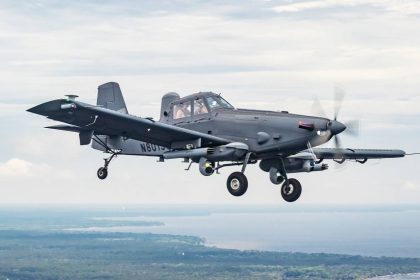
Some U-28As are reportedly based at Ouagadougou, Burkina Faso capital.

From there, these aircraft (a military version of the civil PC-12 purchased at a unit price of 3.5 million USD from the Swiss company Pilatus) have been flying surveillance missions in the region, pursuing rebels pick ups in the desert and possibly eavesdropping suspect radio communications.

U2bA

Image credit: U.S. Air Force

Other special operations planes (namely, some M-28 Skytrucks) used to carry special operators to places with unprepared landing strips and capable to perform special forces insertion and extraction in missions unsuitable for larger special ops aircraft (as the C-130 or the C-17), were spotted transiting through the UK on their way to a Middle East or African airport last year.

In order to keep a “low profile” and appear similar to general aviation aircraft during their clandestine missions, most of these special planes flying in Africa are painted in light gray or in white, as civilian planes, and sometimes they even carry civilian registrations.

Anyway, regardless what the official sources say, the U.S. are not evaluating whether to send reconnaissance planes, drones over Mali to collect intel data that could be useful for the French Air Force air strikes: such manned and unmanned aircraft have been operating and spying over the West Africa country for months.

Therefore, since Paris is probably already exploiting intel provided by Washington, what it needs the most from the U.S. is a bunch of aerial refuelers and cargo planes to sustain the air campaign.

Enhanced by Zemanta

There are three planes and one US Army MH-47 of the 160th SOAR in this stunning night picture. Can you spot them all? October 31, 2012

Posted by David Cenciotti in : Helicopters , 5comments

Taken at Geronimo Landing Zone near Fort Polk, Louisiana, during Joint Readiness Training Center – Decisive Action, on Oct. 18, 2012, the following image shows a U.S. Army MH-47 Chinook belonging to the 160th Special Operations Aviation Regiment, the almost legendary special ops unit of the Army that provides helicopter aviation support to special operations forces (and that was involved, probably with Stealth Chinooks, in the Osama Bin Laden raid).

However, there are at least three more aircraft (barely) visible in the same breathtaking shot.

Can you spot them all?

Image credit: U.S. Army

All the war tech you'll find in "Act of Valor" action movie April 8, 2012

Posted by David Cenciotti in : Special Operations , 9comments

There are various reasons why “Act of Valor”, the movie released on Feb. 24, 2012, is interesting from the military geek point of view.

First of all it features the Navy SEALs some of which are not actors but regular guys, active duty military that have taken part to the most dangerous U.S. special operations all around the world; missions that, as the movie clearly shows, are often (if not always) supported by cargo planes, helicopters, combat planes, and drones.

The movie opens with footage of a High-Altitude Low Opening (HALO), a type of airborne jump that is repeated another couple of times during the story, during daylight and at night. As they did during a recent operation in Somalia.

Noteworthy, unlike it happened during Operation Neptune’s Spear, the raid that killed Osama Bin Laden, the SEALs assault on a riverside compound is not performed using fast-rope and stealthy Black Hawks choppers. However, the exfiltration of the hostage involves two MH-47G Chinooks of the 160 SOAR (Special Operations Aviation Regiment) carrying SOC-Rs (Special Operations Craft  – Riverine), high speed boats used for insertion/extraction ops and fire support into a low-to-medium threat environment in a riverine area.

During the exfil operation the SEALs use a RQ-11 Raven drone,  a man-portable UAS (Unmanned Aerial System) controlled directly by the ground troops. The Raven is a relatively small bot whose ability is to automatically follow a moving target that was selected by touching the screen of the ROVER-like ground control system. Even if I’m not sure that the kind of imagery delivered to the end user and the targeting features are exactly as portrayed in the movie, the system should work in this way: once a series of pixels was selected, the systems tracks the movements of those pixels on the ground.

The movie features also a very well known Predator used for an unusual (or at least scarcely advertised) role for this asset: COMINT (Communication Intelligence) rather than the typical SCAR (Strike Coordination And Reconnaissance). Actually, if I recall correctly, the drone is used in the movie to detect environmental sounds coming from the compound, a task I’m not sure can be achieved with the current available sensors.

The first kill of the movie is worth a mention, since a sniper takes out an enemy sentry and when the dead man falls back into the river one of the SEALs is under the water with his hands above the surface to grab the body before it splashes.

Along with some interesting footage filmed on the flight deck of USS Bonhomme Richard amphibious assault ship, another interesting scene is the assault on a yacht and accompanying boats involving a Mark V Special Operations Craft and an HH-60 Sea Hawk using the Fast Rope Insertion Extraction System (FRIES), to let the SEALs descend on the target vessel.

Also interesting is the use of  a SEAL Delivery Vehicle (SDV), an underwater watercraft deployed from a submarine to reach the Somalian coast.

Although they can be considered no more than warbirds, the movie also features a white Grumman HU-16 Albatross seaplane and an uncolored Douglas DC-3 cargo both landing in the desert.

On a side note: the official Act of Valor poster (the one used in Italy and UK, not sure it is the same in the U.S.) shows an HH-3F Pelican helicopter on the right hand corner: a type of chopper used by the U.S. Coast Guard and Air Force in the Vietnam War and phased out 20 years ago (in the U.S., Italy is still using them, even if it is replacing its ageing fleet with the new HH-139).

Unknown hatch on captured U.S. stealth drone raises questions December 19, 2011

Posted by David Cenciotti in : Captured Stealth Drone, Drones, Iran, Military Aviation , 11comments

The amout of contribution I receive each time I publish a blog post on the stealth drone now part of Iran’s asset is amazing. For instance, yesterday, few minutes after publishing the Infographic that I used to explain how the drone was captured (a theory based on the known facts to date), I got an email from Dave Krakow with an interesting drawing he sent me to show how the mysterious hatch on the top of the RQ-170 Sentinel, it’s not up to the typical American Aerospace standards. “The details are imprecise, nothing like Lockheed Martin products.”

Image courtesy: Dave Krakow

Dave believes the thing shown by Iranians was possibly constructed previously, for radar signature research, with details added in a hurry for cameras. “A lot of the commentary on the web regarding general accuracy assumes Iranian intelligence has only the same photos we have on the internet, and thus they could only know certain details if they had an original.  I don’t think this is a reasonable assumption” he wrote to me.

For sure, as highlighted in the above image, the mysterious “top hatch” (that I supposed could be used to deploy a recovery chute) features some oddities. Some of them in particular, raise questions. However the angle of the camera, the effect of the zoom, and many other contributing factors (lights, shadows, image compression etc) may have affected the quality of the footage shown on Iran State TV rendering, for example, fasteners seemingly randomly spaced.

Furthermore, there’s still a chance that Iranians worked on the Sentinel after they recovered it: maybe they tried to get access to the internal hardware, removed panels to inspect lenses, memories to look for interesting data or to disable any self-destruction mechanisms or Emergency Locator-like systems, in order to prevent the Americans from locating or destroying it.

Nevertheless, we can’t rule out the possibility that the one showcased in what looked like a school in Kashmar was actually obtained by melting pieces belonging to various wrecked Sentinels that Iran has downed in the past, even if this would imply that the U.S. have already lost two or more “Beast of Kandahar” robots in Iran! By the way, Iran has recently announced it will show the remains of three U.S. and four Israeli drones downed in the last years while spying on Iran’s nuclear program.

Someone argued that a deployed recovery chute would have confirmation only if hatch doors were opened but I’ve already given a possible explaination for the fact that they were closed.

Someone suggested the drone is too clean for a crash landing, however, if a recovery chute made its crash landing soft, I would expect a damaged belly, as the hidden bottom of the drone seems to confirm.

Stay tuned.

This, along with all the previous articles on the Sentinel drone in Iran, can be found at the following link (click and scroll down): http://theaviationist.com/category/captured-stealth-drone/

Infographic: how the U.S. top secret stealth drone was captured by Iran December 17, 2011

Posted by David Cenciotti in : Captured Stealth Drone, Drones, Iran, Military Aviation , 14comments

Even if the story that the U.S. stealthy RQ-170 Sentinel drone captured by Iran was hijacked using a GPS spoofing attack is based on known facts and vulnerabilities highlighted in Air Force official documents, the “ambush”, as detailed by an Iranian Electronic Warfare engineer to the Christian Science Monitor, contains some controversial points.

First of all,  the lost-link procedure does not foresse the RQ-170 landing autonomously at his actual homebase (because of the many variables, such as wind and traffic) but orbiting until link is re-established or the drone runs out of fuel.

For instance, even under Remote Split Operations, landing is performed in Line Of Sight by the local ground control station: latency induced by the SATCOM link is not compatible with the last phases of the flight when immediate reactions of the robot’s control surfaces to the inputs given remotely by the pilot are required to safely bring the drone on the ground.

Furthermore, provided that the autolanding is used in the lost-link events, it is not that easy to land the drone on a different landing field than its homebase without causing major damages.

Finally, it seems quite weird that any insider so proud to have achieved a hack of the most secret U.S. unmanned aerial system (UAS) could be at the same time so uncautious to give the details of the entire operation to the public domain, with the first and most obvious consequence of not being able to repeat it in the future. Unless, the type of attack they have described is all but unexpected but very well known because highlighted in the above mentioned official documents.

So, I’ve asked once again my friend Ugo Crisponi to put on a nice infographic what I think may have happened on Dec. 4, 2011, when the drone was “downed”, based on all the details I was able to collect so far.

Here it is.

I think the drone’s link with Creech AFB was disrupted using jamming. How did the Iranians know the “Beast of Kandahar” was in the vicinity if they couldn’t see it on the radar? They may have intensified jamming around uranium enrichment sites.

Serbians were able to shot down the F-117 because during the Allied Force planners put the F117s on repetitive routings. Stealth planes are not invisible. They are extremely difficult to see, if you don’t know where they are and you are not close enough to track them. Maybe something similar happened in Iran.

I think that Iran played a role in the crash landing simply because they were able to recover it. If they hadn’t known where the drone had landed they would not have been able to get their hands on it.

Once the link was lost, as per procedure, the drone started an series of racetracks/orbits waiting for the signal to be re-established. In this phase, maybe the Iranians were able to spoof the onboard GPS and guide the drone in the wrong direction. Nevertheless this would mean that the most important American drone relies only on the GPS for navigational purposes and doesn’t use an INS (Inertial Navigation System) platform. Indeed even some GPS-guided bombs as the JDAM (Joint Direct Attack Munition) use anti-jamming and anti-GPS spoofing systems, some of those are based on simple inertial measurement units.

Then, when the Sentinel ran out of fuel, it crashed. Even though it was not mentioned before, there’s a possibility that the drone survived the impact because it was equipped with a safety chute. In fact, I’ve noticed a mysterious hatch on the top of the RQ-170, that, among other things could host the parachute used to safe the precious drone.

It’s obviously a speculation because such a chute could safe the airframe but could also preserve it for the enemy when the drone runs out of fuel during a mission behind the enemy lines. As happened in Iran.

Look at the following video.

Stay tuned.

This, along with all the previous articles on the Sentinel drone in Iran, can be found at the following link (click and scroll down): http://theaviationist.com/category/captured-stealth-drone/


Switch to our mobile site