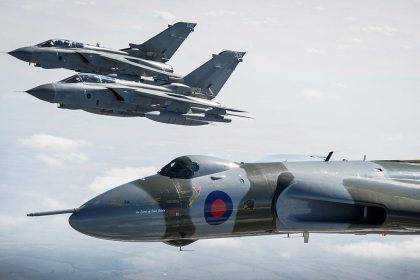
More airpower to surround Iran: UK ready to deploy Typhoons to the Persian Gulf November 7, 2012
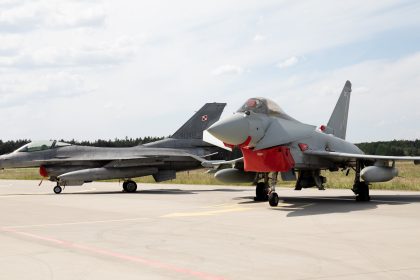
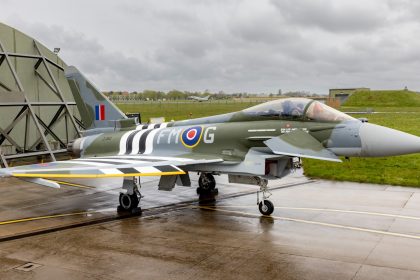
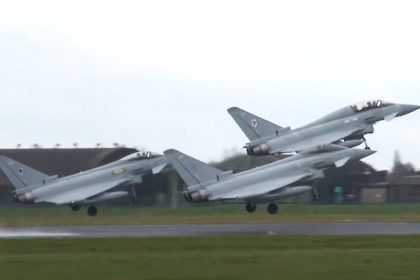
Posted by Richard Clements in : Iran, Military Aviation , add a commentSeveral news agencies are reporting that the British Ministry of Defense is considering deploying Eurofighter Typhoons to Al Dhafra airbase, in the United Arab Emirates, on a long term basis.
The British Newspaper The Independent ran an article quoting MOD sources as saying that the aircraft not only are to deploy to the region, but could be part funded by the UAE themselves.
The French Air Force already have a presence at the base and that presence is funded by the UAE and is also home to the 380th Air Expeditionary Wing of the U.S. Air Force with jets (including the stealthy F-22 Raptor) and Patriot missile batteries.
The Typhoons could be used to protect the Strait of Hormuz, should the Iranians decide to blockade the strategically important bottle neck for 40% of the worlds oil, should they come under attack.
However the official line from the Ministry of Defense in London came in the form of a press release which said: “The UK regularly deploys Typhoon to UAE as part of our routine exercise programme and to demonstrate our military commitment to UAE and the security of the wider region. We have a mutual interest with our GCC [Gulf] partners in ensuring peace and stability in the region, and exercises such as this allow us to practice working together.”
The MoD added: “These deployments are not due to our concerns over Iran’s nuclear programme. As we continue to make clear, the Government does not believe military action against Iran is the right course of action at this time, although no option is off the table.”
Image credit: Nicola Ruffino
Although its clear the decision hasn’t been made, in public at least, it does look with the funding possibly sorted that this will come about.
It may just be a case of timing the announcement, as it happens British Prime Minsiter David Cameron is currently in Dubai trying to drum up trade for British defense contractors and Eurofighter; it could be announced whilst Cameron is in the area and be a bit of a deal sweetener for sales of Eurofighter jets to UAE.
Richard Clements for TheAviationist.com
Related Articles
- A rare look into the Eurofighter Typhoon ASTA (Aircrew Synthetic Training Aids) simulator (theaviationist.com)
- First Eurofighter Typhoon jets in new unit markings at Trapani (theaviationist.com)
- An ordinary day at RAF Coningsby airbase, UK’s main Eurofighter Typhoon base (theaviationist.com)
- New Eurofighter Typhoon Squadron activated at Trapani airbase, Italy (theaviationist.com)
- Britain and UAE agree partnership in boost for Typhoon jet (telegraph.co.uk)
UK’s first RC-135W “Airseeker” intelligence gathering aircraft in service by the end of 2013 September 24, 2012
Posted by Richard Clements in : Military Aviation , 3commentsUK’s Royal Air Force will have the first of its planned three RC-135W aircraft, named the Airseeker project by the RAF (not clear if the aircraft is to be given that name or it’s just the name of the project) by December 2013.
Flight Global ran an article that padded out a few details on the British purchase of the Rivet-Joint aircraft.
The conversion of the ex-US Air Force KC-135 tankers started back in January 2011. The glass cockpit is well advanced in its installation and the first aircraft is thought to be rolling out for its paint scheme during January 2013, with flight testing and acceptance following soon after.
“A number of aircraft skins have been replaced to deal with corrosion and prepare the aircraft for its service life as an RC-135″ UK’s Defence Equipment & Support (DE&S) said in an article in its monthly publication “Decider”. “Additional work has included removing the tankers refuelling boom system, installing an air-to-air refuelling receiver system above the the cockpit, and replacing every wire in the aircraft. Mission equipment racks have also been fitted in the rear cabin, Progress in the aircraft is on schedule, with delivery on track for December next year.”
RAF crews have been undertaking training at Offutt Air Force Base, Nebraska on the RC-135V/W aircraft based there and once qualified on the Rivet Joint initial qualification training will be allowed to fly on the U.S Joint Rivet aircraft until the RAF aircraft are ready for service. The first crews arrived at Offutt during January 2011, therefore may have already qualified to operate the type.
The Airseeker aircraft will be operated by 51 Squadron flying from RAF Waddington, that flew the Nimrod until Jun. 29, 2011, when the last two examples of the SIGINT plane were withdrawn from service.
Richard Clements for TheAviationist.com
Image credit: U.S. Air Force
Related Articles
- Royal Air Force pays tribute to the “queen of the skies” VC-10 with a three-ship flypast across the UK (theaviationist.com)
- RAF Typhoon scrambles for second intercept in London Olympics No-Fly Zone (theaviationist.com)
- Olympics air security gets its first test as Typhoon is scrambled from RAF Northolt, in noth-west London (theaviationist.com)
- Reaper drone and Apache helicopter involved in the Camp Bastion battle that wiped out the U.S. Marine Corps Harrier force in Afghanistan (theaviationist.com)
- The Royal Air Force to deploy Tornado fighter bombers in the United Arab Emirates (theaviationist.com)
- Airbus A330 Multi-role Tanker Transport loses refueling boom in flight. Again. (theaviationist.com)
The Royal Air Force to deploy Tornado fighter bombers in the United Arab Emirates September 5, 2012
Posted by Richard Clements in : Military Aviation , 1 comment so farAfter the U.S. F-22 Raptor stealth fighters one in April, another deployment will take place in the United Arab Emirates (thus, not far from Iran), in the coming weeks.
In fact, the UK’s Royal Air Force has announced that aircraft and personnel from RAF Marham in Norfolk are to take part in Exercise “Shaheen Star” in the UAE.
Although it was not made public, the aircraft should be be based at the largest airbase in the area, Al Dhafra.
Tornado GR4 fighter bombers from 31 Squadron (that are going to be forward deployed to Afghanistan during March 2013) “will conduct intensive training over a number of weeks, working alongside air forces from partner nations in the region.”
The deployment will be supported by a huge (leased) Antonov An-124 arrived at RAF Marham, which was loaded with all of the support equipment and left on Sept. 2.
What the website doesn’t say is that the Tornado GR4 aircraft left Marham at 11.15am local on Tuesday 4. Sept and met up with a tanker over southern England before departing over France.
31 Squadron saw action over Libya during 2011.
Richard Clements for TheAviationist.com
Image credit: Rob Birmingham
Related Articles
- Royal Air Force pays tribute to the “queen of the skies” VC-10 with a three-ship flypast across the UK (theaviationist.com)
- Olympics air security gets its first test as Typhoon is scrambled from RAF Northolt, in noth-west London (theaviationist.com)
- RAF looses two Tornado GR4 aircraft in crash off eastern Scottish coast (theaviationist.com)
British pilots flew armed U.S drones during the Libyan conflict July 29, 2012
Posted by Richard Clements in : Drones , 1 comment so farSeveral online news outlets, including the British Newspaper The Guardian, have been running news articles stating that British exchange pilots in the U.S flew armed American Predator drones during the Libyan conflict. The disclosure had slipped out during a parliamentary answer, some 10 months after the end of the conflict, during which the British Government had insisted that no British armed drones had been used. Whilst technically still true the MOD (Ministry of Defence) has since admitted that RAF personnel on an exchange program had indeed flown the armed predators during the conflict whom became a key part of the air war.
During the conflict, between April and October (2011), the Predators performed some 145 air strikes according the figures released by the Pentagon; it remains unclear how many of those air strikes were flown by British personnel. The Guardian quoted a RAF source as saying that the British pilots would have followed British ROEs (Rules Of Engagement) rather than U.S. ones. “If they were asked to go beyond their own nation’s rules, then they would refuse to do so.”
The Defence Minister Lord Astor had “let the cat out of the bag” on Tuesday Jul. 26 during questions and said “Her Majesty’s government do not use armed remotely piloted air systems against terrorist suspects outside Afghanistan. However, UK personnel flew armed remotely piloted air systems against Gaddafi’s forces in Libya in 2011, in support of the NATO humanitarian mission authorised under UNSCR resolution 1973.”
The MoD was quick to make a statement on the subject: “There were no and are no UK remotely piloted air systems operating outside of Afghanistan. The UK armed forces routinely embed UK personnel with allied nation units (and vice versa) via exchange programmes. As confirmed by Lord Astor, UK personnel embedded within a US unit flew armed remotely piloted air systems missions against Gaddafi’s forces in Libya in 2011,” the spokesman said to The Guardian.
In 2007, to operate its MQ-9 Reaper (Predator B) drone alongside the USAF in support of UK ground forces in Afghanistan, the Royal Air Force formed 39 Sqn at Creech Air Force Base in Nevada.
British Reapers provide real-time video imagery to ground commanders, with the capability to attack ground targets if required.
Richard Clements for TheAviationist.com
Image credit: Crown Copyright
RAF loses two Tornado GR4 aircraft in crash off eastern Scottish coast July 3, 2012
Posted by Richard Clements in : Aviation Safety, Military Aviation , 2commentsNews reports have come in the afternoon of Jul. 3 that two RAF Tornado GR4 aircraft have crashed into the Moray Firth off the Eastern coast of Scotland.
The RNLI (Coastguard) has released information that two aircrew have been rescued from the water and have been flown to hospital in Inverness whereas the two remaining aircrew remain at the time of writing missing.
The incident is thought to have taken place shortly before 13.50 local time as this was when the alarm was raised and shortly after an RAF SAR helicopter plucked the pair of flyers from the sea.
Three lifeboats have been searching an area 25 miles (40km) south of Wick in the Beatrice Oil Field, which has an oil platform and a gas platform along with two experimental offshore wind turbines.
No further details have been released at this time.
A mid-air collision must be considered among the possible causes of the incident.
Richard Clements for TheAviationist.com
Image credit: Jez B/Flickr