.
jump to navigation

Last of the legendary U.S. Air Force F-4 Phantom jets to become yet another missile victim May 2, 2013

Posted by Jacek Siminski in : Drones, Military Aviation , 7comments

The last of the produced F-4 Phantom jets has been converted into a flying dummy target-drone for missile training.

The plane was a part of 309th AMARG (Aerospace Maintenance and Regeneration Group) based in Tuscon, Arizona and went through tests on Apr. 17.

The RF-4C, production no. 68-0599 is not a machine that is young or freshly retired, as it has been a part of the AMARG inventory since Jan. 18, 1989.

Just after being prepared for flying in a form of a target drone it was given a name Last One.

Last Phantom

Image Credit: AMARG

It is 316th QRF-4C (target drone designation for F-4) that was created. The conversion of the former MiG-21 adversary is conducted with the help of BAe Systems.

The aerial target drone will be managed by 82nd Aerial Targets Squadron based in Tyndall AFB.  The conversion itself is not a quick process, as it takes about 160 days which is almost half a year!

The QF-4 is created using the planes that sit on the USAF’s desert boneyard in Tuscon, Arizona.

As no Phantoms are left to be converted, the oldest F-16s are next in the queue  to be converted into dummy targets for training or new missile research. The first F-16 made its first flight in May 2012.

This is as far as the Air Force goes.

The US Navy is not using Phantoms anymore, as the last ones were also QF-4 target drones in service with Naval Air Warfare Center in Point Magu, California. The Phantom drones are expected to be a part of USAF target dummy inventory until 2013-2014 (later they will be replaced by the abovementioned F-16).

The QF-4 has replaced QF-106 target drone.

The QF-4′s not only serve a drone role, as several of  them are still painted in historical camo and take part in the USAF Heritage Flights at the airshows when not being used as targets.

When being a target, the QF-4 provides quite realistic training platform, as it can imitate all kinds of evasive maneuvers.

Image Credit: air-and-space.com

The following video shows practical application of QF-4 in training of the Air National Guard:

In the video we can see two F-15 jets shooting at the targets – the QF-4 Phantoms. To simulate the aerial combat with the highest possible fidelity the targets are equipped with the whole array of countermeasures (chaffs and flares) and may be flown remotely (when serving as a target) or with a pilot in cockpit (Heritage flights, maintenance). When unmanned, the QF-4 also carries an explosive device for self-destruct purpose in case it becomes uncontrollable.

Even if most modern air forces are equipped with more advanced fighter planes, the F-4 is still comparable if not superior to many enemy aircraft U.S. fighter could face in case of war….

Jacek Siminski for TheAviationist

Enhanced by Zemanta

F-14, F-4 and F-5 jets: not the U.S. Navy of the ’70s but today’s National Army Day in Iran April 21, 2013

Posted by David Cenciotti in : Iran, Military Aviation , 17comments

On Apr. 18, Iran celebrated the traditional National Army Day in honor of its land, sea and air forces.

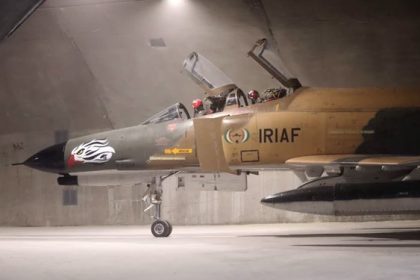
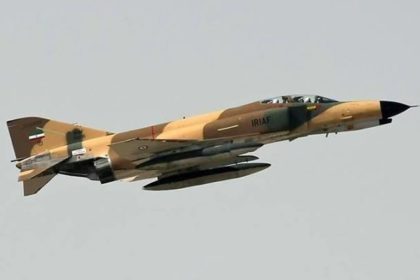
As usual, along with the parade, the event featured an aerial display by the Islamic Republic of Iran Air Force (IRIAF) which included F-14s, F-5s, F-4s, Saeqeh and Su-24s.

According to the Press TV, “after the military parade, Iran’s military commanders said their forces are more than ever ready to defend the country against foreign threats, including those of the United States and its ally Israel. The Iranian Army has in recent months staged several drills to test-fire different types of home-made missiles and torpedoes. The army has also tested a large number of home-made submarines, gun ships, artillery, helicopters, fighter jest, drones, air defense and electronic systems.”

Saeqeh

It will take at least some time before the recently unveiled Qaher 313 stealth fighter plane will be able to attend the yearly aerial display…..

Enhanced by Zemanta

Photo allegedly shows interception of a fleeing Syrian Mig-23 by two Turkish F-4 Phantoms January 5, 2013

Posted by David Cenciotti in : Syria , 6comments

On Jan. 5, 2013, a Syrian Arab Air Force Mig-23 whose pilot had been ordered to attack Aleppo, fled to Turkey.

Upon entering Turkey’s airspace, the defecting pilot replied to the radio calls of the Turkish Air Defense controllers and requested asylum.

It was then intercepted by a flight of two F-4 Phantom that were flying a routine CAP (Combat Air Patrol) sortie near the southern border that escorted the Syrian Mig to a safe landing at Adana airbase.

It took only 35 minutes for the Turkish Air Force to intercept the Syrian plane. Last year TuAF F-16s intercepted a Syrian airliner that was flying through Ankara’s airspace with suspect materials on board.

Noteworthy, some Turkish media outlets used the image below to show the interception.

Image source: Yenişafak

However, the image does not show the interception and it seems to be extensively photoshopped.

Indeed, the interception took place in the evening (between 20.40 and 21.15 LT); the two Turkish Phantoms in the image are not armed; the depicted Mig-23 is not a BN variant in service with the SyAAF but a Flogger in the typical Russian grey color scheme.

A quick Google search returned this Mig-23 photo that seems to have been used to compose the fake interception image.

Image via FAS website

Enhanced by Zemanta

Emergency over North Sea: cockpit recording lets you hear aircrew ejecting from an F-4D Phantom jet December 12, 2012

Posted by David Cenciotti in : Aviation Safety, Military Aviation, Military History , 5comments

The cockpit audio you can find below in the form of video with trancript was recorded in 1975, during a flight that ended with the ejection of a pilot and a WSO (Weapon System Officer) out of a U.S. Air Force F-4D Phantom, about 80 miles off the coast of England. It was uploaded to Youtube with some background photo by the son of the pilot who says: “Both my dad and his navigator were rescued [...]”

The recording starts with “Trest 11″ a flight of three Phantom jet performing air-to-air training before (at 04:00 min) one of the F-4s suffers a compressor stall.

Hear the rest of the advendure unfolding.

Image credit: U.S. Air Force

Although the pilot of the doomed fighter jet gives bearing, range and distance to RAF Bentwaters, “Trest” was a standard radio callsign of the 48th FW, based at RAF Lakenheath.

Enhanced by Zemanta

Phabulous Phantom Photo: F-4 fighter jet’s romantic take off into a rainbow October 1, 2012

Posted by David Cenciotti in : Military Aviation , 3comments

Taken few hours ago at Decimomannu airbase, in Sardinia, by Gian Luca Onnis, the following picture shows a German Air Force F-4 Phantom with the Jadgdeschwader (JG) 71 “Richthofen”, taking off into a rainbow, shortly after a thunderstorm.

The JG-71, from Wittmund, is Germany’s last F-4 operational squadron and the sortie on Oct. 1 afternoon was the last one on the Phantom for the squadron’s commander: the change of command ceremony will take place at “Deci” on Oct. 2.

Image credit: Gian Luca Onnis


Switch to our mobile site