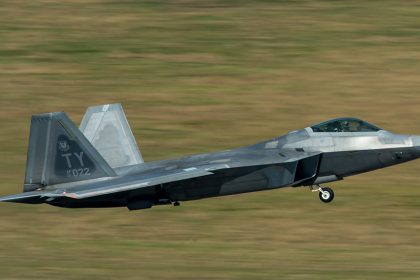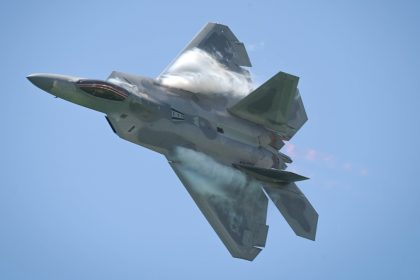
Video shows Hawaiian-style F-22 Raptor operations April 27, 2013
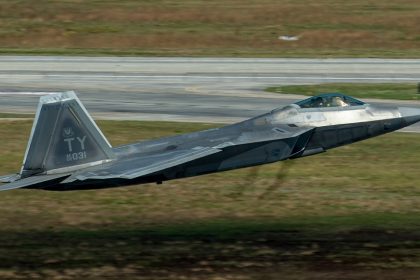
Posted by David Cenciotti in : Military Aviation , 1 comment so farThe following video, shows F-22 Raptor stealth fighters flown by the Hawaii Air National Guard’s 199th Fighter Squadron and the active duty Air Force’s 19th Fighter Squadron takinv off during an early morning 14-ship sortie rotation.
Note at the 00:30 mark the surfer carrying his surfboard and walking next to the airport’s fence as one of the radar-evading planes taxies: a scene that can be seen only at the Hawaii….
As the units were being readied to declare FOC (Full Operational Capability), on Apr. 7, the squadrons launched and recovered a record number of sorties which is the most executed by these squadrons on a single day since the conversion to the F-22s.
Related articles
F-22 Raptor stealth fighter’s advanced helmet axed by sequestration cuts April 12, 2013
Posted by David Cenciotti in : Military Aviation , 2commentsLast month we praised the decision by the U.S. Air Force to give a modern Helmet-mounted cueing system to the F-22 Raptor pilots.
In fact, the fifth generation fighter plane was (actually, still is) the only one among the U.S. front line tri-service fleet to lack such an advanced piece of flight gear that projects aiming information through the pilot’s line of sight, enabling the aircrew to look out in any direction with the cueing data always in their field of vision.
However, the Visionix Scorpion helmet-mounted cueing system (HMCS), that would have made the F-22 capable to use HOBS (High Off Boresight System) air-to-air missiles as the AIM-9X, filling a gap against other current and future stealth planes in close air combat, will not be integrated into the Raptor.
In fact, as reported by Flight’s Dave Majumdar, next summer’s Scorpion technology demonstration was canceled by budget sequester-related cuts.
The cancellation of the helmet’s integration into the F-22 is just one of the effects of sequestration: seventeen squadrons belonging to the various U.S. Air Force commands were grounded or are going to operate at a reduced readiness level until the end of Fiscal Year 2013 as a consequence of budget cuts.
As already said, the U.S. Air Force as you know it, no longer exists: the problem is that sequestration is going to have an impact not only on the number of active squadrons but also on the pilots training and equipment.
Related articles
U.S. moved its F-22 stealth fighter jets to South Korea. Here’s what they could do over there. March 31, 2013
Posted by David Cenciotti in : North Korea , 6commentsAn unspecified number of F-22 stealth fighter jets arrived in South Korea on Sunday, Mar. 31, 2013.
According to the Wall Street Journal, the aircraft flew from Kadena air base, in Okinawa, Japan, to Osan in South Korea to take part to the Exercise Eagle Foal.
The arrival of the U.S. most advanced fighter planes follows the “show of force” by the B-52s bombers and the B-2 stealth batwing bombers, that conducted training missions in South Korea’s gunnery ranges in the past weeks.
Even if it is almost only symbolic, the presence of the Raptors in the Korean peninsula is just the latest U.S. deterrent to the Pyongyang’s alleged attack plan (threatening some U.S. towns) and the demonstration by the Pentagon of the capabilities Washington is capable to put in place should the need to intervene arise.
What’s the role the F-22 could play in case of attack on North Korean targets?
Although the Raptors would probably escort the big bombers during the opening stages of an eventual campaign (after the rain of cruise missiles that would wipe out most of North Korea’s air defenses…), their role could not be limited to providing air superiority (to be easily and quickly achieved considered the status of the geriatric North Korean Air Force and its obsolete Migs): as demonstrated in last year’s Exercise Chimichanga,the F-22 has the ability to play a dual role in the same mission: HVAAE (High Value Air Asset Escort) and air-to-surface.
Indeed, the F-22 can be tasked to escort bombers into a an anti-access target area (a superfluos task when air superiority has been already achieved) and then perform an immediate restrike on the same target attacked by the B-2, B-52 or B-1 bombers being accompanied, or attack another nearby ground target, if needed.
With the latest release of software and hardware upgrades being fielded within a 6.9 billion USD program, the fleet of radar evading 5th generation planes is being turned into multirole: Raptors are getting synthetic aperture radar (SAR) with ground mapping capability as well as the ability to carry eight 113kg (250lb) Small diameter bombs (SDBs), multipurpose, insensitive, penetrating blast-fragmentation warhead for stationary targets that can be equipped with deployable wings for extended standoff range.
Related articles
China’s new stealth fighter’s missile launch rails prove Beijing can improve U.S. technology March 26, 2013
Posted by David Cenciotti in : China , 8commentsIn order to preserve their stealthiness and keep the RCS (Radar Cross Section) as low as possible, radar-evading planes rely on weapons bay: bombs and missiles to be fired are kept inside the bays until it’s time to use them.
For instance, the F-35 can carry one AIM-120D (AIM-120C8), on a trapeze : when needed, the BVR (Beyond Visual Range) missile is lowered into the airstream on the open bomb bay door, and ejected.
F-22 Raptors use canted trapeze to put the AIM-9 Sidewinder seeked into the airstream to achieve a lock on the target as the side bay doors are open.
Image credit: U.S. Air Force
Once the missile is fired, the bay doors close up.
Obviously, such method requires the stealth plane to fly with the open bay doors for a certain amount of time, a condition that can limit the aircraft performance, maneuverability, and increases the overall plane’s RCS, with a temporary exposure of the aircraft to the enemy radars.
Something that can be quite lethal in a Within Visual Range scenario.
The problem is to be partly solved with the use of missiles featuring the Lock On After Launch capability. With this kind of missile (available on the Raptor when the AIM-9M will be replaced by the AIM-9X Block II) the bay doors remain open just the time it is needed to eject the missile into the airstream.
However, China might have found a clever solution to the problem, as the latest images of the J-20 Mighty Dragon stealth fighter jet, emerging from the Chinese Internet, seem to suggest.
Indeed, the second prototype of the aircraft features a missile deployment device on the side weapons bay which extracts the selected air-to-air missile and then closes the door to keep the reduced RCS.
Simpler and probably cheaper than the use of LOAL missiles, the J-20′s deployment device shows that Chinese engineers are not simply copying U.S. tech: if not improving it, they are at least troubleshooting some of the issues already faced by their American counterparts, with some clever ideas.
Graphs from Chinese forums
The missile launch rail was used to carry the PL-10 IR air-to-air missile during tests.
Anyway, it’s worth noticing that along with AIM-9X missiles, the F-22 pilots will receive Scorpion HMCS (Helmet Mounted Cueing Systems) that will be particularly useful in case of dogfight. There are no information about similar helmets being fielded to Chinese fighter planes.
Related articles
(Finally) U.S. Air Force to add a new Helmet Mounted Cueing system to the Raptor stealth fighter March 18, 2013
Posted by David Cenciotti in : Military Aviation , 6commentsAlthough it is integrated in U.S. F-15C/D, F-16 Block 40 and 50 and F-18C/D/E/F, on the Eurofighter Typhoon and on several other modern planes (including the F-35 Joint Strike Fighter – with some difficulties), a modern Helmet-mounted cueing system is a feature that the F-22 Raptor lacks.
There are various reasons why the pilots of the most advanced (and much troubled) air superiority fighter were not given a helmet that, by projecting aircraft’s airspeed, altitude, weapons status, aiming and symbology, provides the essential flight and weapon aiming information through line of sight imagery, enabling the aircrew to look out in any direction with all the required data always in their field of vision: (too much) confidence that capability was not needed since no opponents would get close enough to be engaged with an AIM-9X in a cone more than 80 degrees to either side of the nose of the aircraft; limited head space below the canopy; the use of missiles carried inside ventral bays whose sensor can’t provide aiming to the system until they are ejected.
And also various integration problems that brought the Air Force to cancel funding…
However, even the (almost) invincible F-22 eventually needed an advanced helmet that could make the HOBS (High Off Bore Sight) possible.
The U.S. Air Force is preparing to evaluate the Visionix Scorpion helmet-mounted cueing system (HMCS) on the F-22 Raptor.
“We absolutely hope to have the Scorpion helmet [on the Raptor],We think we’ll get into that business this summer,” said to Flight Global Col. Robert Novotny, commander of the 53rd Test and Evaluation Group (TEG), who looks into new technologies for the Air Force from Nellis Air Force Base.
The Scorpion HMCS is a paddle shaped full colour display and will give the Raptor a high off-boresight (HOBS) capability ahead of the initial installation of the AIM-9X planned for 2015 with a full upgrade to the missile in the 2017 time frame, when the fighters increment 3.2B upgrade program comes into play.
Image credit: Gentex
Novotny went on to add: “If we can get that [HMCS] in the jet, then we can get them an off-boresight heat-seeking missile like the AIM-9X.We want to get this done because we’ll bring some great capability to the pilot, as all helmets do, and give them the off-boresight later.”
The addition of the HMCS and the AIM-9X on the F-22 shows that, in the foreseeable future, the Within Visual Range scenario can be more likely and worriesome for the best American fighter plane than some Raptor fans are willing to admit.
Written with Richard Clements