jump to navigation

Diplomatic crisis between Italy and India worsens over jailed marines in anti-piracy task March 8, 2012

Posted by David Cenciotti in Italian Navy, Maritime Security.
Tags: , , , , , ,
4 comments

Any Indian juridicial action “not fully in line with international law risks creating a dangerous precedent concerning international peace and anti-piracy missions; missions to which Indian military take part and whose effectiveness and operational capability would be put at risk ”: this is the content of the warning statement relayed by the Italian Prime Minister Mario Monti to his Indian counterpart Manmohan Singh following the decision of a court in the southern state of Kerala who jailed for two more weeks, while investigation is underway, the two Italian Navy marines, accused to have killed two Indian fishermen in a shooting off India’s coast on Feb. 15.

The two Italian soldiers were on an anti-piracy mission on board the merchant ship Enrica Lexie. The presence of military personnel for VPD (Vessel Protection Detachment) is ruled by an Italian law compliant with the UN anti-piracy resolution and there are about 100 military currently aboard cargo ships in areas under threat of pirates.

Although the episode is still under investigation, the position of Rome is that the shooting happened in international waters and the case should be judged in Italy. Furthermore, Italy says that military should be gived absolute judicial immunity to the foreign state’s jurisdiction (as happens in Afghanistan, for instance). On the other side, the Indian authorities say that the victims are Indian hence the case should be handled by New Delhi that doesn’t grant the validity of the VPD (that is valid between NATO and EU members).

The Italian Foreign Affairs Minister has visited India last week while a diplomatic delegation is still on-site to try to find a solution to the stand-off.

This episode has some similarities with the incident of the USMC EA-6B (callsign “Easy 01″) that in 1998, during a low level mission from Aviano airbase hit a cableway at 360ft and caused the death of 20 people.

The crew was not judged in Italy, because an Italian court recognized that NATO treaties gave jurisdiction to U.S. military courts that, in spite of some violations to the regulations for military VFR flights in the area, found the pilot and the navigator not guilty of involuntary manslaughter and negligent homicide (later they were found guilty for having destroyed a videotape recorded during the doomed flight).


Indian Navy Dornier 228 films Costa cruise ship adrift in the Indian Ocean February 28, 2012

Posted by David Cenciotti in Maritime Security.
Tags: , , , , , , , , , , , ,
add a comment

The video below was filmed by an Indian Navy Dornier Do 228. It shows the Costa Allegra cruise ship adrift in the Indian Ocean.


Costa Allegra, le prime immagini dall’aereo dei…, posted with vodpod

The Indian Navy has deployed one Dornier to Seychelles under a government to government treaty. The patrol aircraft is stationed at Victoria, is operated for Exclusive Economic Zone surveillance and anti-piracy patrols by Indian aircrew in response to requirement projected by the Seychellois government.

According to this press release, the airplane will fill the gap until a new Dornier under manufacture at Hindustan Aeronautics Limited, India, is handed over to the Seychelles government.

Here’s an image of an Indian Navy Do.228.

In the meanwhile, helicopters have been used to deliver food and satellite phones on board.

Costa cruise ship adrift in world’s most dangerous waters. Seychelles Coast Guard airplane, ships launched to the rescue. February 27, 2012

Posted by David Cenciotti in Maritime Security.
Tags: , , , , , , , , ,
add a comment

It’s not a lucky period for Costa cruise ships.

Little more than a month since the Costa Concordia ran aground on rocks off the Isola del Giglio Island, Italy, another Costa cruise ship is facing an emergency. The Costa Allegra (188 meters long, 28,597 tonnes, 399 cabins, capacity of 1,400 pax) is adrift with 1,049 people on board, in the dark, about 250 miles southwest of the Seychelles, in the Indian Ocean.

Image credit: AP Photo/Tano Pecoraro

The ship had left Madagascar on Saturday and was due to reach Mahe, in the Seychelles, on Tuesday. Following a fire (that has been extinguished), the ship is immobilized, with no electric lights and emergency batteries being used to keep essential services going. Although there’s no immediate danger for the people on board, all passengers and part of the crew are at the muster stations.

Merchant ships and tug boats have been directed to the rescue of the liner but the first asset to reach the stranded ship has been an unspecified maritime patrol aircraft belonging to the Seychelles Islands Development Company & Coast Guard launched by Seychelles International airport.

The aircraft has overflown the Costa Allegra assessing the status of the ship and relaying it to the Coast Guard and other ships involved in the rescue operation.

Mahe also hosts a U.S. drone detachment involved in the anti-piracy activities in the Horn of Africa (and are believed to launch air strikes against terrorist camps in the region): indeed, the Costa Allegra is adrift in an extremely dangerous waters, where the risk of pirate skiff attacks is ranked high.

For this reason, among the people on board the ship there are also Italian Navy armed guards: a Military Security Team is embarked on all Italian ships in seas under threat of pirates. A standard practice on all ships these days, even if Somali pirates have never hijacked cruise ships in the area.

Two Italian Navy riflemen belonging to the San Marco Battalion, are currently under custody in India pending the investigation about the alleged killing of two Indian fishermen 30 miles off the southern Indian coast on Feb. 15.

Image via Guido Olimpio

F-35 progress report. The year so far in review. February 23, 2012

Posted by David Cenciotti in F-35.
Tags: , , , , , , , , ,
1 comment so far

Update Feb. 23 22.47 GMT

Lockheed Martin has just released a media update that provides some interesting figures about the F-35 System Development and Demonstration (SDD) flight test plan. The press release traces the history of the JSF program since the beginning of 2012. However, I’ve modified it a little bit to add some interesting information about the program: either officially released news by partner countries authorities or details reported by media all around the world.

  • On Jan. 9, AF-4, an F-35A Conventional Takeoff and Landing (CTOL) test aircraft, reached the highest altitude to date in an F-35; 43,000 feet Mean Sea Level (MSL).
  • Demonstrating the ongoing maturation of the F-35 integrated sensor suite, AF-3, an F-35A CTOL test jet, completed the first low Distributed Aperture System (DAS) approach on Jan. 17.
  • With the ferry flight of BF-7, an F-35B STOVL, Eglin AFB, Fla., became home of the largest F-35 fleet in the DOD on Jan. 19. BF-7 was the 23rd F-35 Lightning II delivered to the DOD.
  • The F-35 SDD fleet including AA-1, the original test aircraft, crossed the 2,500 flight hour threshold on Jan. 25.
  • During a Media Briefing in Rome, Italy, Tom Burbage, Executive VP of Lockheed Martin and General Manager of F-35 Program Integration, said that the F-35C (Carrier Variant) was fixed with a new tailhook system that will be tested beginning next April, making arrested landing on aircraft carriers possible after the series of failed tests. “We will solve all issues” he said.
  • On Jan. 30 the Associated Press reported that Australia is reviewing its purchaase schedule for 12 F-35 Joint Strike Fighters.
  • A BAC1-11 configured with the F-35′s AN/APG-81 active electronically scanned array (AESA) radar and the AN/AAQ-37 infrared distributed aperture system (DAS) has taken part to the Bold Alligator 2012 exercise.
  • On Feb. 7 a UK Ministry of Defence spokeswoman announced that Britain will not make final decisions on the overall number of F-35 before the next planned Strategic Defence Review (in 2015).
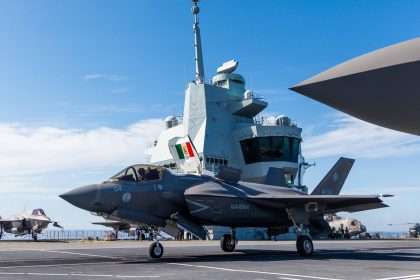
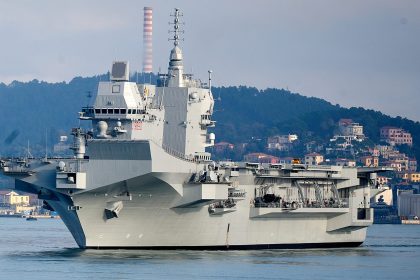
  • On Feb. 15, Italian Minister of Defense announced Italy’s plan to purchase 90 F-35s. The aircraft will be delivered to four Italian Air Force squadrons at Amendola and Ghedi, and one Navy squadron at Grottaglie (equipped with F-35B that will also operate from Cavour aircraft carrier).
  • On Feb. 17 the Government of the Netherlands announced that the first F-35 designated for the RNlAF had its jet engine installed. The Netherlands has ordered two JSFs as test aircraft.
  • On Feb. 19 the Canadian Press reported that Canadian Defense experts are considering a further upgrade to the aging RCAF F-18s (CF-188s in the local designation) to fill the gap until the delivery of the first F-35s, expected in 2016.
  • On Feb. 21 Royal Air Force test pilot Squadron Leader Jim Schofield flew CF-2, the Carrier Variant of the F-35 that will be known as Joint Combat Aircraft in UK.
  • On Feb. 22, six days after the first F-35A CTOL (Conventional Take Off and Landing) had flown with external stores, even the STOVL (Short Take Off and Vertical Landing) variant of the Joint Strike Fighter, flew for the first time with external weapons.Noteworthy, along with the AIM-9X carried by the CTOL, the F-35B carried a never seen before white 25 mm gun pod on the centerline.
  • On Feb. 23 Turkey confirmed its plan to buy 100 F-35s for 16 billion USD. “In the first stage, orders will be given for two F-35 planes. Turkey plans in total to buy 100 F-35 warplanes” the Minister of Defense said.

Cumulative flight test activity totals for 2012 through Feb. 20 are provided below:

  • F-35A CTOL jets have flown 46 times.
  • F-35B STOVL aircraft have completed 45 flights.
  • F-35C Carrier Variant (CV) jets have flown 23 times.

From the start of flight testing in December 2006, F-35s have flown 1,704 times, including the production-model flights and AA-1, the original flight test aircraft.

Image credit: Locheed Martin

Alleged killing of two Indian fishermen in anti-piracy operation sparks diplomatic crisis between India and Italy February 19, 2012

Posted by David Cenciotti in Italian Navy.
Tags: , , , , ,
18 comments

Two Italian Navy riflemen belonging to the San Marco Battalion, are currently under custody in India pending the investigation about the alleged killing of two Indian fishermen 30 miles off the southern Indian coast on Feb. 15.

The two military were on board the merchant ship Enrica Lexie as Military Security Team on Italian ships in areas under threat of pirates. Although the episode is still under investigation, the Italian Navy explained in an official statement that at about 12.30PM  Italian Time, the merchant ship was approached by a suspect vessel with armed sailors that did not respond to warning signs.

In compliance with the stardand procedures, the security team on board the Enrica Lexie fired three sets of warning shots for deterrence whose effect was to discourage the pirates. The alleged pirate boat departed from the Italian merchant ship without signs “of obvious onboard damages.”

However, two fishermen died and Indian authorities denied that any of the crew members of the “suspect” vessel was armed.

The Italian merchant ship was ordered to dock at the port of Kochi waiting for it to carry out the investigation.
Even though it’s still difficult to piece fact together, the episode happened in international waters, on an Italian ship, hence the jurisdiction must be Italian. Furthermore, the two military should be subject to absolute judicial immunity.

Then, there are a lot of inconsistencies between the Italian and Indian versions, to such an extent the fact that the two fisherman were killed in another shooting, involving another ship, can’t be ruled out.
For instance, Italians stated a total of 20 rounds in bursts of warning were shot, none of which hit the vessel, whereas the Indians affirmed that the fishing boat was hit by 60 shots . If so, however, as some sources have pointed out, the boat would suffer serious damage and could hardly reach the port.

Moreover, the Indian authorities have refused to show the bodies of the two killed fishermen nor to perform the autopsy.
Although, not as dangerous as the Gulf of Aden and the Somali Basin, where ships, helicopters, maritime patrol aircraft and drones contribute to the anti-piracy operations, the seas surrounding southern India have been the scene of an increasing number of pirate attacks.


Image credit: The Hindu Business Line

Italy has decided: F-35s to be cut by more than 30 percent. February 15, 2012

Posted by David Cenciotti in F-35, Italian Air Force, Italian Navy.
Tags: , , , , , , , , ,
12 comments

More technology, less personnel and only 90 F-35s: this is the outcome Italian Defense spending review.

On Feb. 15, the long awaited Italian Defense spending review was finally presented to the Parliament by the Minister of Defense Giampaolo Paola.

“Long awaited” because the review was supposed to shed some light on the future of the Lockheed Martin F-35 Lightning II in Italy: Rome’s commitment to the program (as a Level 2 partner with 2.5 Billion Euro already invested and an original envisaged requirement for 131 planes) is important to keep the troubled and costly stealth multirole jet affordable.

The reform seeks to balance the spending for personnel, operations and investment, to ensure the future financial sustainability and operational effectiveness of the armed forces. In simple words: cuts to personnel and programs with the long term goal to cover the personnel spending with half the allocated budget (worth 0.9 percent of the GDP) and use the remainder between operations (including training and maintenance) and procurement (25 percent each) of advanced technologies.

Therefore, along with the reduction by 43,000 people to abate the current 70 percent of the overall defense budget for spending on military personnel, the review has led to the revision of the some important programs. First of all, the much criticized F-35 program.

Accordingly, 41 aircraft will be scrapped leaving the Italian Air Force and Navy with only 90 F-35 in the A and B version. The latter, recently removed from probation, will replace the Navy’s AV-8B+ Harrier II on board the Cavour aircraft carrier as well as the Air Force’s AMX, both involved in the recent Air War in Libya.

“The F-35 program was reviewed. Nevertheless it remains a major commitment in terms of technology, technology transfer to the industry and employment” Di Paola said few days after placing the first order for three F-35s.

Digital mock-up by Al Clark

Italy buys its first three F-35s. With a shocking announcement: “a JSF will cost less than a Eurofighter Typhoon” February 8, 2012

Posted by David Cenciotti in F-35, Military Aviation.
Tags: , , , , ,
9 comments

On Feb. 7, 2012, Gen. Claudio Debertolis, head of the agency that is responsible for the procurement of new armaments, has announced that Italy has already ordered the first three Lockheed Martin F-35s.

Unit price: 80 million USD.

Talking to the lower house’s defense commitee, Debertolis explained that these first planes will cost more than the rest of the fleet since costs are going to decrease as the program, currently in Low Rate Initial Production,  continues. The Italian high rank officer is particularly optimistic, as he believes that the unit price will be around 70 million each (Lockheed Martin estimates 65M USD for the F-35A and about 73M USD for the F-35B), less than the 79 million USD currently paid for the Eurofighter Typhoon and much less of the 121 million USD per aircraft anticipated in 2011.

Quite surprising, since unit price is one of the JSF partner’s main concern, but possible, considering also that the Typhoon has just lost India’s mother of all tenders based on price.

Although there’s no official commitment yet, the initial requirement for Italy foresaw 131 examples (69 conventional take-off and landing F-35As and 62 of the short take-off and vertical landing variant F-35Bs). Debertolis confirmed that determining how many aircraft Italy will purchase is not a current task, since it will depend on the Defense Budget Review. Nevertheless, even if the number of aircraft will be much lower than the initial 131, the MoD will work to make sure that the industry will get the expected compensation.

Italy is working on stretching deliveries and slowing purchase  “a much easier task than that with the Eurofighter program, since the F-35 procurement is modular therefore delays don’t imply increasing costs” Debertolis said.

Furthermore with the recent Eurofighter defeat in India, Italy is going to stop working on the Typhoon and “divert” part (if not all) of its workforce towards the F-35, being assembled at the Cameri FACO (Final Assembly and Check Out) facility.

Finally, Debertolis has confirmed that Italy will have both A and B variants, with the STOVL (Short Take Off Vertical Landing) ones serving both the Air Force and the Navy, that will use them on the Cavour aircraft carrier.

In spite of the widespread criticism surrounding the program and the global financial crisis it looks like the F-35 has, if not a bright future ahead, at least good chances to survive the austerity measures of the new Monti’s technocratic cabinet.

Image credit: Lockheed Martin

Recognized Maritime Picture, Sensor Fusion and AIS: inside the Italian Navy’s new Maritime Operation Center February 4, 2012

Posted by David Cenciotti in Italian Navy.
Tags: , , , , , ,
2 comments

On Jan. 19, the Marina Militare (Italian Navy) inaugurated its new Maritime Operation Center (MOC) with a ceremony that was attended by the Minister of Defense Giampaolo di Paola, along with the Navy Chief of Staff Adm. Bruno Branciforte and the Commander in Chief of the Fleet, Adm. Luigi Binelli Mantelli.

The new center, located inside the complex of Santa Rosa, near Rome, where the HQ of the Commander in Chief of the Fleet (CINCNAV) is based since 1972, was designed to meet the service’s strategic concept, based on the integrated surveillance of maritime areas of interest and the projection capabilities in the maritime environment.

The new MOC brings under the same roof the Maritime Surveillance Operations Center and the Air-Sea Operation Center.

The Air-Sea Operation Center controls the assigned forces (ships, submarines, aircraft) using a complex command and control system whose core is a Maritime Command and Control Information System.

The Maritime Surveillance Operations Center collects all data required to achieve the Maritime Situational Awareness (MSA) and generate a Recognized Maritime Picture (RMP). The RMP is obtained by fusing the information collected from several “sensors”, as  radars, warships, patrol aircraft and drones, as well as other national or allied command and control systems.

One of the most important sources is the coastal radar network, mainly located in southern Italy. This network is currently being upgraded with the installation of remotely-controlled next generation sensors featuring auto-tracking and ISAR (Inverse Synthetic Aperture Radar) technology.

The AIS (Automatic Identification System), is also used to improve the MSA. Information is gathered by ashore AIS stations as well as by warships and patrol aircraft, both equipped with their own interrogation systems.

Information about merchant shipping is shared through the Virtual Regional Maritime Traffic Center (V-RMTC). The V-RMTC is a virtual network that, resorting to Internet, interconnects the operational centers of the all the navies of the countries adhering to the initiative.
This network, provides unclassified information on merchant shipping consisting of 300 tons or more units.

Although it deals with commercial traffic, the V-RMTC has had an operational engagement in Lebanon, during Operation “Leonte”, when it allowed building a Recognized Maritime Merchant Picture for Lebanon (RMMP-L).

All images by Giovanni Maduli for The Aviationist.com

Old Harriers and new choppers unleashed. Welcome aboard the Cavour aircraft carrier during “blue water ops”. January 27, 2012

Posted by David Cenciotti in Aircraft Carriers.
Tags: , , , , , , , , , , ,
2 comments

On Jan. 25, along with the ambassadors of NATO members, EU, Middle East and Mediterranean partners, The Aviationist has had the opportunity to visit the Cavour aircraft carrier during “blue water ops” off Civitavecchia port.

The event was jointly organized by the Ministry of Defense and the Ministry of Foreign Affairs to showcase one of the most important assets of the Italian Defense, one of the few European aircraft carriers that is not only important for military operations, but it is also a versatile platform that made its operative debut during the Haiti relief mission.

The Cavour symbolizes “a variety of possible uses that make it cost-effective” said Adm. Luigi Binelli Mantelli, future Chief of Staff of the Italian Navy.

Along with the F-35 program, the Italian Navy flagship was recently targeted by potential budget cuts as a consequence of the country’s financial crisis. However, “the AV-8B will fly until 2020, when they will be replaced by the F-35B. The MoD Di Paola has confirmed the project will continue. We don’t know how many aircraft we will get. The Air Force will get the majority, but even the Italian Navy will receive its planes” Binelli Mantelli said.

According to the Admiral, the F-35, is mainly an Air Force project, since the service needs the plane for its future. However, the Navy has joined the program and the future STOVL (Short Take Off Vertical Landing) variant of the Joint Strike Fighter, that was removed from probation one year earlier than expected, will serve as a force multiplier and complement the capabilities of the ship, capabilities that were showed to the ambassadors, diplomats and media during a tactical event involving the AV-8B+ Harrier (both single and double seat), AW-101 and NH-90 helicopters, the San Marco Regiment special forces and the Caio Duilio, a radar-evading Anti-Air Warfare destroyer.

Giovanni Maduli took the following images for The Aviationist.

“The F-35 remains essential to the future of air superiority” Panetta says. And Lockheed Martin reassures: “we will solve all JSF problems.” January 27, 2012

Posted by David Cenciotti in F-35.
Tags: , , , , , , , , , ,
1 comment so far

On Jan. 26, several hours before U.S. SECDEF Leon Panetta would say the Joint Strike Fighter remains a DoD top priority program “essential to the future of air superiority”, Charles “Tom” Burbage, Executive VP of Lockheed Martin and General Manager of F-35 Program Integration, had already explained in a Press Briefing held in Rome that, in spite of rumors and criticism surrounding the costly fifth generation combat plane, he did not anticipate any significant downsizing of the program.

“Every country is reducing defense budget but no country has reduced the F-35” he said, explaining also that one of the most appealing features of the program for international partners is the involvement of local companies, which supply components, systems and know-how, well before a single aircraft is purchased.

Moreover, the F-35 has recently collected some important achievement, making Burbage and the rest of the company optimistic about the future of the entire program.

First came in December 2011 the selection of the JSF as the Japan Air Self Defense Force (JASDF) next gengeration aircraft, following the F-X competitive bid process that saw the Lockheed plane win on both the Eurofighter Typhoon and the Boeing F-18 Super Hornet.

Then the F-35B STOVL (Short Take Off Vertical Landing) was removed from probation one year ahead of schedule. Finally, the F-35C (Carrier Variant) was fixed with a new tailhook system that will be tested beginning next April, making arrested landing on aircraft carriers possible after the series of failed tests.

Last year was particularly important for the revolutionary plane. It flew about 20% more than expected, performed sea trials taking off and landing (vertically) from USS Wasp and “had no issues on the ship”, Burbage said, in spite of the alleged noise and heating problems.

Dealing with the series of issues highlighted by the JSF Concurrency Quick Look Review and other official and unofficial reports leaked at the end of last year, Burbage explains: “we are currently 20% into the test program. Today’s issues are not going to affect customers that will receive the aircraft years later, when the problem is fixed.”

In the last few days, Burbage and its entourage have met the Italian Minister of Defense Di Paola and the top Italian Air Force and Navy officers. Talks were satisfactory and Lockheed is quite confident that in spite of the financial crisis and raising criticism at political level, Italy will keep the commitment as Level 2 partner (worth 2 Billion USD already invested) in the program, which calls for total U.S. purchases of 2,443 F-35s in both A, B and C versions for the Air Force, Navy and Marine Corps, and envisages 697 planes for other partners (UK, Italy, Netherlands, Australia, Canada, Denmark, Norway and Turkey).

Japan aside, the F-35 has export chances also in South Korea, that is the only non-partner country Lockheed Martin is in talks for a possible JSF sale. Should the F-35 be selected in South Korea, the number of planes procured by Security Cooperative Participants (Singapore and Israel)  and foreign customers (including Japan) will exceed the number of F-35s ordered by partners.

Since there’s no commitment yet nor any value was set, no reduction or cut in the amount of aircraft can be foreseen. Italy is not buying 131 planes. The initial requirement was for 69 F-35A and 62 F-35B (40 for the Air Force and 22 for the Navy), but Italy will buy the plane in batches: 4 planes, then 5 planes and so on. Therefore, Italy will have some F-35s, some of them will be STOVL ones to equip the Cavour aircraft carrier.

Eventually, in the U.S. the F-35 survived the Pentagon budget cuts: the US will continue buying F-35s, but will slow its purchase of the stealth fighter planes.

Indeed, it’s a very good period for the Joint Strike Fighter.