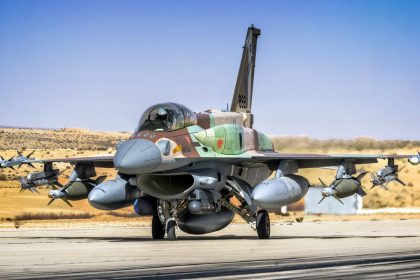
What kind of target did the Israeli Air Force really hit in Syria? May 8, 2013
Posted by David Cenciotti in : Military Aviation, Syria , 5commentsTwice between May 3 and 5, the Israeli Air Force conducted air strikes in Syria using Precision Guided Munitions.
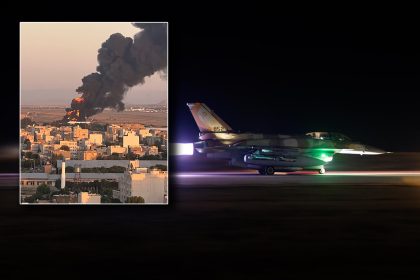
The first raid hit a convoy believed to be moving Fateh-110 missiles destined to Hezbollah, whereas the second one hit several ground targets located near Damascus: the Jamraya scientific research centre (the only one officially confirmed by the Syrian TV), some missile fuel storage depot as well as the 4th Brigade of the Republican Guard’s barracks.
After an open source imagery analysis of Al-Manar TV (a Lebanese satellite television station affiliated with Hezbollah) The Aviationist’s contributor and military expert Giuliano Ranieri was able to locate the site of the attack near Jamraya research center.
Actually, it’s is still not clear whether the center, attacked in January, was hit again or not; still, the building complex targeted in the night between May 4 and 5 could have been be a research center’s back-up structure, used to continue scientific works.
© 2013 Europa Technologies
Image © DigitalGlobe
© 2013 Google
© 2013 ORION-ME
Images of the site seem to show that no penetrating weapons were employed nor ventilation systems, typical of underground bunkers can be seen, a sign that, quite likely, the target could have been a mysterious facility operating under cover rather than a military installation.
“It’s hard to understand what the facilities was: just dead hens and collapsed walls can be seen in the photos published by the media outlets…” Ranieri explains.
Regardless of what the facility might have hidden, the attack seem to have been accurate and quite far from populated areas.
Another sortie was made against a munition depot near Al-Dimaas, 15 km from Jamraya.
Related articles
Examining Israeli Air Force Weaponeering in the Damascus Strike May 6, 2013
Posted by Michael Glynn in : Military Aviation, Syria, weapons , 12commentsFor the second time in three days, strike aircraft of the Israeli Air Force (IAF) attacked targets in the vicinity of Damascus International Airport. The targets are alleged to have been shipments of Syrian ballistic missiles bound for Hezbollah fighters in Lebanon. U.S. Intelligence sources and open-source reporting have claimed that Israeli jets struck these weapons caches during the first raid without penetrating Syrian airspace.
If it is true that Israeli fighters remained over Lebanon during the strike, it raises interesting questions regarding the choice of weapons used in the raid. The distance from the Lebanese border to Damascus prevents the use of JDAM series weapons or Paveway series Laser Guided Bombs. However, by examining the IAF order of battle, it can be inferred that the Israelis likely utilized the Rafael Popeye standoff missile to strike these targets.
The IAF currently utilizes three weapons that possess the range and precision targeting capabilities necessary for the Damascus raid. The Popeye, with a reported 48 nm range, could easily be launched from inside Lebanese airspace and fly the approximately 30 nm to strike Damascus. Additionally, the end-game EO/IR targeting and large 750 lb warhead makes the weapon a logical choice.
It is unlikely, but possible, that the Israelis used the Delilah air to surface missile. Delilah was originally conceived as a low-speed, loitering weapon that could strike moving targets and be reprogrammed after launch. The loiter capability of the weapon makes it ideal for attacking surface to air (SAM) sites or radars as well as high value mobile targets such as ballistic missiles. However, the small 66 lb warhead is a poor choice for a large target such as a warehouse.
It is also possible that the Israelis used the GBU-39 Small Diameter Bomb. The folding wings of the glide weapon give the requisite range. However, the small warhead makes the weapon a less attractive choice, unless a large number of the weapons were used. The GBU-39 uses a JDAM style GPS guidance system and is believed to only have been integrated on the F-15I strike fighter.
Michael Glynn for TheAviationist.com
Related articles
Israeli Air Force strikes Syria for the second time. Syrian air defenses unable to react. May 5, 2013
Posted by David Cenciotti in : Military Aviation, Syria , add a commentFor the second time in three days, the Israeli Air Force has conducted air strikes in Syria.
If the first raid hit a convoy believed to be moving Fateh-110 missiles destined to Hezbollah, the one launched in the night between May 4 and 5 pounded several targets located near Damascus: the Jamraya scientific research centre (the only one officially confirmed by the Syrian TV), some missile fuel storage depot as well as the 4th Brigade of the Republican Guard’s barracks.
By the type of targets allegedly hit by the last raid we can assume that Israel is not only worried that the Fateh-110 missiles coming via Lebanon could reach Hezbollah, but also that Tel Aviv wants to degrade the Syrian capability to use its chemical weapons by neutralizing its Scud missiles fuel stocks.
In other words, since destroying CW warehouses could be difficult and dangerous, they are attacking the missiles fuel depots.
Indeed, the following video most probably shows the massive explosion of a fuel depot hit by Laser Guided Bombs.
A mushroom cloud that reminds that of nuclear weapons (even if, quite obviously, no nukes were dropped).
The attack on the Republican Guard (provided the elite unit was not hit just because it was next to the missiles to defend them), may have been a message to Assad: Israel can hit his closest ring of defense against the rebels.
Regardless of the purpose of the attack, what is quite evidend is that the Israeli fighters can almost freely violate (Lebanon and) Syria’s airspace without being disturbed too much by the local air defenses.
As explained after the Israeli air strike on a weapons convoy and military complex near Damascus, in January, the IAF bombers entered and egressed the Syrian airspace almost completely undetected thanks to a huge Electronic Warfare support.
An integral part of the “package” involved in the air strikes over Syria must have been Israeli ELINT aircraft and the Suter airborne network system capable to blind the Syrian radars, monitor them, or inject misleading information.
Perhaps many Assad’s air defenses have been sabotaged or hit by the rebels activity but the area is still believed to be heavily defended by several Soviet-made SAM (Surface to Air Missile) batteries.
In June 2012, a Syrian coastal anti-aircraft artillery battery downed a Turkish Air Force RF-4E Phantom that had violated the Syrian airspace over the Mediterranean Sea, proving Damascus’s air defenses capabilities.
A major role, especially in the phases preceding the attack was also played by drones, performing ISR (Intelligence Surveillance and Reconnaissance) missions in South Lebanon and, possibly, along the border with Syria.
The IAF operates a huge fleet of UAVs of various kind, used for various purposes, including pinpointing missiles being moved from Lebanon to Syria.
Noteworthy, according to some readers of The Aviationist, there are so many Israeli drones flying over Lebanon lately, that the Israeli Air Force mistakenly shot down one of them on Apr. 25 near Haifa. A blue-on-blue episode or just speculation?
Related articles
Israel strikes weapons convoy in Syria to halt shipment of “game changing” missiles to Hezbollah May 4, 2013
Posted by Richard Clements in : Military Aviation, Syria , 1 comment so farAlthough it was not officially confirmed by either side, early in the morning on May 4, news agencies reported that Israeli jets have conducted a new air strike in Syria, destroying a convoy of weapons possibly destined for use by Hezbollah.
Reuters went on to quote an Israeli embassy spokesman as saying ”We cannot comment on these reports, but what we can say is that Israel is determined to prevent the transfer of chemical weapons or other game-changing weaponry by the Syrian regime to terrorists, especially to Hezbollah in Lebanon.”
Two U.S officials quoted by CNN said that they had data that suggests that Israeli jets flying over Lebanon had carried out the attack without entering the Syrian airspace, perhaps suggesting the use of missiles or some kind of stand-off weapon was used.
Some news agencies reported that a warehouse which stored chemical weapons was hit; an Isreali source was quoted by the CNN as saying ”We will do whatever is necessary to stop the transfer of weapons from Syria to terrorist organizations. We have done it in the past and we will do it if necessary the future.”
None of the media outlets have suggested what type of aircraft had carried out the strike but its thought the air strike occured in the Thursday May 2. Friday May 3. timeframe and involved 16 aircraft, including some Electronic Warfare assets, as those that were used in the last air strike in Syria.
David Cenciotti has contributed to this post
Related articles
F-16 fighter jet shoots down drone inside Israeli airspace April 25, 2013
Posted by David Cenciotti in : Military Aviation , 2commentsAt around 1.30 PM local time on Apr. 25, 2013, the Israeli Air Force shot down an UAV (unmamned aerial vehicle) from Lebanon over the sea off Haifa, in norther Israel.
An F-16 intercepted and downed the drone whose remains fell into the sea, at approximately 10 kilometers from the coastline, withinin Israel’s territorial waters, where Israeli warships are currently searching for debris.
Has happened in the recent past, during operation Pillars of Defense last year, the IDF used the social media, and in particular Twitter and Facebook, to share the news and reaffirm its right for self-defense.
However, the IDF has not yet determined the type or operator of the drone; the only information provided so far is that it came from Lebanon. Later on Apr. 25, UNIFIL (United Nations Interim Force in Lebanon) couldn’t confirm that the drone was launched from an area under their control.
Even if Hezbollah was among the suspect, having launched a similar drone over Israel last year (an UAV that was shot down over Negev by an F-16) the group denied sending the one that violated the Israeli airspace today.