.
jump to navigation

Bomber incident: two Nuclear-armed Russian Tu-95s reportedly skirt U.S. military base at Guam February 16, 2013

Posted by David Cenciotti in : Military Aviation , 7comments

According to the Washington Free Beacon website two Russian Tu-95 Bear-H strategic bombers circled Guam island, in the Pacific Ocean, on Feb. 12.

“Defense officials said the bombers tracked over Guam were likely equipped with six Kh-55 or Kh-55SM cruise missiles that can hit targets up to 1,800 miles away with either a high-explosive warhead or a 200-kiloton nuclear warhead,” reports Bill Gertz in his piece.

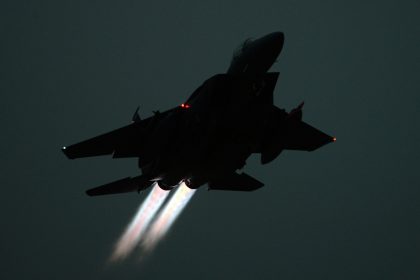
The episode happened shortly before President Obama delivered his State of the Union address and prompted U.S. to scramble some Kadena F-15s temporary deployed to Andersen Air Force Base.

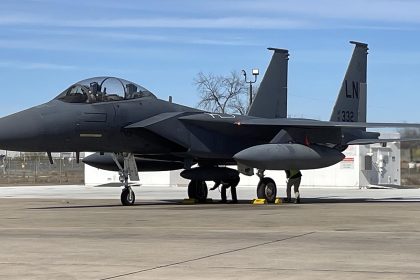
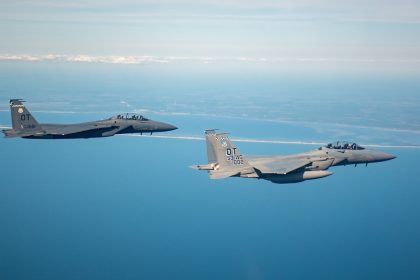
The Eagles shadowed the two Russian bombers until they left the the area in a northbound direction.

Andersen AFB, on Guam, is strategically located 1,800 miles (about 2,900 km) to the east of China.

It has hosted a deployed strategic bomber force since 2004; recently, the Air Force has announced it will base two B-2 Spirit bombers in the Pacific atoll.

Although this kind of incident is not frequent, this is not the first time Russian strategic bombers conduct a long range training sorties into the south Pacific. And circumnavigate Guam.

In 2007, President Vladimir Putin said Russia had resumed the long-range flights of its strategic bombers that had been suspended in 1992. According to Putin, those tours of duty would be conducted regularly and on strategic scale.

On Aug. 8, 2007 two Tu-95 undertook a 13-hour round trip from Blagoveshchensk base to “visit” Guam for the first time since the end of the Cold War.

Guam is among the key strategic U.S. military installations in the Pacific theater; a base that is pivotal to the Air Sea Battle Concept strategy designed to counter China’s military power in a region characterized by territorial disputes.

Tracking the Bear

Image of a past interception. Credit: U.S. Air Force

Enhanced by Zemanta

Thirty minutes to choose your fighter jet: how the Shah of Iran chose the F-14 Tomcat over the F-15 Eagle February 11, 2013

Posted by Dario Leone in : Military Aviation , 30comments

Despite all the skepticism about the actual airworthiness of Iran’s new stealth fighter “Qaher 313″, one thing is certain: Iran is still flying the iconic Grumman F-14.

More than 6 years after its last flight with the U.S. Navy, the Tomcat is still in service in a small number of examples with the Islamic Republic of Iran Air Force (IRIAF), to such an extent, Iran has recently tested a brand new air-to-air missile dubbed “Fakour”, for the combat plane made famous by Top Gun.

In fact, 80 F-14s were ordered by the Shah and 79 were effectively delivered. The procurement of the Tomcat to Iran was very important not only for Grumman, which was facing serious cash flow problems due to the difficult development of the aircraft, but also for the future of the fighter itself, since at the time F-14’s program was affected by schedule slippage and cost overruns.

IRIAF F-14

Image credit: Grumman/IIAF

When the Shah announced his intention to replace the old F-4 Phantoms in service with the Imperial Iranian Air Force, it was clear that both the USAF’s new F-15 and the Navy’s F-14 would have had the same opportunity to become Iranian’s main fighter.

So, after briefings held by USAF and Navy personnel in the Shah’s palace in Tehran, Iranian officials decided that it would have been the flight demonstration at Andrews Air Force Base, near Washington DC, scheduled in July 1973, to determine which one between the two fighters, would be the best to satisfy the then Imperial Iranian Air Force’s requiremens.

The flight demonstration was scheduled not to exceed 30 minutes from the first take off to the landing of the second aircraft.

The base was closed for that short time in which at the presence of the Shah, the two U.S. fighters had to fly their demonstration: it was decided  that the USAF’s F-15, piloted by Irv Burrows (McDonnell Douglas’ test pilot), would have performed first, while Don Evans and Dennis Romano (Grumman’s test crew) with their F-14, would wait their turn after the Eagle.

While the F-15 taxied onto runway, Don and Dennis started engines of the Tomcat ahead of the schedule and burned down fuel in the warm up area during the Eagle demonstration, to reduce the difference in thrust to weight ratio between the two fighters. However F-15’s demonstration was spectacular, not only for the raw power of the aircraft but also for pilot’s skills: Burrows was a great pilot and that day, he showed all his ability.

Flagship departs

Image credit: U.S. Air Force

The flight demonstration was the same for both aircraft: it consisted in a sequence of maneuvers beginning with a high performance take off followed by an Immelman turn and climb-out, then a descent to a high speed fly-by, two high-g low altitude turns followed by a slow speed fly-by in the landing configuration and last, the landing.

Since the F-15 has a higher thrust to weight ratio than the F-14A, the Eagle performed a really impressive flight profile during which it pulled an incredible 7-g 360 degree turn.

After the F-15 had finished its display, everyone was waiting for the underpowered F-14A demonstration: the Tomcat’s TF-30 engines would have not given to the aircraft the same thrust to weigh ratio of the Eagle.

However, during the F-15’s performance, Evans and Romano burned down a great quantity of fuel and now they had only 2,500 pounds of remaining gas: while this little quantity was only sufficient to accomplish their flight demonstration, 2,500 pounds was also one eight of the Tomcat’s  internal fuel capacity and thanks to this fact the Tomcat had the same thrust to weight ratio of the Eagle.

At this point the F-14 had one thing that the F-15 didn’t have: variable geometry wings that would have made the difference for the grace of the flight demonstration.

Don and Dennis pushed both throttles to full zone five afterburner (which was the maximum afterburner thrust setting for TF-30 engine) and took off to perform the same demonstration of the F-15: the sequence of the maneuvers was just like the Eagle’s one, but the Tomcat’s crew, during the knife-edge pass, decided to sweep the wings from fully swept to fully forward and then they executed a turn at the maximum Tomcat’s performance, producing a large cloud of vapor off the wings due to the shock wave.

F-14

Image credit: U.S. Navy

Then approaching the mid with the wings swept at 40 degrees, the Tomcat went into a full afterburner 360 degree 8 ½ g turn accelerated to 400 knots, very impressive to see. To end the demonstration, Evans and Romano added a touch-and-go landing: when the main landing gears came in touch with the runway they inserted full zone five afterburners and the Tomcat climbed in vertical. At this point, while they had almost ran out of fuel, they made a spectacular carrier landing approach and they fully stopped in one thousand feet of runway.

Once the show ended, the Shah literally ignored the Eagle and walked directly towards the Tomcat speaking for some minutes with the crew still sat in the cockpit of the fighter: he’d chosen the Tomcat, saving the Grumman and assuring a future to the F-14.

Enhanced by Zemanta

Wargames in the Negev: Italian combat planes train with the Israeli Air Force. Again. February 8, 2013

Posted by David Cenciotti in : Italian Air Force, Military Aviation , 2comments

The news was kept confidential until the Israeli Air Force released some interesting details on its website but the Italian Air Force has just finished its third annual deployment in Israel, the last of a series of joint exercises between the two air forces.

AMX in Israel

Image credit: IAF

AMX and Tornado combat planes conducted joint drills with jets of the Israeli Air Force from Ovda airbase, southern Israel.

The two-week exercise saw the Italian planes fly in a simulated air war scenario: the training included sorties against aerial threats, live firing against ground targets, and very low level flying.

The Italian pilots enjoyed the oppotunity to share their experience with the combat proven Israeli crews and operate at much lower altitude than that allowed in Italy.

Along with the AMXs and Tornados, the F-16s of the 140 Sqn “Golden Eagle” from Nevatim and F-15s of the 133 Sqn “Knights of the Twin Tail” from Tel Nof.

The last of series of exercises that have seen planes of both nations cooperate during reciprocal visits reaffirms the strong ties between Rome and Tel Aviv in the defense field.

On Jul. 19, 2012, Israel’s Ministry of Defense signed a contract worth 1 billion USD for 30 Italian M-346 Master as replacement of the aging Air Force’s fleet of A-4 Skyhawks, used as advanced trainers for combat pilots designated for fighter jets.

On Jul. 20, it was announced that Israel’s IAI will supply the Italian Air Force with  two Gulfstream G550 Eitam conformal airborne early warning (CAEW) aircraft as part of “a larger Government-to-Government agreement between Israel and Italy [worth 1 billion USD] that includes aircraft, engines, maintenance, logistics, simulators and training, provided also by other Israeli and international companies.”

F-16 IAF

Image credit: IAF

Enhanced by Zemanta

F-15 fighter jets escort Alaska Airlines plane to Seattle after security scare (possibly) originated by crank call January 18, 2013

Posted by David Cenciotti in : Military Aviation , add a comment

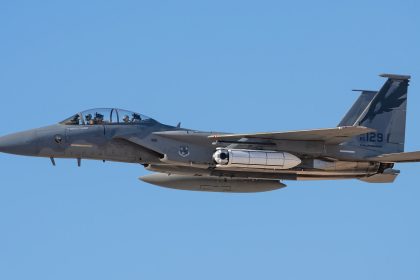
On Jan. 17, NORAD (North America Air Defense) Command scrambled two F-15C fighter jets belonging to the Oregon Air National Guard, to intercept and escort to Seattle, an Alaska Airlines flight allegedly carrying a hijacker.

Shadowed by the two 142nd Fighter Wing‘s F-15s on QRA (Quick Reaction Alert), the civilian plane, a Boeing 737-800, landed safely at Seattle around 7.00 pm local time, where local agents found that the security scare was actually a false alarm.

The decision to intercept the airliner came after the FBI received an anonymous call, that the commercial flight was the potential target of a hijacking.

F-15 Portland

Image credit: U.S. Air Force

According to the early information from FBI the security scare was probably originated by a crank call, and the man named as the potential hijacker was possibly the victim of a hoax.

Enhanced by Zemanta

“Soesterberg we have a problem”: the story of a pilotless Soviet MiG-23 over Belgium October 3, 2012

Posted by Dario Leone in : Military Aviation , 5comments

Jul. 4 1989 was a hell of an Independence Day for the 32nd TFS (Tactical Fighter Squadron) “Wolfhounds”, a unit of the USAFE (United States Air Forces in Europe) based at Soesterberg AB (Air Base), in Netherlands.

In fact when Captains J.D. “JD” Martin and Bill “Turf” Murphy were scrambled with their F-15C Eagle fighter jets, they could not imagine that their mission was to intercept a very strange MiG.

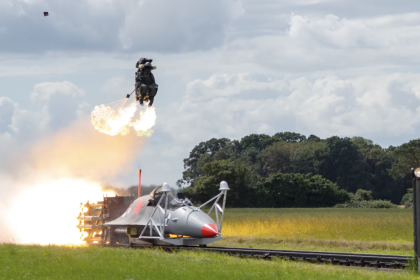
The same day from Kolobzreg, in Poland, a Soviet MiG-23M “Flogger B” and its pilot Colonel Nikolai Skurigin, had taken off for a routine training mission, when the MiG suffered what seemed to be an engine failure that forced Skurigin t0 ejected from his jet.

But the Flogger’s engine had some residual power and the MiG, instead of descending, began to climb towards NATO airspace.

Two QRA(I) (Quick Reaction Alert (Interceptor) F-15s at Soesterberg were scrambled to intercept the “bogey.”

Image credit: U.S. Air Force

In spite of the significant communication problems with their GCI (Ground Control Intercept), the two Eagle pilots were able to get close to the MiG-23 from behind. To their surprise, “JD” and “Turf” found that the Soviet combat plane was not only unarmed, but also unmanned!

Pilotless and escorted by two U.S. Air Force F-15s the Flogger climbed to 39,500ft until it ran out of fuel and began to descend.

First, the MiG-23 appeared to be heading to Lille, on the border between France and Belgium, but later on it appeared that it would crash in an empty field and there was not need to shoot it down.

Unfortunately the aircraft hit a farm in Belgium, killing an 18 year old Belgian.

When the following day Colonel Skurigin discovered that the pilotless flight had caused the death of an innocent, he showed publicly his regret for the ejection from his jet.

The 32nd TFS  “Wolfhounds”, instead  played a key role in Desert Storm two years later downing an Iraqi MiG-23 and it was disbanded in January 1994.


Switch to our mobile site