.
jump to navigation

B-52 bomber flying in your vicinity? Don’t worry, it may just be targeting your house March 25, 2013

Posted by David Cenciotti in : Military Aviation , 4comments

The following short video shows a B-52 Stratofortress during a standard training mission of the War Week, an exercise which incorporates Aerial Refueling, Weapons Tactics and High Altitude Maneuvering.

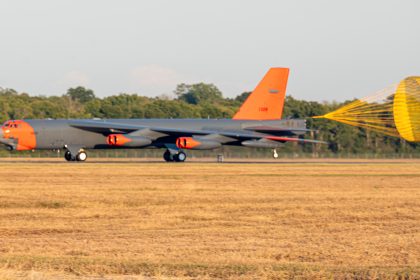
The iconic bomber can be seen taking off, cruising, releasing simulated bombs, taking fuel midair from a KC-135 Stratotanker refueler and landing at Barksdale Air Force Base, Lousiana.

As some viewers have noticed with a bit of concern on Youtube, the B-52 used what appears to be the garden of a civil house as the target of its simulated bombing run.

Nothing special to be honest: in order to improve the skills they may need one day against actual ones, aircrews of U.S. and foreign attack planes can use civilian buildings, infrastructures located inside or outside training areas and gunnery ranges.

Buildings, bridges, highway passages can be used as simulated targets that a B-52 on a training sortie has to identify and attack using cruise missiles, GPS guided weapons, unguided munitions, mines and so on.

Until they don’t drop an actual bomb on them, civilians should not be too worried to be in the B-52′s Radar Navigator crosshairs.

Target

More than 60 years after it started to fly with the U.S. Air Force, the B-52 is still being upgraded.

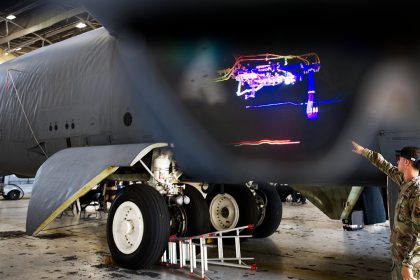
The heavy bomber fleet will soon be equipped with the Sniper pod, that will enable a better integration with ground forces and provide improved precision in laser guided bomb air strikes.

“This pod gives a faster response time to our targets. What would normally take me 30 to 40 button presses in five minutes now only takes me a few seconds to actually target and drop munitions,” said Capt. Ryan Allen, 20th Bomb Squadron radar navigation instructor.

Furthermore, the pod has a greater visibility range and can feed live video to ground troops, to let them see what the Sniper pod sees.

The Sniper pod already equips fast combat jets as well as the B-1 Lancer, and with a software upgrade called Net-T (network tactical) it can be turned into a wireless router that can provide connectivity to ground troops on the battlefield.

Enhanced by Zemanta

[Photo Gallery] A B-52 Stratofortress bomber on a Red Flag mission over Las Vegas February 6, 2013

Posted by David Cenciotti in : Military Aviation , add a comment

The following pictures were taken at Nellis Air Force Base, Nevada, on Jan. 31, 2013.

They show a B-52H Stratofortress assigned to the 20th Bomb Squadron, from Barksdale Air Force Base, Louisiana, flying a Red Flag sortie from the famous airport located northeast of Sin City.

The B-52 has eight turbojet engines, each capable of producing 17,000 pounds of thrust, with a top speed of 650 miles per hour. They leave long white contrails over Nevada during the training mission.

The B-52 is entering its sixth decade of service. Nevertheless it remains the backbone of the Air Force bomber fleet.

Image credit: U.S. Air Force

Enhanced by Zemanta

[Photo] B-52 Stratofortress bomber banks on approach to Nellis Air Force Base January 30, 2013

Posted by David Cenciotti in : Military Aviation , add a comment

Taken on Jan. 24, during Red Flag 13-2 currently underway, the following cool image shows a B-52 Stratofortress from Barksdale Air Force Base, La., banking on approach to Nellis Air Force Base with Las Vegas clearly visible in the background.

Considered the position of the plane and the displacement from the runway’s extended center line, the bomber was probably finishing the base turn while on a visual approach at Nellis: no big deal for the B-52 that, in spite of it’s rather maneuverable.

RED FLAG 13-2

Image credit: U.S. Air Force

Enhanced by Zemanta

Take a seat next to the B-52 heavy bomber’s Radar Navigator December 24, 2012

Posted by David Cenciotti in : Military Aviation , add a comment

The following video brings you on board a U.S. Air Force B-52 Stratofortress during a mission from Barksdale Air Force Base, Louisiana.

Anything related to the most iconic U.S. bomber is interesting. Still, I believe this video is worth a special mention because, unlike the majority of the other ones you can find online, it gives you the exclusive opportunity to take a quick look at the Radar Navigator and Navigator stations located on the lower deck.

The Radar Navigator is the B-52 crew member whose role is to identify targets and design the attack using cruise missiles, GPS guided weapons, unguided munitions, mines and so on, to achieve a specific level of target damage.

This officer manages targeting pods and weapons by means of the Offensive Avionics System that the video briefly shows at work.

Image credit: U.S. Air Force

The video reminded me of an interesting and quite detailed article about B-52′s Radar Navigators published few months ago on the Barksdale AFB webpage:

It takes a whole crew to complete a B-52H Stratofortress mission with precision.

One of these crew members, the radar navigator, contributes to the mission by identifying targets and making sure the weapons hit their target.

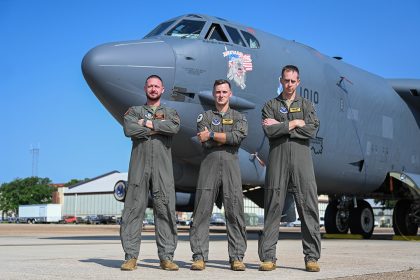
“First and foremost, it’s my job to get bombs on-target, on-time,” said Capt. Nate Barnhart, 20th Bomb Squadron radar navigator instructor.

Depending on mission requirements, the radar navigator identifies a target and determines whether the aircraft should execute a bomb run or if the targeting pod would be needed in a close-air-support environment.

“The radar navigator has endless duties that pilots and crew rely on in order to achieve the mission,” said Maj. Aaron Tillman, a B-52H aircraft commander with the 20 BS. “The radar navigator is primarily responsible for the mission planning and weaponeering of numerous cruise missiles, GPS guided weapons, unguided munitions, mines and more.”

The B-52H’s payload flexibility means the radar navigator’s inputs are crucial, Tillman said.

“As the aircraft commander, I must rely on the information the radar navigator gives me,” he said. “I rely on the radar navigator to select the right weapons, against the right target, to impact and detonate in or around a target in a very precise way in order to meet our objectives.”

The Radar Navigator’s uses a complicated navigation system known as the Offensive Avionics System, which includes four screens he or she is constantly cross-checking.

“The radar has a multitude of uses,” Barnhart said. “From takeoff and throughout the mission, it’s used to evaluate our position from a fixed point, such as a bridge or significant terrain feature. Additionally, we are able to use it to scan for weather or to find a tanker during aerial refueling.”

Before a standard training sortie, the aircrew receives an intel scenario and formulates a tactical game plan to strike the target in accordance with the commander’s intent and the acceptable level of risk, Barnhart said.

“Once the tactical planning is complete, the crew will table fly,” he said.

During this table flight, the crew discusses their flight route and the various factors or parameters they need to meet in order to defeat the threats and get weapons on target.

“Thorough mission planning is the key to success in the aircraft,” Barnhart said.

The long trip to the planning table begins with undergraduate navigator training at Pensacola Naval Air Station, Fla., or Randolph Air Force Base, Texas.

“It was a year long and was quite demanding,” Barnhart said, who graduated from the 562nd Flying Training Squadron at Randolph in July of 2005. “The course covers general navigation and Airmanship that can be useful across all Air Force platforms.”

When a class graduates, the new navigators are given a list of planes and assignments they can choose from, said Barnhart.

“Each class is racked and stacked with the top student getting his or her choice from the available list,” Barnhart said. “From there it is up to class ranking for who gets what assignment.”

When looking for a radar navigator, Tillman looks for someone who works well under pressure and has a desire to learn. A radar navigator must be detail oriented, thorough, and good at problem solving.

“He or she must be assertive, a strong team member and enthusiastic,” he said. “The crew most definitely cannot do our mission without the radar navigator.”

Enhanced by Zemanta

Video: Landing a B-52 at Barksdale Air Force Base October 1, 2012

Posted by David Cenciotti in : Military Aviation , add a comment

This video will put you aboard a Buff as the strategic bomber intercepts and follows the localizer on an ILS approach for runway 33 and, after landing, taxies to the parking spot among many other B-52s at Barksdale Air Force Base.

Watch the control yoke continuously moving as the pilots direct the huge plane into the approach procedure.

Barksdale’s 307th Bomb Wing/93rd Bomb Squadron recently deployed to Europe, using a radio callsign reminiscent of the WWII and (most probably) of the Sept. 11 terrorist attack on the Benghazi consulate.


Switch to our mobile site