Alaska's F-22 stealth fighter jets became the first operational Raptors to drop GBU-39 small diameter bombs August 17, 2012
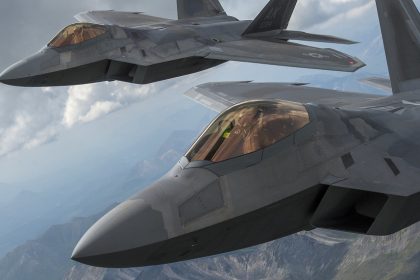
Posted by David Cenciotti in : Military Aviation, weapons , 3commentsThe 3rd Wing F-22 stealthy multi-role fighters based at Joint Base Elmendorf-Richardson became the first operational Raptor unit to drop GBU-39 small diameter bombs.
It happened during exercise Combat Hammer, a weapon system evaluation program sponsored by the 86th Fighter Weapons Squadron, in the Utah Test and Training Range, “the only location in the U.S. where the F-22s can employ SDBs at speeds and altitudes unique to the Raptor,” said Maj. Wade Bridges, a Reserve F-22 pilot assigned to the 302nd Fighter Squadron.
The Alaska’s F-22s have received the software increment 3.1 that enables them to drop the 250-lb multipurpose, insensitive, penetrating, blast-fragmentation warhead for stationary targets; equipped with deployable wings for extended standoff range.
Among the Lessons Learned of the Air War in Libya, there was the need to employ SDBs to improve accuracy and reduce collateral damage.
The SDB is currently integrated on the F-15E Strike Eagle whereas all the remaining U.S. bombers (including the F-35) will get the GBU-39 in the future. The Italian and Israeli air forces have procured this kind of weapon as well.
Separation tests on the Raptor began in Sept. 2007.
The training event allowed for Total Force Integration across the F-22 fleet: pilots from both the 302nd and the 525th Fighter Squadrons and maintainers from the 3rd Maintenance Group and the 477th Fighter Group deployed from Alaska to take part in the exercise, alongside the Hawaii’s 199th and 19th Fighter Squadrons pilots and associated ground personnel who took part to this Combat Hammer as well.
The successful delivery of air-to-ground weapons marks an important step for the Hawaiian Raptors towards declaration of Initial Operational Capability.
As the debate about the F-22 “invicibility” goes on after the confrontation with the Eurofighter Typhoon during the Red Flag Alaska, the integration of the SDB is another good news for the troubled stealthy fleet which follows the one about a gradual lifting of restrictions imposed by the hypoxia like symptoms plaguiing the aircraft missions in the last two years.
Image credit: U.S. Air Force
Related Articles
- F-22 Raptor kill markings shown off by German Eurofighter Typhoons. “The F-22 is not invincible” saga continues. (theaviationist.com)
- Farnborough 2012: “Yesterday we had Raptor salad for lunch” Typhoon pilot said after dogfighting with the F-22 at Red Flag Alaska (theaviationist.com)
- Photo: F-22 Raptor refuels off the east coast (theaviationist.com)
- F-22 to deploy to Japan. With a solution to the oxygen problem (and some concerns about the AMRAAM missile) (theaviationist.com)
- Lockheed Martin, Boeing, Honeywell and Pratt & Whitney sued by F-22 pilot’s widow (theaviationist.com)
[HD Video] Hang onto the wing of a C-130 Hercules as it flies at tree top height in the valleys during Red Flag Alaska August 2, 2012
Posted by David Cenciotti in : Military Aviation , 4commentsAs already explained, even in the hi-tech age of stealth bombers, low-level flying is still one of the most important parts of combat pilot training.
The fact that some recent scenarios give combat planes the opportunity to quietly operate at medium or high altitude with standoff weapons, because of the lack of anti-aircraft threats, doesn’t imply there’s no longer need to train for flying at low level.
Aircraft involved in special operations, reconnaissance, Search And Rescue, troops or humanitarian airdrops in trouble spots around the world may have to fly at low altitudes as this may be the best way to penetrate the enemy airspace avoiding detection by the enemy’s air defense system.
Even a stealth plane (or helicopter), spotted visually by an opponent, could be required to escape at tree top height to survive an engagement by enemy fighter planes or an IR guided missile.
Low level flying is quite demanding because of the risk involved with flying at high speeds few meters above the terrain. That’s why it’s still part of the Red Flag exercise.
In this impressive HD video, you’ll join a Polish Air Force C-130 as it flies at low altitude between the valleys of Alaska during a RF sortie.
Related Articles
- Typhoons, Raptors, Vipers and Eagles at the latest Red Flag Alaska. With many firsts and lasts. (theaviationist.com)
- If you want to know what a Red Flag’s mass launch from Nellis Air Force Base looks like, watch this video (theaviationist.com)
- Farnborough 2012: “Yesterday we had Raptor salad for lunch” Typhoon pilot said after dogfighting with the F-22 at Red Flag Alaska (theaviationist.com)
- F-22 Raptor kill markings shown off by German Eurofighter Typhoons. “The F-22 is not invincible” saga continues. (theaviationist.com)
- Russian Air Force to take part in next Red Flag exercise. Who’s gonna play the Aggressor role? (theaviationist.com)
- [Photo Gallery] Colombian Air Force Kfir combat planes at their first Red Flag ever (theaviationist.com)
- Video: Red Flag night launch and recovery time lapse (spanning about 5 hours or so in just 3 minutes). (theaviationist.com)
What a photo of two Soviet Mig-29s intercepted by four U.S. F-15s over the Bering Strait says about fighter tactics February 3, 2012
Posted by David Cenciotti in : Military Aviation , 5commentsAlthough it has been already published on several websites, this image suggests some interesting analysis.
It was taken on Aug. 1, 1989, and shows two Soviet Mig-29 being intercepted by four (one is the camera ship, another one is not visible in this photograph) F-15s of the 21st Composite Fighter Wing, whosee 43rd and 54th Tactical Fighter Squadrons patrolled 580,000 square miles from the North Pole to the tip of the Aleutian Islands.
The planes’ contrails give an idea of the maneuver used by the U.S. fighters to intercept the Mig-29s.
“What you can clearly see in the photograph is the wingman crossing the leader’s flight path to obtain a WEZ [Weapon Engagement Zone]-in-depth position to be ready to use the missiles as soon as the leader achieves the VID [Visual IDentification]” explains Lt.Col. Salvatore “Cheero” Ferrara, an Italian Air Force pilot assigned to the JSF program at Washington DC, formerly flying as an interceptor pilot with both the F-104 and the F-16.
“Although I think the wingman’s cross is a bit belated, the image shows a typical “deploy” maneuver of the U.S. fighters, in which the leader is “eyeball” and the wingman becomes “shooter”. All the visual interception are conducted in this way, even though, with the current “sensor fusion”, this kind of maneuver might change in the future” Ferrara says.
In simple words, the wingman, initially located on the “southern side” of the maneuver crosses the formation leader’s flight path to emerge on the other side in a defensive-spread position. From there, the wingman can almost “look through” the leader’s aircraft towards the target and continue the stern approach until it reach the Weapon Engagement Zone from which the air-to-air weapon can be fired.
Not in this case, though, since the U.S. fighters intercepted the Soviet Fulcrums on their way to Elmendorf AFB, in Alaska, where they refueled before continuing to Abbotsford, in Canada, for the International Airshow.
ItAF stopovers in Lajes, Azores August 25, 2010
Posted by David Cenciotti in : Military Aviation , add a commentStrategically located in the Atlantic Ocean, some 3.700 chilometers from New York City and about 1.600 chilometers from Lisbon, Lajes airbase, in the Azores (Portugal), is one of the most frequent stopovers for military traffic on the Middle East/Europe – US routes. US aircraft of all types and services, coming back from TDY in support of various operations or deploying to the CONUS (CONtinental US) often pay visit to the Portuguese airport. Miguel Santos is a retired PoAF Lt.Col. and an aircraft spotter and photographer who lives in Terceira island, Azores, and who has often the opportunity to take extremely interesting pictures and logs of the visiting aircraft. Fortunately, he’s also a reader of this blog and offered me the opportunity to publish some pictures he took of the Tornados IDS and ECR deploying to the Red Flag in Alaska and returning to Italy and of the two batches of leased US F-16ADFs being returned by the Aeronautica Militare to the 309th AMARG (Aerospace Maintenance and Regeneration Group), Davis-Monthan AFB, near Tucson, AZ.
Dealing with the Tornados, Miguel provided the images and the following detailed informations about the deployments:
Arr. Dep. C/s Type Serial/Code
04-Jun-10 05-Jun-10 RETRO11 CE-115 TOR ECR MM7068/50-46
04-Jun-10 05-Jun-10 RETRO12 CE-115 TOR ECR MM7052/50-02
04-Jun-10 05-Jun-10 RETRO13 CE-115 TOR ECR MM7021/50-01
04-Jun-10 05-Jun-10 RETRO14 CE-115 TOR ECR MM7055/50-42
04-Jun-10 05-Jun-10 RETRO15 CE-115 TOR IDS MM7058/6-11
04-Jun-10 05-Jun-10 RETRO16 CE-115 TOR IDS MM7015/6-32
04-Jun-10 05-Jun-10 BLUE61 KC10A MPRS 60028
04-Jun-10 05-Jun-10 BLUE72 K35R 38019/D
04-Jun-10 05-Jun-10 I2183 C130J MM62186/46-51
04-Jun-10 05-Jun-10 RETRO21 CE-115 TOR IDS MM7007/6-01
04-Jun-10 05-Jun-10 RETRO22 CE-115 TOR IDS MM7043/6-25
04-Jun-10 05-Jun-10 RETRO23 CE-115 TOR IDS MM7011/6-13
04-Jun-10 05-Jun-10 RETRO24 CE-115 TOR IDS MM7071/6-12
04-Jun-10 05-Jun-10 RETRO25 CE-115 TOR IDS MM7038/6-37
04-Jun-10 05-Jun-10 RETRO26 CE-115 TOR IDS MM7026/6-35
04-Jun-10 05-Jun-10 BLUE71 KC10A MPRS 70123
04-Jun-10 05-Jun-10 I2184 C130J MM62175/46-40
04-Jun-10 05-Jun-10 I2182 KC130J MM62183/46-48
04-Jun-10 05-Jun-10 I2181 C130J-30 MM62188/46-54
14-Jul-10 16-Jul-10 RETRO11 CE-116 TOR IDS MM7058/6-11
14-Jul-10 16-Jul-10 RETRO12 CE-116 TOR IDS MM7043/6-25
14-Jul-10 16-Jul-10 RETRO13 CE-116 TOR IDS MM7071/6-12
14-Jul-10 16-Jul-10 RETRO14 CE-116 TOR IDS MM7015/6-32
14-Jul-10 16-Jul-10 RETRO15 CE-116 TOR IDS MM7026/6-35
14-Jul-10 16-Jul-10 RETRO16 CE-116 TOR IDS MM7007/6-01
14-Jul-10 16-Jul-10 BLUE61 DC10 50030
14-Jul-10 16-Jul-10 I2184 C130J MM62186/46-51
15-Jul-10 16-Jul-10 RETRO21 CE-116 TOR MM7068 / 50-46
15-Jul-10 16-Jul-10 RETRO22 CE-116 TOR MM7052 / 50-02
15-Jul-10 16-Jul-10 RETRO23 CE-116 TOR MM7021 / 50-01
15-Jul-10 16-Jul-10 RETRO24 CE-116 TOR MM7055 / 50-42
15-Jul-10 16-Jul-10 RETRO25 CE-116 TOR MM7011 / 6-13
15-Jul-10 16-Jul-10 RETRO26 CE-116 TOR MM7038 / 6-37
15-Jul-10 16-Jul-10 BLUE71 DC10 30080
15-Jul-10 16-Jul-10 BLUE72 K35R .00335
15-Jul-10 16-Jul-10 I2185 C130J MM62175/46-40
15-Jul-10 16-Jul-10 I2183 C130J MM62191/46-57
15-Jul-10 16-Jul-10 I2182 C130J MM62188/46-54