Here’s how Coalition Patrol Planes Hunt Somali Pirates in the Horn of Africa January 22, 2013
Posted by Michael Glynn in : Maritime Security, Military Aviation , add a commentDJIBOUTI – The shipping lanes of the pirate-infested Somali basin have faded somewhat from the headlines in the past year as attacks and successful hijackings have dropped significantly. The decrease is due in part to the continued efforts of several coalition air forces to patrol the Indian Ocean and Gulf of Aden in a continuous, coordinated way.
The Aviationist took an in-depth look at the forces and methods involved to help fight piracy from the air.
The former French Foreign Legion outpost in Djibouti has become a hotbed of military activity as Western forces have waged a protracted but largely secret campaign against extremists in the hinterlands of Somalia, Yemen, and the waters off East Africa. Predator and Reaper drones fly daily from the base, striking targets in restive northern Yemen and Southern Somalia. The airbase is also home to a contingent of maritime patrol aircraft from a variety of nations.
Image credit: U.S. Navy
Since the early 2000′s, Djibouti has hosted P-3 Orion patrol aircraft from the U.S. Navy (USN), Spanish Air Force, and German Navy. In 2009, Japan Maritime Self Defense Force (JMSDF) Orion crews made history when they began the nation’s first deployment abroad since the end of World War II. While the humanitarian aspect of anti-piracy operations blunt some criticism, the reality of the JMSDF deploying aircraft far from home is not lost on either Japanese nationalists, yearning for a return of an assertive, interventionist military, or critics of the nation’s conduct half a century ago. In 2010, Singapore marked a first when it deployed Fokker F-50 patrol aircraft, following the hijacking of a Singaporean cargo ship.
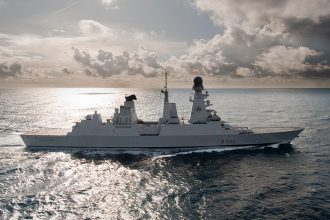
The P-3′s fly daily from Djibouti, working in concert with a task-force of warships from multiple nations to provide over-watch and real-time updates on the position of suspected pirate vessels. The geography and lack of assets are challenges for the naval task force. As countermeasures have increased and pirates have gained experience, aggressive captains have pushed out further and further from their home waters in hopes of hijacking a vulnerable cargo ship and earning a hefty ransom. In recent years, attacks have been recorded as far as 800 nautical miles off the Somali coast. The distances and areas involved demand close coordination between all aircraft and ships involved.
While military spokesmen declined to comment, observers have noted that the Orions fly their anti-piracy sorties unarmed. The aircrews rely on information to neutralize the threat of piracy, rather than escalating the situation with weapons. While counter-intuitive, understanding the motives of pirate crews helps to explain the desire to deescalate a potentially deadly situation. The goal of Somali pirate crews is to board a relatively helpless cargo ship, overpower the crew, and steam as rapidly as possible towards the Somali coast. Once the ship is near the coast, the crewmembers are brought ashore, taken inland and hidden, to prevent a rescue attempt. The owners of the ship are then contacted and negotiations begin to ransom both the ship and the crew. The vast majority of hijackings end with the crew and vessel returned safely to their owners following a ransom payment. Any attempt by military forces to stage a rescue or use violence against the pirates ultimately imperils the crew and other hostages.
Image credit: U.S. Navy
With weapons removed from the playing field, aircrews use surveillance equipment and simple physics to their advantage. The crews aim first to identify suspected pirate vessels and warn nearby merchant ships to alter course. Somali pirates use medium sized fishing dhows as “motherships”, allowing them to sail far out to sea and lie in wait for weeks on end. When the mothership notices a cargo ship approaching, several small skiffs are launched. These speedboats are quick, but cannot sail far or handle heavy seas. As a result, in order to catch a cargo ship, the mothership has to effectively be out in front of the target. A merchant ship steaming at 20 knots can use its speed advantage to disengage and prevent the mothership from getting close enough to launch her skiffs, if given enough warning to change course and disrupt the engagement.
The challenge of differentiating motherships from innocent fishermen is made a bit easier by visual clues used to spot potential pirates. Skiffs on the deck, extra cans of gas, and boarding ladders are simple signs that a dhow is probably on the look-out for something other than fish. A fishing dhow cruising the Indian Ocean shipping lanes without any nets is also an easy signal that trouble is in store. Orion crews take note of suspected pirate motherships and broadcast warning messages to merchant ships in the area.
USN Orion crews have been involved in several high-profile piracy incidents, including the hijacking of the M/V Maersk Alabama and dramatic rescue of her captain in April 2009. A P-3C from USN VP-8 was the first aircraft or ship on the scene following the hijacking. VP-8 crews provided surveillance during the negotiations and were overhead sending real-time imagery to commanders during the attack that lead to the death of the remaining pirates and the rescue of Capt. Richard Phillips. USN Orions also provided support following the hijacking of the sailing vessel Quest in Feb. 2011. Sadly, the crew of the Quest was killed by hijackers before negotiations could be successfully completed.
While attacks and hijackings have decreased, the patrol plane presence has not. The JMSDF is currently building a hanger and support facilities to allow a continuous detachment to operate from the Djibouti-Ambouli airfield. Likewise, western naval forces show no signs of departing from this strategically located African base.
Michael Glynn for TheAviationist.com
Related articles
UK’s Response Force Task Group heading to the Mediterranean Sea October 1, 2012
Posted by Richard Clements in : Maritime Security , add a commentLed by HMS Illustrious (aka “Lusty”), elements of the UK’s Response Force Task Group (RFTG), left Portsmouth on Oct. 1, to take part to part to a series of exercises around the UK as well as in the Mediterranean Sea.
After taking part to the Exercise “Cougar 12″ in South West UK, that will start with a full on beach assault from Royal Marines which will include air support provided by assets from HMS Illustrious, the naval force will then set sail south and will meet up with the rest of the RTFG in the Mediterranean.
Once in the Mediterranean, the deployment of four warships, an amphibious support ship, a transport ship, three commando units and helicopters from no less than eight Fleet Air Arm, RAF and Army Air Corp squadrons will take part in two large exercises and multiple other activities.
The first of the two large scale exercises in the Med will see the British force team up with the French Carrier FS Charles De Gaulle, which will provide the fast jet element with its Super Etendard and Rafale fighters, a role that will be performed by the Queen Elizabeth class carriers (currently under construction for the Royal Navy) when it enters the active service towards the end of the decade.
The joint multi-national drills will take place in or around Corsica and will help train the Anglo-French force train towards a joint amphibious force.
Afterwards, the Task Group will also visit Malta and Algeria before moving on to the Adriatic which will see the group train with the Albanian military.
As well as the French, the British group will also train alongside U.S, Algerian and Albanian forces.
HMS Illustrious takes HMS Ocean‘s place in the Task Group as Ocean is currently in for a re-fit after its Olympic Security Duties, the UK’s Response Force Task Group first saw combat over Libya during 2011 and is in essence a rapid reaction force that is on a 5 day notice period to go anywhere in the world should the UK government require it.
Although it will operate in the Eastern Mediterranean Sea, the British Task Force could easily be diverted to the Gulf region via the Suez Canal within a week of being ordered to do so.
The Mediterranean region has already seen the gathering of several U.S. special operations planes following the attack of the U.S. consulate in Benghazi, whereas the drums of war beat in Mali too.
A large naval exercise, believed to be aimed at training warships belonging to 25 nations to react to any Iranian attempt to mine or blockade the Strait of Hormuz in response to an Israeli pre-emptive strike against Tehran’s nuclear weapons program, has taken place in the Persian Gulf in the second half of September.
Written with David Cenciotti
Image credit: NATO
The Spanish Air Force's Orion Detachment in Djibouti reaches 4,000 flight hours fighting piracy off Horn of Africa August 31, 2012
Posted by felixiturbide in : Maritime Security, Military Aviation , add a commentThe Spanish Air Force (Ejercito del Aire) detachment in Djibouti, inside the structure of the EUNAVFOR (European Union Naval Force) in the Operation ATALANTA, reached the 4,000 flying hours in operational missions in support of the fight against piracy in the Indian Ocean and Gulf of Aden.
Image credit: Spanish Air Force
This unit of the Spanish Air Force deployed in Djibouti has a Tactical Air Detachment entity with the mission of the surveillance, reconnaissance, information gathering and prevention of maritime piracy in the framework of Operation ATALANTA, within the European Security and Defence Policy (ESDP) and has been deployed continuously since the beginning of the mission, now three and a half years.
The past Aug. 19, during a flight with the Lockheed P-3 Orion, the ORION Detachment surpassed 4,000 flight hours in this mission. Of this total, approximately one quarter represents the contribution of the crew and staff of the 48 & 49 Wings, when they are deployed with a CN-235 VIGMA aircraft supporting the operation.
Image Credit: Lockheed Martin
This important figure coincides with the 50 years being in service of the Lockheed P-3 Orion, joining a very few club of airplanes in the world that can tout this distinct honor such as the spy plane Lockheed U-2 and the Boeing B-52 Stratofortress in the USAF, and the British Vickers VC10 in the RAF.
The P-3 Orion has been in the frontline from the Cuban Missile Crisis, three months after delivery of the first unit to the US Navy in 1962 to nowadays anti-piracy missions over the Gulf of Aden, with the spaniards P-3M Orion, flying tens of thousands of missions over the world’s seas and oceans.
El Lince Analista for TheAviationist.com
Related Articles
- Spain to defer the delivery and purchase of 12 Typhoon fighter planes signed with the Eurofighter Defense Consortium (theaviationist.com)
- Here’s the most updated data about Isaac you can find on the Web: received in real time from a Hurricane Hunter’s dropsonde (theaviationist.com)
- Watch NOAA weather reconnaissance planes flying inside Tropical Storm “Isaac” in almost real-time (theaviationist.com)
U.S. Navy releases image of the small motor vessel fired upon by USNS Rappahannock off the United Arab Emirates July 18, 2012
Posted by David Cenciotti in : Maritime Security , add a commentHere’s the U.S. Navy’s official version of the incident that occurred on Jul. 16, off the United Arab Emirates:
An embarked security team aboard the Military Sealift Command fleet replenishment oiler USNS Rappahannock (T-AO 204) fired upon a small motor vessel after it disregarded warnings and rapidly approached the U.S. ship near Jebel Ali, United Arab Emirates.
In accordance with Navy force protection procedures, the sailors aboard Rappahannock used a series of non-lethal, preplanned responses to warn the vessel before resorting to lethal force.
The U.S. crew repeatedly attempted to warn the vessel’s operators to turn away from their deliberate approach. When those efforts failed to deter the approaching vessel, the security team on Rappahannock fired rounds from a 50-caliber machine gun. The incident is under investigation.
An Indian fisherman was killed.
The episode, with conflicting versions from both sides, reminds the incident occurred 30 miles off the southern Indian coast on Feb. 15, 2012, when two Italian Navy riflemen belonging to the San Marco Battalion, fired three sets of warning shots for deterrence against a boat, allegedly killing two Indian fishermen.
The incident sparked a diplomatic crisis between Italy and India, and the two military, on board the merchant ship Enrica Lexie as Military Security Team, are still under custody in India.
Anyway, after releasing a low resolution image of the small motor vessel involved in the incident, the Navy has uploaded to Flickr a hi-rez version of the photo, that can be useful for further analysis.
Image credit: U.S. Navy
European Helicopters make first land attack on Somali Pirates May 15, 2012
Posted by Richard Clements in : Helicopters, Maritime Security , 1 comment so farThe Daily Telegraph newspaper has run a report stating that at dawn on Tuesday May 15 several European helicopters flew along the Somalian coast line to attack and destroy numerous pirate skiffs that were dragged above the high tide line.
According to the article troops were not landed from the anti-piracy helicopters indicating that they attack was conducted using the on board machine guns. Most probably, the presence of the small boats on the beach within reach of helicopter gun fire was revealed by drones circling high above the area from several days.
In February, after some 400 attacks and 100 hijackings in three years on international shipping, UK’s Prime Minister David Cameron was believed to be about to send one of two helicopter carriers loaded with Apache and Lynx attack helicopters, along with Royal Marines, to take out the Pirate camps once and for all.
Some six weeks ago the European Union passed a ruling that disruptive attacks on the Somalian pirates was to be permitted and this could be the first in numerous attacks on the pirate problem in the area.
The Telegraph article stated that troops from several European countries took part in the morning raid as confirmed by official sources, the Navies from France, Germany, Italy, Spain, Netherlands and Portugal all have warships off the coast of Somalia.
No Europeans were hurt during the raid and it would seems no pirates were hurt either: this just looks a case of attacking the tools of the trade for the pirates denying them the ability to put to sea to carry out their crimes against commercial shipping.
Even the U.S. Navy has a strong presence in the area: helicopters from ships within the 5th Fleet AOR (Area Of Operations) are constantly involved in anti-piracy operations in the Indian Ocean and Horn of Africa.
Written with David Cenciotti
Image credit: Navy