Lockheed awarded $6.9 billion upgrade “indefinite-delivery/indefinite-quantity” contract to make the F-22 Raptor a real multirole fighter jet February 27, 2013
Posted by Richard Clements in : Military Aviation , 2commentsThe US Air Force has awarded Lockheed Martin an indefinite-delivery/indefinite-quantity contract with a ceiling of $6.9 billion to upgrade the service’s fleet of F-22 Raptor stealth fighters.
Lockheed said that ”The Air Force uses this to authorize the Incremental Modernization capability efforts such as Increment 3.1, Increment 3.2A and Increment 3.2B”
“F-22 modernization provides upgrades that ensures the Raptor maintains air dominance against an ever advancing threat – with capabilities such as advanced weapons, multi-spectral sensors, advanced networking technology and advanced anti-jamming technology.”
Image credit: U.S. Air Force
Under increment 3.1 upgrade the fleet of radar evading 5th generation planes will get synthetic aperture radar (SAR) with ground mapping capability as well as the ability to carry eight 113kg (250lb) Small diameter bombs, in 2014; the increment 3.2A will see additional electronic protection measures and upgrades to the Link-16 data link system and its ability to work with the jets sensor suite.
In 2017, increment 3.2B will see the software and hardware upgrade to allow the Raptor to use the AIM-120D and AIM-9X missile systems, although a limited ability will be added before this date.
The use of the AIM-9X with an Helmet Mounted Display (initially not implemented on the plane) would give the F-22 an HOBS (High-Off Bore Sight) capability currently lacking.
Further upgrades as part of 3.2B will see further improvements to the electronic protection system and an upgrade to the aircraft geo-location system.
Increment 3.3 is in the pipelines but will be funded from another proposal at a later date and no further details as to what this will actually be is available.
The upgrades will give the costly and troubled stealth fighter, whose dominance of the skies has been debated since the Eurofighter Typhoons involved in the Red Flag Alaska exercise last year achieved some (simulated) Raptor kills, the capability to perform effectively in both air-to-air and air-to-surface missions.
Something the F-35 should sometime do as well.
David Cenciotti has contributed to this post
Related articles
"Tall Man 55": B-58 Hustler supersonic bomber propaganda movie aimed at scaring the Soviets during the Cold War June 20, 2012
Posted by David Cenciotti in : Military History , 4commentsThe following is an interesting ’60s propaganda movie about the Convair B-58 Hustler whose purpose was to raise the awareness of the Americans about the U.S. Air Force operations (“jet noise is the sound of freedom” kind of message) and, above all, to scare the Soviets with footage of the Strategic Air Command‘s first supersonic bomber capable of Mach 2.
Although it may seem ages away, the basic procedures used half a century ago during the Cold War are more or less the same that would be used today by the current U.S. fleet of heavy bombers.
H/T to Leonardo Ferrazzi for the heads-up
Related Articles
- Jet-porn: U.S. Air Force B-1 bomber flying low and fast in some of the best “Bone” photos ever taken. (theaviationist.com)
- Putin Wants New Long-Range Bombers and a Gazillion Drones (wired.com)
- The B-58 Hustler (scottlocklin.wordpress.com)
Air Force mini-Shuttle returns to Earth at the end of clandestine 15-month mission around the globe June 16, 2012
Posted by David Cenciotti in : Space , 1 comment so farOn Jun. 16, 2012 at 05.48 AM local (12.48 GMT), 469 days after it was launched, the Air Force’s X-37B Orbital Test Vehicle landed at Vandenberg Air Force Base, California at the end of the longest space mission only after the Discovery shuttle program.
The venicle glided powerless to landing on Vandenberg’s runway, located some 150 miles to the northwest of Los Angeles,.
The X-37B OTV-2, one of two unmanned, reusable space planes, about a fourhty the size of the shuttle, was launched atop an Atlas 5 rocket on Mar. 5, 2011, from Cape Canaveral, Florida, to conduct on-orbit experiments and checkout of the vehicle itself.
However, since it is a Defense Advanced Research Projects Agency project since 2004, secrecy surrounds the scope and details of the long OTV-2 journey around the planet.
According to Spaceflight Now, speculations about the real purposes of the the test bed “has ranged from secret flyby surveillance of China’s orbital station to the weaponization of space.”
According to the the Air Force: “the X-37B’s advanced thermal protection and solar power systems, and environmental modeling and range safety technologies are just some of the technologies being tested. Each mission helps us continue to advance the state-of-the-art in these areas” said Lt. Col. Tom McIntyre, the X-37B program manager.
Image credit: US Air Force
Photo: The most famous U.S. nuclear bomber generates (peace sign) rainbow condensation cloud May 6, 2012
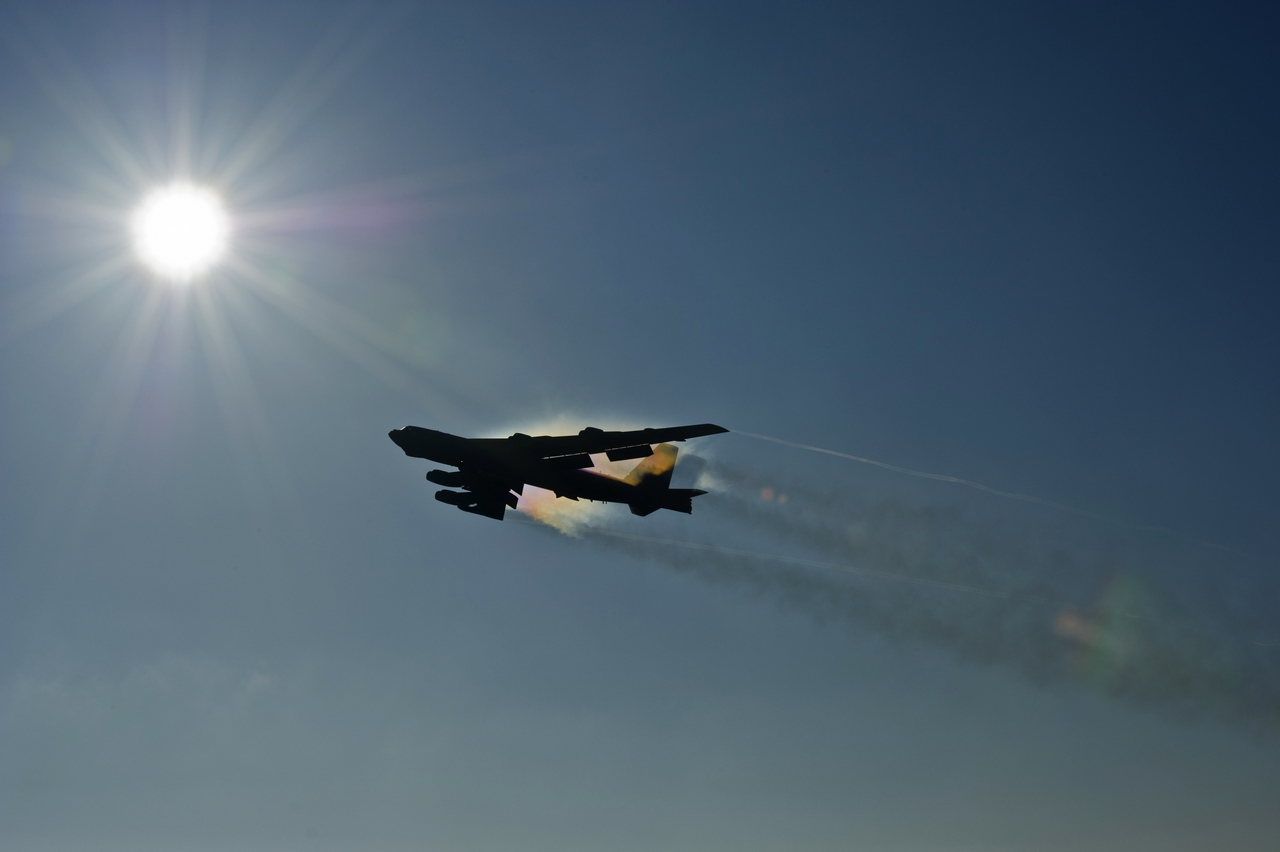
Posted by David Cenciotti in : Military Aviation , 1 comment so farThe following photo shows a B-52H Stratofortress from the 96th Bomb Squadron, Barksdale Air Force Base, La., generating a rainbow-colored condensation cloud on take off on a training flight, on Apr 18.
I found it a bit funny that the most famous nuclear bomber in the U.S. Air Force inventory created one of the most easily recognizable peace sign.
However, it must be said that its mission has changed in half a century: from a nuclear role of strategic deterrence, the B-52 is currently used for a wide variety of conventional missions ranging from the BAI (Battlefield Area Interdiction) to CAS (Close Air Support), to TASMO (Tactical Air Support to Maritime Operations) using GPS and Laser-guided bombs, cruise missiles and aerial mines.
Image credit: U.S. Air Force
The long-range, heavy bomber, designed during the Cold War, will keep flying through 2040 although the Air Force’s youngest B-52, Tail No. 1040, the last of 744 Stratofortress planes to be manufactured and delivered to the USAF in 1962, will hit an important milestone this year, when it turns 50 years old.
Related articles
- Lockheed Martin’s picture of the final F-22 Raptor. Taken with a (costly) Hasselblad H4D super-high definition camera. (theaviationist.com)
- B-1s and F-22s involved in a long range strike exercise. Getting ready for North Korea or Iran? (theaviationist.com)
- Exclusive: What nobody else will tell you about the U.S. F-22 stealth fighters deployed near Iran (theaviationist.com)
- B-2 stealth bomber to get 2 billion dollar upgrades. Including a new email system. (theaviationist.com)
- Low level flying in the age of stealth bombers and standoff weapons: welcome to the famous “Mach Loop” (theaviationist.com)
- New B-52 Low Flyby Photo Demonstrates That Bomber Pilots Are Absolutely Nuts Too [Planelopnik] (jalopnik.com)
Israeli spy blimp crashes near Gaza May 6, 2012
Posted by David Cenciotti in : airships, Military Aviation , add a commentAn Israel Defence Forces observation airship crashed on May. 4, on the Israeli side of the Gaza border.
The spy blimp was performing a routine surveillance deployment in the Gaza sector when a civilian crop duster flying by hit its cable. As a consequence of the incident, the balloon crashed whereas the crop duster landed safely.
Even if the extent of damage is not known, the airship can be fixed: a technical team was immediately dispatched to the crash site to try to retrieve the zeppelin and ensure it can be repaired as soon as possible.
71-meter in length spy blimps floating at about 400 meters of altitute and carrying a wide array of sensors are routinely involved in the Gaza strip.
Although much demanded in Afghanistan too, to perform vital ISR (Intelligence Surveillance Reconnaissance) missions, it’s still unclear whether the two giant blimps built in the U.S. lately will ever be deployed in combat zone, as reported by Wired’s Danger Room, lately.
One is the Air Force’s Blue Devil Block 2 a large 1.4 cubic feet fat at 370 feet long manned airship that was expected to fly at 20,000 feet and carry cameras and eavesdropping gear to track insurgents on a surface of at least four square kilometers. The other massive (hybrid) airship is called Long Endurance Multi-Intelligence Vehicle (LEMV) and it’s being built by Northrop Grumman for the U.S. Army. It will feature more than three weeks endurance with 2,750 lbs ISR payload, payload volume more than 2,700 cubic feet and a service ceiling greater than 22,000 ft MSL.
Both were expected to start flight testing in 2012. However, the Blue Devil could soon be canceled because of the ever growing program costs along with the Air Force’s reluctant approach to the slow-moving platform (even if there’s a plan to equip the giant Air Force blimp with missiles and use it for homeland security purposes as a flying lethal “Big Brother”), whereas the LEMV’s acceptance long endurance flight and Army Joint Military Utility Assessment in Afghanistan were delayed as a consequence of some technical setbacks.
An Israel Air Force observation blimp in the Negev Desert. Credit: Carmel Horowitz/Israel Air Force Flickr photostream