jump to navigation

“F-35C unable to land aboard aircraft carriers” report says. U.S. Navy and Royal Navy have something to be worried about. January 9, 2012

Posted by David Cenciotti in Aircraft Carriers, F-35.
Tags: , , , , , , ,
3 comments

As highlighted by an interesting article published on F-16.net, among all the other flaws listed in the JSF Concurrency Quick Look Review dated 29 November 2011 (an official document recently leaked), there is one issue that might have a significant impact on American and British naval aviation’s future plane.

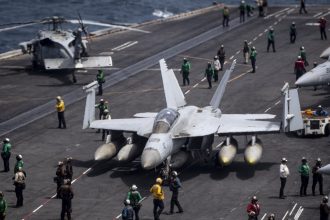
According to the leaked report, the F-35C, the variant developed for the U.S. Navy (and chosen by the UK for its future aircraft carrier), is unable to get aboard a flattop because of its tailhook design issues.

During specific tests conducted at NAWC-AD (Naval Air Warfare Center – Aircraft Division) Lakehurst, the F-35C failed to engage the MK-7 arresting gear with a disappointing score of 0 successes in 8 attempts. Considered that arrestment testing takes place on a normal airport, without the thrill of bad weather, pitching deck, nearby obstacles, low fuel, lack of alternate airfields and all those factors that make a trap on an aircraft carrier the scariest kind of flying.

Root cause analysis points to some AHS (Arresting Hook System) design issues:

  1. aircraft geometry (short distance between the Main Landing Gear tires and the tailook point)
  2. tailkook point design, with scarce ability to scoop low positioned cables
  3. tailkook hold-down ineffective performance in damping bounces relative to the deck surface profiles.

In other words, the distance of 7.1 feet between the tires and the tailhook is too short and the responsive dynamics are such that the cable lies nearly flat on the deck by the time the tailkook point should intercept it for arrestment.

Although the current F-35C tailhook point design was based on that of the Hornet, the F-18 geometry places the distance of its main landing gear to tailhook point at 18.2 feet, a longer distance where the trampled cable has enough time to respond and flex back to its original position.

To address the tailhook issues, the tailhook point and hold down damper components will be redesigned and tested at NAWC-AD, Lakehurst in April 2012.

Most probably, LM engineers will find a way to fix the AHS problem.

However, “if the proposed redesigned components do not prove to be compatible with MK-7 arresting gear, then significant redesign impacts will ensue. Accordingly, the program is conducting a formal trade study to assess options beyond AHS redesign. One option includes adjustments of AHS airframe location. However, since arrestment loads are significant and the aircraft has certain constraints with respect to engine location and survivability considerations, any readjustment of AHS location will have major, direct primary and secondary structure impacts” report says.

While the X-47B UCAV has a longer MLG to tailhook distance (longer than the TA-4J) than the F-35, meaning that it should not be affected by the same problem, maybe the UK Royal Navy is still in time to design its future carrier’s arresting gear to comply with the F-35C’s AHS. Or revert back to the F-35B….:-)

Image source: Lockheed Martin

Landing a Rafale an aircraft carrier. At night. A video shows why a night trap is the scariest and most demanding kind of flying. January 2, 2012

Posted by David Cenciotti in Aircraft Carriers, Military Aviation.
Tags: , , , , , ,
1 comment so far

Ever wondered how’s landing a jet on an aircraft carrier at night?

This French Navy Rafale’s HUD (Head Up Display) video gives a hint. Barely visible at the beginning of the footage (a very little light) is the (pitching) deck, filled with planes, people and an “island”.

Alongside the Eurofighter Typhoon, the French “omnirole” combat plane was extensively involved in Libya as well as shortlisted in the estimated $11 billion India’s Medium Multirole Combat Aircraft (MMRCA) tender whose winner should be made public in the next three weeks (for these reasons, I used a video of a French plane and not one of an American jet, to show you the thrill of a “night trap”).

Thanks to Riccardo Braccini for the heads up on FB.

Wanna know where the new Chinese aircraft carrier will be in the next few days? Here it is. A website gives you the coordinates. December 21, 2011

Posted by David Cenciotti in Aircraft Carriers, China, Military Aviation.
Tags: , , , ,
1 comment so far

This time you don’t need a satellite to get a glimpse of the Varyag in the Yellow Sea. If you wish to know where the refurbished Chinese aircraft carrier will be until Dec. 29, you can simply visit this Chinese website that has just published the coordinates of the points that limit the area of operations of the carrier (most probably taken from a NOTAM or a bulletin issued by maritime authorities to inform other ships of the temporary prohibited area).

I mapped them with Google Earth and took a couple of screenshots in order to give you an idea where the aircraft carrier will operate for its third sea trial cruise.

So what those interested can do is to point their satellites towards the area and send some spyplanes and subs in the vicinity to study the ship’s onboard equipment, its radar and signals signature, and so on.

Image source: fyjs.cn

Satellite captures first Chinese aircraft carrier in the Yellow Sea December 14, 2011

Posted by David Cenciotti in Aircraft Carriers, China, Military Aviation.
Tags: , , , , , ,
add a comment

Taken in the Yellow Sea on Dec. 8, 2011, this images from the DigitalGlobe Analysis Center depicts the Chinese aircraft carrier Varyag during it’s second sea trial in the Yellow Sea, approximately 100 kilometers south-southeast of the port of Dalian. Although testing activities with embarked planes began on Aug. 11, 2011, no plane appears on the flight deck of the Varyag.

Purchased in 1998, the Kutznesov Class 60,000 ton aircraft carrier should be used to test qualify Chinese pilots flying with the made-in-China Shenyang J-15 a multi-role Gen.4.5 plane (based on the Su-33 airframe with Chinese-developed technology) as well as to test equipments that could be used in China’s future operative aircraft carrier (expected no sooner than 2020).

For this reason satellites (and most probably spyplanes) will closely follow Varyag sea trials: to understand the type of threat the U.S. will face in the Pacific in next decades.

Image Credit : DigitalGlobe

Is the F-35 stealth jet so advanced that it can be flown using one hand only? Picture raise question November 10, 2011

Posted by David Cenciotti in Aircraft Carriers, Aviation, F-35, Military Aviation.
Tags: , , , , , , , , , ,
2 comments

Do you remember HOTAS (Hands On Throttle And Stick)?

Ok, forget it.

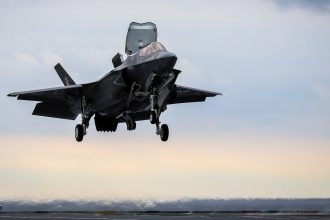
As the following  Lockheed Martin picture shows, the F-35B, the (most costly) Short Take Off and Vertical Landing (STOVL) version of the Joint Strike Fighter, is not only pretty easy to fly as I witnessed in a ride on board the JSF Cockpit Demo, but it embodies so much advanced technology to be flown by the pilot with only one hand (resting his left one).

Obviously I’m kidding.

Indeed the above picture depicts Marine Corps Maj. Richard Rusnok on board the second F-35B test aircraft “BF-4″ as he returns to land aboard USS Wasp on Oct.6, 2011, during STOVL ship suitability testing aboard the land amphibious assault ship off the coast of Virginia. He’s simply resting his left arm on the canopy edge. As someone commented, at least this shows that the F-35 cockpit is quite comfortable!

However a funny image about the F-35 (especially after publishing the famous “F-35 Garbage” picture that someone saw as disrespectful….?!) gives me the opportunity to talk about a standard feature of all the most recent generations of fighters.

Hands On Throttle And Stick is the concept according to which all the vital switches and buttons a combat pilot needs to access the radar functions, the weapon control and flight managent systems, the attack and identification systems, the radio and navigation equipment, etc, are placed on the flight control stick and engine throttle, allowing him/her to give inputs to the onboard computers without having to remove a hand from the flight controls.

Coupled with a JHMCS (joint helmet-mounted cueing system), HOTAS enables the pilot to perform a high-G turn while using the throttle to obtain the desired thrust and switch from the air-to-ground to the air-to-air mode (and vice versa) and cue onboard weapons against enemy aircraft or ground vehicles merely by pointing his head at the target to guide the weapons.

Some aircraft as the Typhoon, use the DVI (Direct Voice Input) creating an integrated system dubbed VTAS (Voice Throttle And Stick). In VTAS cockpits, voice can be used to control some non-critical systems reducing pilot workload and removing the need for him to look down at any of the MFD (Multi-Function Displays).

DVI is affected by in-flight environment noise and has to cope with quick voice level variability under high-G stress, different types of microphones with different frequency responses, and also different type of English (English spoken by an American or British pilot is sensibly different from the one of a Spanish or Italian one). So far, I’ve never heard of VTAS being effectively used in combat, but most probably, DVI will be extensively used in the next years and even the F-35 should have a speech recognition system in the future.

Naturally, there are some phases of the flight that don’t require the pilot to keep the hands on the flight controls. Sometimes pilots leave the control stick free although its position is not kept by the autopilot.

For instance, during catapult launches from aircraft carriers, after rudders have been deflected for take off, F-18 pilots are required to hang on a handle on the cockpit mount in order to prevent the quick acceleration inducing some involuntary movement on the flight control stick.

Republic of Korea Navy’s warships meet the Italian aircraft carrier Cavour in the Mediterranean Sea October 31, 2011

Posted by David Cenciotti in Aircraft Carriers, Italian Navy, Military Aviation.
Tags: , , , , , , ,
add a comment

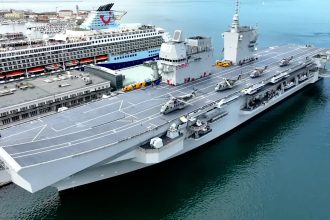
On Oct. 29, two warships of the Republic of Korea Navy or ROK Navy (ROKN) involved in a training campaign in the Indian Ocean and the Mediterranean met with the Italian aircraft carrier Cavour in the Ionian Sea, 60NM from the Italian coasts, in what has been the first Passex (Passage Exercise) between the two navies.

Image source: Marina Militare

The South Korean naval group was made by the Kang Gam Cham, a class Chungmugong Yi Sun-sin destroyer, and by the Cheonji, a Fast Combat Support Ship of the same class.

After a first radio contact on the radio, the ships have performed a series of tactical maneuvers which included take off and landing operations on both vessels by an Italian helicopter.

F-35B first landing on USS Wasp – video with background music to mask noise level? October 4, 2011

Posted by David Cenciotti in Aircraft Carriers, F-35, Italian Navy, Military Aviation.
Tags: , , , , , , , ,
4 comments

On Oct. 3, the F-35B test aircraft BF-2, piloted by Marine Corps test pilot Lt. Col. Fred Schenk, performed the first at-sea vertical landing on USS Wasp’s (LHD 1) flight deck.

The first vertical landing marks the first step of the initial ship trials for the STOVL (Short Take Off Vertical Landing) version of the JSF (Joint Strike Fighter), whose goal is to collect data about the aircraft capabilities to perform take-offs and landing on a ship and its degree of integration with the vessel. The trials are expected to last two weeks.

Here’s the video of the first vertical landing.

You will notice that the landing procedure is almost the same used by the USMC (and Italian or Spanish Navy) AV-8B Harriers even if the F-35 should be much easier to fly and land than the “Jump Jet” thanks also to some hi-tech sensors and, above all, to the futuristic pilot’s helmet-mounted display system (HMDS), that combines images coming from a set of cameras mounted on the jet’s outer surfaces providing a sort of X-ray vision.

This post’s title is defiant but, oddly, the video doesn’t let you hear the aircraft engine noise that has been one of the issue of the STOVL JSF. According to some studies the F-35B could be two to three times louder than another modern fighter jet raising noise concerns for those onboard ship, both above and below deck.

As many already know by now, the F-35B si the most costly version of the already costly F-35B. But it is also vital to the USMC (and to the other foreign services, like the Marina Militare) that needs it to replace both the Harrier and the F-18 Hornet. So vital that there’s no “Plan B” if the F-35B does not survive after the two-year probation period that then-Defense Secretary Robert Gates placed upon the variant when it encountered technical and noise problems and fell behind the testing schedule.

The USMC needs an aircraft that can be based everywhere and able to support Marine ground operation from a forward located amphibious assault ship, an aircraft that would double the number of aircraft carriers able to carry strike aircraft. However the service has also a plan to buy 80 Carrier variant models, to support the Navy’s carrier fleet, even if the F-35B will be also able to operate from a USN supercarrier.

Noteworthy, the USS Wasp, already involved in the at-sea trials of the V-22, was stationed on the US East Coast, at a short
helicopter ride from New York Harbor (along with the USS New York and the USS San Antonio) to provide relief and support after Hurricane Irene.

So, if the F-35C and (probably) B represent the future of the naval aviation, the F-18 both Legacy (C version) and Rhino/Super Hornet (E/F models) are the present. The following video provides a glimpse into today’s flying activities of a US Navy squadron (the VF-211) embarked on USS Enteprise.

Guess what’s worse than a flameout on take off? A flameout on catapult launch from an aircraft carrier August 22, 2011

Posted by David Cenciotti in Aircraft Carriers, Aviation Safety, Military Aviation.
Tags: , , , , , , , , , , ,
4 comments

A quite embarrassing episode marked the end of MAKS 2011 air show on Aug. 21, at Ramenskoye air base, near Moscow. The Sukhoi PAK-FA/T-50, Russia’s 5th generation fighter plane, was forced to abort take off after suffering a flameout in the right-hand Saturn engine.

As below footage shows, the T-50-2, the second prototype of the stealth fighter (52 Blue), aborts its take off roll  after bursts of flames erupted from the engine.

Deploying the airbrakes and the two drag chutes after reaching a speed of around 60 MPH, Sukhoi’s test pilot was able to halt the aircraft well before the end of the runway.

If the PAK-FA flameout in front of some 200.000 spectators had only a negative impact on Sukhoi’s reputation, similar engine failures can be quite thrilling if they occur to fully loaded planes in dangerous phases of a flight: departure, initial climb, landing.

I took the following picture in the Indian Ocean aboard USS Nimitz (CVN-68) on Oct. 19, 2009. An F-18C (BuNo 165205 Modex 405) belonging to the VFA-86 “Sidewinders” experiences a compressor stall during the catapult launch from CAT number 4. The aircraft is fully loaded with fuel and weapons, and it is taking off to perform an on-call CAS in support of Operation Enduring Freedom in Afghanistan.

Fortunately, the aircraft took off in spite of the loud bang and flames coming out from the port engine exhaust that in the second image seems to be operating without the afterburner.

Here’s the entire sequence of the launch showing the single engine departure.

The compressor surge is a particular kind of compressor stall that occurs when the hot vapour generated by the aircraft carrier’s catapult is ingested by the aircraft air intake thus creating a breakdown in compression resulting in a the compressor’s inability to absorb the momentary disturbance and to continue pushing the air against the already-compressed air behind it. As a consequence, there’s a momentary reversal of air flow and a violent expulsion of previously compressed air out through the engine intake producing some loud bangs from the engine and “back fires”.

The compressor will usually recover to normal flow once the engine pressure ratio reduces to a level at which the compressor is capable of sustaining stable airflow. Some engines have automatic recover functions even if pilots experiencing the surge can be compelled to act on the throttle or, in some cases, relight the engine.

Compressor surges are frequent on U.S. aircraft carriers. Unlike the T-50, that could precautionally abort its take off, carrier air wing airplanes can’t stop their run once it’s started. Fortunately, F-18s are used to take off even if an engine is temporarily unserviceable: this shows once again how rusty Legacy Hornet are sometime tougher than some 4+ or 5th generation “colleagues”.

I don’t know if a PAK-FA would be able to take off after experiencing a compressor surge aboard an aircraft carrier but I know for sure the F-35C (that, along with the other variants has returned to fly last week, after being grounded for an IPP failure on Aug. 3) won’t: it’s an easy-to-fly, single-pilot, 5th generation fighter jet. With a single engine.

A glimpse into the future with the first F-35C catapult launch video July 27, 2011

Posted by David Cenciotti in Aircraft Carriers, F-35, Military Aviation.
Tags: , , , , , , , , , , , , , , , , , , , , ,
3 comments

Ok, it isn’t taken on the deck of USS Nimitz. However, the following video, just released by the US Navy, gives you an idea of what US (and British) naval aviation will look like in the future. Just imagine some more green, blue, yellow, red jackets, the typical “island” of a supercarrier in the background, steam coming out of the catapults, and the sea at the end of the deck. To be honest, to add some more realism, we should add some payload (weapons and tanks) to that clean and light aircraft….

The video was taken at Lakehurst on Jul. 27, 2011 when Navy test pilot Lt. Christopher Tabert took off with the F-35C CF-3, the  designated carrier suitability testing aircraft, launched by a steam catapult during catapult and jet blast deflector testing.

Noteworthy, as the F-18, the F-35C has the rudders deflected inwards during catapult launches to help the nose raising as the aircraft leaves the ship.

The F-35C is the carrier variant of the Joint Strike Fighter, with larger wing surfaces and reinforced landing gear for slower catapult launch and landing approach speeds and deck impacts associated with the demanding carrier take-off and landing environment than the A (Conventional) and B (STOVL) variant.

USS Enterprise operating in the Mediterranean Sea, SE of Sicily January 29, 2011

Posted by David Cenciotti in Aircraft Carriers, Military Aviation.
Tags: , , , ,
15 comments

The NOTAM below, issued for LIRR (Roma ACC), is one of a series which testifies the presence in the Mediterranean Sea of the USS Enterprise. The “Big E” will be conducting blue waters ops between SE Sicily and the Tyrrheanian Sea until Feb. 4. However, since civil war and anarchy seem to be a concrete risk as thousands Egyptians are clashing with police forces defying the curfew to protest against President Mubarak to express a demand for more democracy and the improvement of living standards, it is quite probable that Enterprise Strike Group will be ready to relocate rather quickly off the coasts of Egypt, to take part to the eventual evacuation of the US Embassy (currently defended by the Egyptian Army) or of American citizens unable to leave the country, should the need arise.

W0268/11 (Issued for LIRR PART 1 OF 2) – NAV WARNING.
CARRIER FLIGHT OPERATIONS WILL BE CONDUCTED IN
ROMA FIR/UIR (NORTH OF 363000N) IN INTL WATERS WI 150NM RADIUS OF
354000N0154500E (LMMM FIR/UIR) /MEDITERRANEAN SEA-SE SICILY ISLAND/
RMK: 1. ACFT WILL OPERATE UNDER THE PROVISION OF DUE REGARD
FOR THE SAFETY OF OTHER AIR AND SFC TFC IN THE VICINITY
OF THE FLEET. ALL FLIGHTS WILL COMPLY WITH APPLICABLE
ICAO PROCEDURES FOR FLT IN INTL AIRSPACE. ACFT WILL
OPERATE IN VMC OR WI RADAR SURVEILLANCE AND RDO COM OF
A SFC OR AIRBORNE RADAR FACILITY. THESE CONDITIONS
PROVIDE A LEVEL OF SAFETY EQUIVALENT TO THAT NORMALLY
GIVEN BY ICAO AIR TRAFFIC CONTROL AGENCIES AND FULFILL
UNITED STATES GOVERNMENT OBLIGATIONS UNDER ARTICLE 3
OF THE CHICAGO CONVENTION OF 1944 WHICH STIPULATES
THERE MUST BE ‘DUE REGARD’ FOR THE SAFETY OF NAVIGATION
OF CIVIL ACFT WHEN FLT IS NOT BEING CONDUCTED UNDER
ICAO FLIGHT PROCEDURES. ESSENTIALLY, FLT UNDER THE
‘DUE REGARD’ OR ‘OPERATIONAL’ OPTION OBLIGATES THE
END PART 1 OF 2. 04 FEB 07:00 2011 UNTIL 04 FEB 23:59 2011.
CREATED: 28 JAN 21:25 2011

W0267/11 (Issued for LIRR PART 2 OF 2) -
OF THE CHICAGO CONVENTION OF 1944 WHICH STIPULATES
THERE MUST BE ‘DUE REGARD’ FOR THE SAFETY OF NAVIGATION
OF CIVIL ACFT WHEN FLT IS NOT BEING CONDUCTED UNDER
ICAO FLIGHT PROCEDURES. ESSENTIALLY, FLT UNDER THE
‘DUE REGARD’ OR ‘OPERATIONAL’ OPTION OBLIGATES THE
MILITARY ACFT COMMANDER TO BE HIS OWN AIR TRAFFIC
CONTROL AGENCY AND TO SEPARATE HIS ACFT FROM OTHER
AIR TRAFFIC.
2. AS FOR ALL ABOVE, GAT (GEN AIR TFC) IS REMINDED THAT
THE ITALIAN ATC WILL PROVIDE SER AS FAR AS PRACTICAL
IN CONNECTION WITH U.S STATED MILITARY ACTIVITY. SFC – FL240)
END PART 2 OF 2, 03 FEB 07:00 2011 UNTIL 03 FEB 23:59 2011.
CREATED: 28 JAN 21:18 2011

I took the following picture of USS Enterprise when I visited the aircraft carrier in 1999 at Leghorn.